
Introduction: Why Prompt Engineering Has Become an Essential AI Skill
Artificial intelligence has become a part of everyday work. From writing blog posts and generating code to creating marketing campaigns, analyzing data, and answering customer questions, AI tools are helping millions of people work faster than ever before. However, the quality of the results depends heavily on one often-overlooked factor: the prompt you provide.
Prompt engineering is the process of writing clear, structured instructions that help AI models understand exactly what you want. A small change in wording, additional context, or a specific output format can dramatically improve the quality, accuracy, and usefulness of an AI's response.
Whether you're a developer, marketer, content writer, designer, student, researcher, educator, or business owner, learning prompt engineering can help you produce better results with less effort. In this guide, you'll discover how prompt engineering works, why it's important, different prompting techniques, practical examples, common mistakes, and expert tips for getting consistently better responses from modern AI models.
What Is Prompt Engineering?
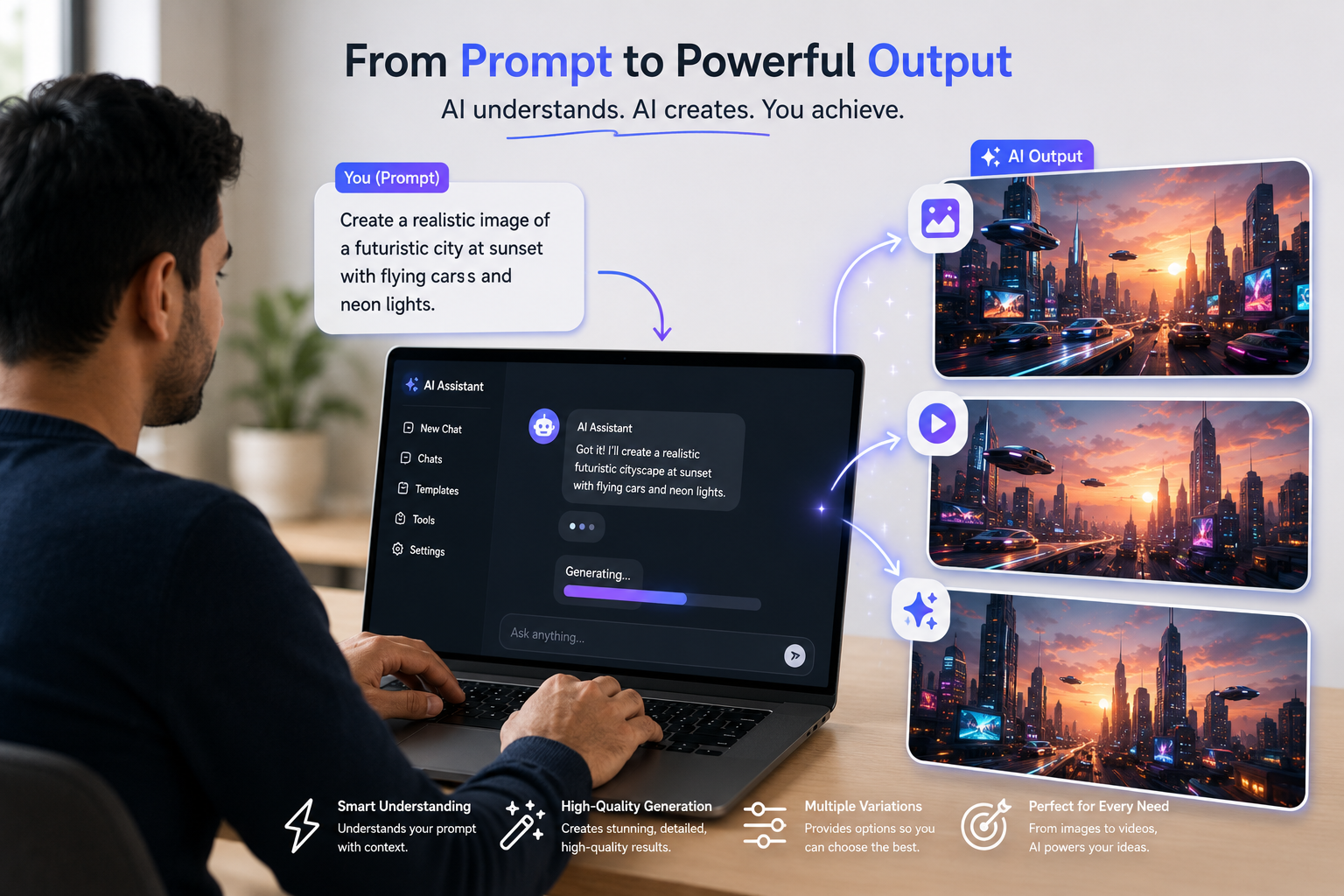
Prompt engineering is the practice of designing and refining instructions, known as prompts, to help artificial intelligence (AI) models generate more accurate, relevant, and useful responses. Instead of simply asking a question, prompt engineering focuses on communicating with AI in a structured way by providing clear goals, context, constraints, and expected output formats.
Think of a prompt as a conversation starter between you and an AI model. The more specific and well-organized your instructions are, the better the AI can understand your intent. A vague prompt may produce a generic answer, while a detailed prompt often results in content that closely matches your expectations.
Prompt engineering isn't limited to software developers. Today, marketers use it to create advertising campaigns, writers generate article outlines, designers brainstorm creative concepts, educators prepare learning materials, analysts summarize reports, and businesses automate repetitive tasks. As AI becomes more capable, knowing how to write effective prompts is quickly becoming a valuable digital skill across nearly every industry.
Why Prompt Engineering Matters
Artificial intelligence can generate articles, write code, analyze data, create marketing campaigns, summarize research, and answer complex questions within seconds. However, the quality of those results depends largely on the instructions you provide. Prompt engineering helps bridge the gap between what you want and what the AI understands, making it one of the most valuable skills for anyone working with modern AI tools.
A carefully written prompt reduces ambiguity and gives the AI enough context to produce responses that are more accurate, relevant, and aligned with your goals. Instead of spending time rewriting poor AI-generated content, you can often achieve better results simply by improving the prompt itself.
Whether you're creating content, writing software, analyzing spreadsheets, designing presentations, or researching a new topic, effective prompts help you work faster while maintaining higher quality. As AI continues to evolve, prompt engineering is becoming less of a niche skill and more of a core digital competency.

Benefits of Learning Prompt Engineering
- Create higher-quality AI responses with less editing.
- Save time by reducing repeated prompt revisions.
- Generate more accurate and context-aware outputs.
- Improve consistency across writing, coding, and research tasks.
- Increase productivity in personal and professional projects.
- Reduce AI misunderstandings and irrelevant responses.
- Work more effectively with tools like ChatGPT, Gemini, Claude, and Microsoft Copilot.
- Develop a valuable skill that is increasingly useful across many industries.
How AI Understands Prompts
Although chatting with an AI assistant can feel like having a conversation with another person, the technology behind it works very differently. AI models don't think, reason, or understand language the way humans do. Instead, they analyze the text you provide, identify patterns learned from vast amounts of training data, and predict the most appropriate response based on your prompt.
Every word, punctuation mark, and instruction contributes to how the AI interprets your request. A detailed prompt provides more context, allowing the model to generate responses that are more relevant and accurate. On the other hand, vague or incomplete prompts often lead to generic answers because the AI has less information to work with.
Understanding a few basic concepts—such as tokens, context windows, and instruction hierarchy—can help you write prompts that consistently produce better results, regardless of which AI platform you're using.
Tokens: The Building Blocks of AI Conversations
AI models don't read entire sentences as humans do. Instead, they break your input into smaller pieces called tokens. A token may represent a complete word, part of a word, a number, or even punctuation. The model processes these tokens one by one to understand the context and generate its response.
What Is a Context Window?
Every AI model has a limit on how much information it can remember during a conversation. This limit is known as the context window. It includes your current prompt, previous messages, uploaded content, and the AI's earlier responses. If a conversation becomes too long, older information may be removed from the context, which can affect the quality and consistency of future answers.
Why Context Matters
Context gives AI the background information it needs to understand your request. Instead of asking, "Write an article," a prompt such as "Write a beginner-friendly, 1,500-word article about prompt engineering using simple language and practical examples" provides clear direction and greatly improves the quality of the output.
The Order of Your Instructions Matters
AI generally performs better when instructions are organized logically. Start by defining the role, explain the task, provide relevant context, specify any constraints, and finish by describing the desired output format. This structured approach reduces ambiguity and helps the model generate responses that closely match your expectations.
Anatomy of a Good Prompt
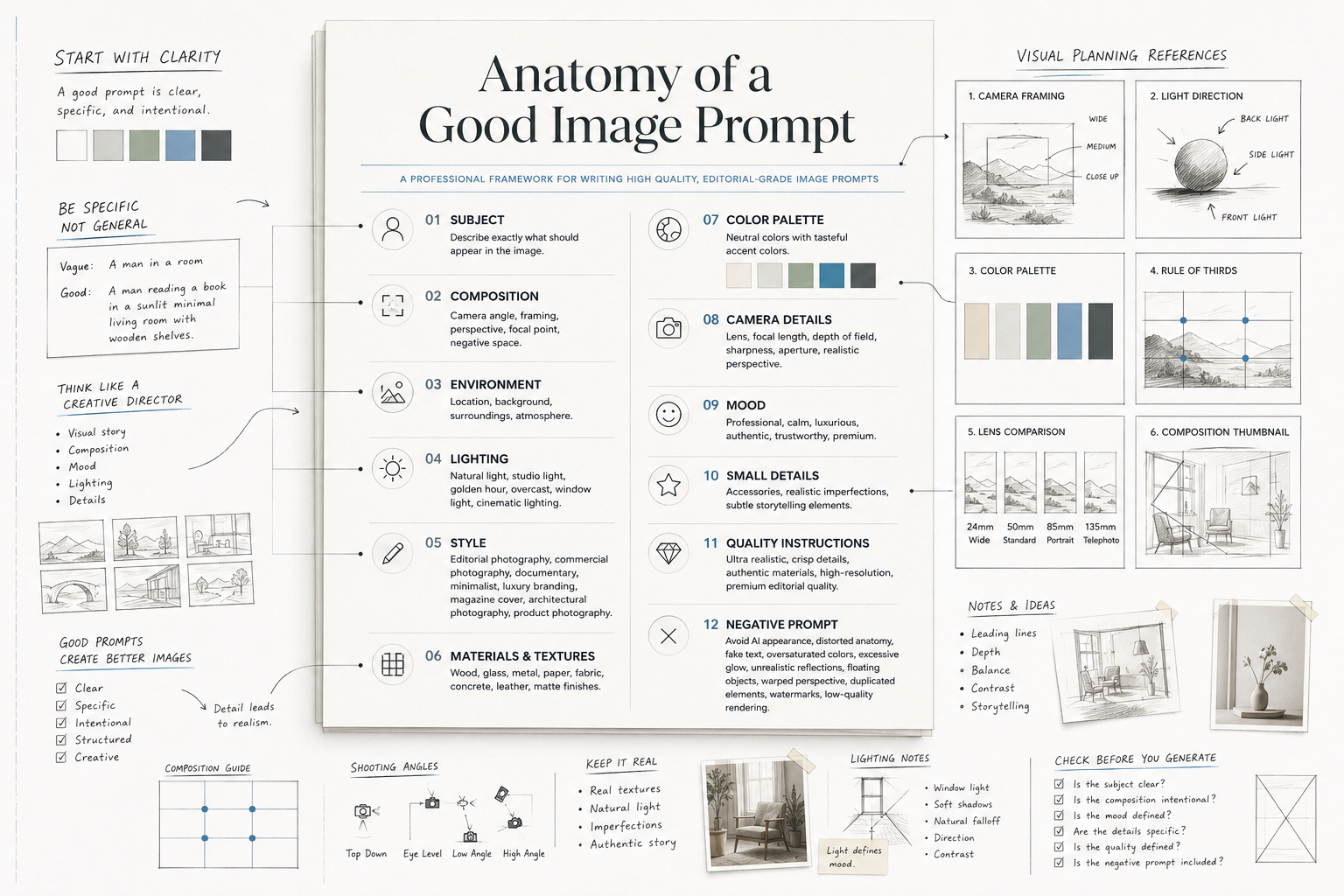
A great AI prompt is more than a simple question. It provides enough information for the AI to understand your objective, the intended audience, the desired writing style, and how the final response should be presented. The more clearly you communicate your expectations, the more useful and accurate the results are likely to be.
While there's no single formula that works for every situation, most effective prompts share a few common elements. Learning these building blocks makes it much easier to create prompts that consistently produce high-quality outputs.
| Prompt Element | Why It Matters | Example |
|---|---|---|
| Goal | Clearly explains what you want the AI to accomplish. | Write a beginner-friendly blog article. |
| Context | Gives background information so the AI understands the situation. | The article is for small business owners with no technical experience. |
| Role | Assigns the AI a specific perspective or expertise. | Act as an experienced SEO content strategist. |
| Constraints | Defines rules, limits, or requirements. | Use simple English and keep the article under 2,000 words. |
| Output Format | Specifies how the response should be organized. | Return HTML with H2 headings and comparison tables. |
| Examples | Demonstrates the style or structure you expect. | Follow the same tone as this sample paragraph. |
Putting Everything Together
Imagine you're asking an AI to write a blog post. Instead of saying, "Write an article about SEO," you could explain who the audience is, what tone to use, how long the article should be, which topics to cover, and the format you expect. This additional information removes ambiguity and allows the AI to generate content that's much closer to your expectations.
Role:
You are an experienced SEO content writer.

Task:
Write a beginner-friendly article about technical SEO.

Audience:
Small business owners with little SEO knowledge.

Requirements:
- 2,500–3,000 words
- Use simple English
- Include practical examples
- Add comparison tables
- Optimize naturally for search engines

Output:
Return semantic HTML only.
Notice how each instruction serves a specific purpose. The AI knows who it should act as, what to create, who the content is for, what rules to follow, and how the final result should be delivered. This structured approach is one of the simplest ways to improve AI-generated responses without needing advanced technical knowledge.
Prompt Engineering Techniques
Not every task requires the same prompting approach. Modern AI models can handle a wide range of requests, but choosing the right prompting technique often determines how accurate, detailed, and reliable the response will be. Some techniques work well for simple questions, while others are better suited for complex reasoning, structured content, programming, or data analysis.
Below are the most widely used prompt engineering techniques, along with practical examples to help you understand when each one should be used.
Zero-Shot Prompting
Zero-shot prompting is the simplest and most commonly used prompting technique. You ask the AI to complete a task without providing any examples of the expected output. The model relies entirely on its training and your written instructions to generate a response.
This technique works well for everyday tasks such as writing emails, summarizing articles, translating text, brainstorming ideas, answering general questions, or creating simple content. Because no examples are provided, the quality of the result depends heavily on how clearly the prompt is written.
Write a 1,500-word beginner-friendly article explaining what technical SEO is. Use simple English and include practical examples.In this example, the AI receives only instructions. It has no sample article to imitate, so it generates the response based on the information provided in the prompt.
When Should You Use Zero-Shot Prompting?
- Writing articles or blog posts.
- Generating ideas or brainstorming.
- Summarizing documents.
- Answering general knowledge questions.
- Creating social media captions.
- Writing emails or business messages.
- Simple coding tasks.
Advantages
- Quick and easy to use.
- No example data is required.
- Works well for most everyday AI tasks.
- Saves time when creating prompts.
Limitations
- The AI may interpret vague instructions differently than you expect.
- Results can vary between AI models.
- Complex tasks often require more context or examples.
- Output consistency may be lower compared to other prompting techniques.
Prompt Engineering Techniques
There isn't a single prompt that works perfectly for every task. Different situations require different prompting techniques depending on the complexity of the request, the amount of context available, and the type of output you expect. Understanding these techniques will help you communicate more effectively with AI models and consistently achieve better results.
Zero-Shot Prompting
Zero-shot prompting asks the AI to complete a task without providing any examples. You simply describe what you want, and the model generates a response based entirely on your instructions. It's the most common prompting technique and works well for everyday tasks such as writing, summarizing, translating, and brainstorming ideas.
One-Shot Prompting
One-shot prompting includes a single example before asking the AI to perform a similar task. That example helps establish the expected format, writing style, or reasoning process, making the output more consistent than a zero-shot prompt.
Few-Shot Prompting
Few-shot prompting provides multiple examples before presenting the actual request. By learning from these examples, the AI can better recognize patterns and generate responses that closely match the desired style, structure, or format. This technique is particularly useful for classification tasks, data extraction, and content generation.
Role Prompting
Role prompting assigns the AI a specific identity or area of expertise before giving instructions. Examples include asking the model to act as an experienced software engineer, SEO consultant, financial advisor, teacher, or technical writer. Providing a role helps the AI generate responses that better match the expected level of knowledge and tone.
Persona Prompting
Persona prompting focuses on defining the personality, communication style, or perspective the AI should adopt. Instead of emphasizing professional expertise, it shapes how the response should sound—for example, friendly, formal, humorous, persuasive, or beginner-friendly.
Chain-of-Thought Prompting
Chain-of-thought prompting encourages the AI to work through a problem in logical steps before arriving at an answer. Breaking complex tasks into smaller reasoning stages often improves performance on mathematical problems, coding challenges, planning tasks, and analytical questions.
Step-by-Step Prompting
Step-by-step prompting asks the AI to explain each stage of a process in sequence. This technique is especially useful for tutorials, troubleshooting guides, educational content, and procedural documentation where readers need clear instructions rather than just a final answer.
Constraint Prompting
Constraint prompting limits how the AI should respond by defining rules such as word count, tone, language, formatting, audience, or prohibited topics. These restrictions reduce ambiguity and help produce outputs that better meet specific requirements.
Structured Output Prompting
Structured output prompting instructs the AI to return information in a predefined format such as HTML, JSON, Markdown, XML, CSV, tables, or bullet lists. This approach is widely used by developers, content creators, and businesses because the output is easier to reuse, automate, or integrate into other systems.
Real-World Prompt Engineering Examples
Understanding prompt engineering concepts is only the first step. The real value comes from applying these techniques to everyday tasks. Whether you're writing content, developing software, analyzing data, or creating marketing campaigns, well-crafted prompts can dramatically improve the quality of AI-generated responses.
Below are practical examples showing how prompt engineering is used across different industries and professions.
Content Writing
Writers use prompt engineering to generate blog outlines, rewrite paragraphs, improve readability, create headlines, and optimize articles for search engines while maintaining a consistent tone of voice.
Act as an experienced SEO content writer.

Write a 2,500-word beginner-friendly article about image compression.

Use semantic HTML, practical examples, comparison tables, and an FAQ section.
Software Development
Developers rely on prompts to generate code, explain algorithms, debug applications, create documentation, write unit tests, and optimize existing code without starting from scratch.
Act as a senior PHP developer.

Review the following code for security vulnerabilities and performance improvements.

Return the optimized version with explanations.
Digital Marketing
Marketing teams use AI to write email campaigns, advertising copy, landing pages, social media posts, and keyword-focused content for search engines.
Create five persuasive Facebook advertisements for an online course.

Audience:
Small business owners

Tone:
Professional and trustworthy

Maximum length:
120 words each.
Business Operations
Businesses use prompt engineering to summarize meetings, generate reports, analyze customer feedback, draft proposals, create presentations, and automate repetitive administrative work.
Education
Teachers and students use AI to explain difficult concepts, generate quizzes, prepare lesson plans, summarize research papers, and create personalized study materials.
Customer Support
Support teams create prompts that generate professional replies, troubleshoot common customer issues, summarize conversations, and produce knowledge base articles more efficiently.
Research and Data Analysis
Researchers use AI to summarize academic papers, compare studies, identify trends, organize notes, and extract key insights from large amounts of information, making complex research more manageable.
Common Prompt Engineering Mistakes
Even powerful AI models can produce poor results if the prompt is unclear or incomplete. Many people assume the AI is making mistakes, when in reality the prompt doesn't provide enough guidance. Learning to recognize these common mistakes will help you write more effective prompts and reduce the need for repeated revisions.
Below are some of the most common prompt engineering mistakes and simple ways to avoid them.
Writing Vague Instructions
Prompts like "Write an article" or "Help me with SEO" don't provide enough information. Clearly describe the goal, audience, tone, length, and expected outcome so the AI knows exactly what you're asking for.
Providing Too Little Context
AI performs better when it understands the background of your request. Including relevant context, project details, or business goals helps produce responses that are more accurate and relevant.
Asking Multiple Unrelated Questions
Combining several unrelated requests into one prompt can confuse the AI and reduce response quality. Break complex projects into smaller prompts that focus on a single objective.
Forgetting to Define the Output Format
If you need HTML, JSON, Markdown, a table, bullet list, or another specific format, mention it directly in the prompt. Otherwise, the AI will choose its own structure, which may not meet your needs.
Ignoring the Target Audience
Content written for beginners should look very different from content written for experienced professionals. Always tell the AI who the intended audience is.
Expecting Perfect Results on the First Attempt
Prompt engineering is often an iterative process. Reviewing the response, refining the prompt, and adding more detail usually leads to much better results than expecting perfection from a single request.
Contradicting Your Own Instructions
Avoid prompts that include conflicting requirements such as asking for a detailed explanation while limiting the response to only a few sentences. Clear, consistent instructions produce more reliable outputs.
| Common Mistake | Better Approach |
|---|---|
| "Write about SEO." | Explain the topic, audience, length, tone, and desired structure. |
| No output format specified. | Request HTML, Markdown, JSON, or another preferred format. |
| Asking too many questions at once. | Split large tasks into smaller prompts. |
| Missing audience information. | Clearly identify who the response is intended for. |
Best Practices for Writing Better AI Prompts
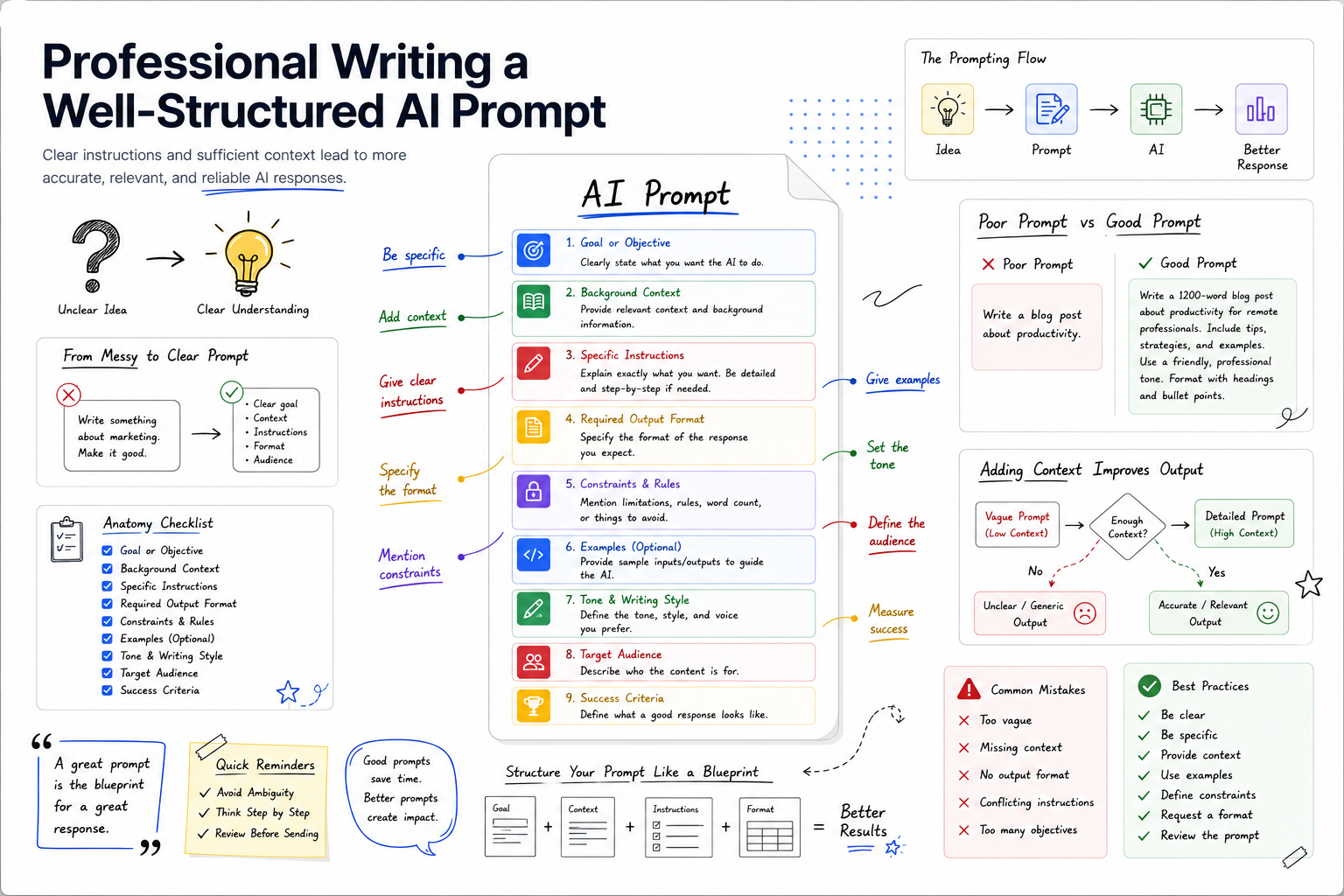
Writing effective AI prompts is a skill that improves with practice. While there isn't a universal formula that guarantees perfect results every time, following a few proven best practices can dramatically improve the quality, consistency, and usefulness of AI-generated responses. These techniques work across most modern AI models, including ChatGPT, Gemini, Claude, Microsoft Copilot, and other large language models.
The goal isn't to write longer prompts—it's to write clearer ones. A well-structured prompt removes ambiguity, provides the right amount of context, and makes it easier for the AI to understand exactly what you're trying to accomplish.
Be Clear and Specific
Clearly explain what you want the AI to do. Instead of using broad requests like "Write something about marketing," describe the topic, audience, length, tone, and purpose of the content.
Provide Enough Context
Context helps the AI understand your situation. Mention your project, industry, experience level, or any background information that could influence the response.
Assign a Role When Appropriate
Asking the AI to act as an SEO consultant, software engineer, teacher, financial advisor, or technical writer often produces responses that better match the expected expertise and communication style.
Define the Desired Output Format
If you need HTML, JSON, Markdown, a table, checklist, or bullet points, mention the format directly in your prompt. This reduces unnecessary formatting changes later.
Break Large Tasks into Smaller Steps
Complex projects are usually easier to complete when divided into smaller prompts. For example, generate an outline first, review it, and then ask the AI to expand each section individually.
Review and Refine Your Prompts
Prompt engineering is an iterative process. If the first response isn't exactly what you expected, adjust the wording, add more context, or clarify your instructions instead of starting over completely.
Verify Important Information
AI-generated content should always be reviewed before being published or used in business decisions. Verify important facts, statistics, legal information, medical advice, financial guidance, and technical recommendations using reliable sources.
| Best Practice | Why It Helps |
|---|---|
| Be specific | Reduces ambiguity and improves accuracy. |
| Provide context | Helps the AI understand your objectives. |
| Define the format | Produces responses that require less editing. |
| Break down complex tasks | Improves reasoning and overall response quality. |
| Review AI output | Ensures accuracy before publishing or sharing. |
Prompt Engineering vs Fine-Tuning
Prompt engineering and fine-tuning are often mentioned together, but they solve different problems. Both improve the way AI models perform, yet they require different levels of effort, technical knowledge, and resources. Understanding the difference helps you choose the right approach for your project instead of using a more complex solution than necessary.
In most everyday situations, prompt engineering is all you need. By writing clearer instructions and providing the right context, you can significantly improve AI responses without changing the underlying model. Fine-tuning, on the other hand, modifies the model itself by training it with additional data so it performs better on specialized tasks.
| Feature | Prompt Engineering | Fine-Tuning |
|---|---|---|
| How it works | Improves results by writing better prompts. | Improves results by training the AI model with additional data. |
| Technical Skill | Beginner friendly. | Requires machine learning knowledge. |
| Cost | Usually little or no additional cost. | Often requires extra computing resources and training costs. |
| Speed | Immediate results. | Can take hours or days depending on the model and dataset. |
| Best For | Writing, coding, research, education, marketing, and everyday AI tasks. | Industry-specific AI applications, custom assistants, and specialized business solutions. |
| Flexibility | Easy to modify for every request. | Less flexible because the model has already been trained. |
When Should You Use Prompt Engineering?
Prompt engineering is the best choice for most users. If you're writing articles, generating code, creating marketing content, summarizing documents, answering questions, or automating everyday work, improving your prompts is usually enough to achieve excellent results.
When Is Fine-Tuning a Better Option?
Fine-tuning is more appropriate when an organization needs an AI model to consistently perform highly specialized tasks using its own data. Examples include medical document analysis, legal research, financial compliance, customer support trained on company knowledge, or industry-specific terminology that isn't handled well through prompting alone.
Industries Using Prompt Engineering
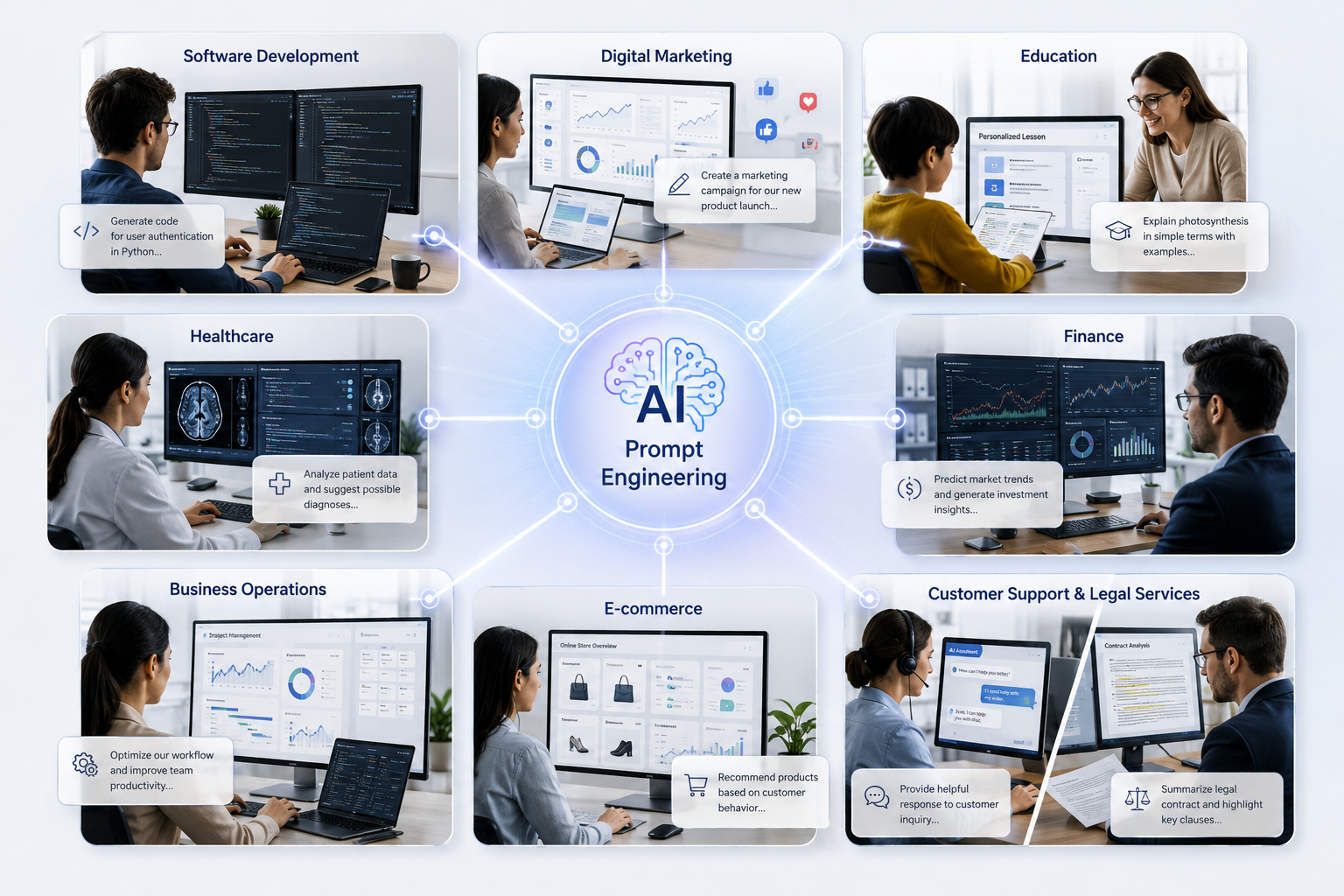
Prompt engineering is no longer limited to AI researchers or software developers. As generative AI becomes part of everyday workflows, organizations across many industries are using well-designed prompts to improve productivity, automate repetitive tasks, generate ideas, and make better decisions. Understanding how different sectors use prompt engineering can help you discover new ways to apply AI in your own work.
While the objectives may differ from one industry to another, the principle remains the same: clear, structured prompts lead to more useful and reliable AI-generated responses.
Software Development
Developers use prompt engineering to generate code, explain programming concepts, debug applications, write documentation, review code quality, and create automated tests more efficiently.
Digital Marketing
Marketing teams create prompts to generate advertising copy, SEO content, email campaigns, product descriptions, landing pages, keyword ideas, and social media content while maintaining a consistent brand voice.
Education
Teachers, students, and researchers use AI prompts to prepare lesson plans, explain difficult topics, summarize academic papers, generate quizzes, and create personalized learning materials.
Healthcare
Healthcare professionals use AI to summarize clinical notes, organize medical research, prepare documentation, and improve administrative workflows while ensuring that critical decisions remain under human supervision.
Finance
Financial organizations use prompt engineering for report generation, investment research, document analysis, customer communication, and risk assessment support.
Customer Support
Support teams generate response templates, summarize customer conversations, classify support tickets, and create knowledge base articles that help resolve issues more quickly.
Legal Services
Legal professionals use carefully designed prompts to review contracts, summarize legal documents, organize case information, and assist with legal research while verifying all outputs before use.
E-commerce
Online businesses generate product descriptions, customer emails, promotional campaigns, FAQ content, and shopping guides using AI to improve efficiency and maintain consistent messaging.
Business Operations
Companies use prompt engineering to automate reports, summarize meetings, analyze feedback, draft proposals, create presentations, and streamline everyday business processes.
Benefits of Learning Prompt Engineering
Prompt engineering is more than learning how to ask AI better questions. It helps you communicate your ideas more clearly, complete tasks more efficiently, and unlock the full capabilities of modern AI tools. As artificial intelligence becomes integrated into workplaces, education, and everyday life, prompt engineering is rapidly becoming a practical digital skill rather than a niche technical specialty.
Whether you're a beginner exploring AI or a professional looking to improve productivity, learning prompt engineering offers benefits that extend far beyond generating better text.
Improve AI Response Quality
Clear prompts reduce ambiguity and help AI generate responses that are more accurate, detailed, and relevant. Instead of spending time correcting weak outputs, you receive results that are much closer to your expectations.
Save Time on Everyday Tasks
Better prompts reduce repeated revisions and follow-up questions. Whether you're writing reports, generating code, creating presentations, or analyzing documents, prompt engineering helps you complete tasks more efficiently.
Increase Productivity
Professionals across many industries use AI to automate repetitive work, brainstorm ideas, summarize information, and organize complex projects. Well-designed prompts allow them to achieve these tasks faster without sacrificing quality.
Produce More Consistent Results
Using structured prompts with clearly defined goals, context, and formatting helps generate consistent responses across different projects, making collaboration and documentation much easier.
Learn a Valuable Career Skill
As organizations continue adopting AI, professionals who understand prompt engineering are becoming increasingly valuable. This skill complements careers in software development, marketing, education, design, research, customer support, and business management.
Adapt to Future AI Technologies
AI tools will continue to evolve, but the ability to communicate clearly with intelligent systems will remain important. Learning prompt engineering today provides a strong foundation for working with future AI assistants, autonomous agents, and multimodal applications.
Limitations of Prompt Engineering
Prompt engineering can significantly improve the quality of AI-generated responses, but it isn't a magic solution. Even the most carefully written prompt cannot overcome every limitation of an AI model. Understanding these limitations helps you set realistic expectations and know when human expertise is still essential.
The goal of prompt engineering is to guide AI toward better results—not to guarantee perfect accuracy in every situation.
AI Can Still Make Mistakes
Even with excellent prompts, AI models may generate incorrect facts, outdated information, or misleading explanations. Always verify important information before relying on it for business, education, healthcare, legal matters, or financial decisions.
Responses Depend on the Model
The same prompt may produce different results across AI models such as ChatGPT, Gemini, Claude, or Microsoft Copilot. Each model has unique capabilities, training data, and response styles.
Complex Tasks May Require Multiple Prompts
Large projects rarely succeed with a single prompt. Creating software, writing books, planning businesses, or conducting detailed research often requires multiple conversations, refinements, and revisions.
Context Window Limits
Every AI model has a maximum context window. If too much information is included in a conversation, older details may no longer be considered, which can reduce consistency in longer discussions.
Human Review Is Still Necessary
AI can generate impressive drafts, but it cannot replace human judgment. Reviewing content for accuracy, tone, ethics, and business requirements remains an important part of any professional workflow.
Privacy and Confidentiality
Avoid sharing confidential business information, personal data, passwords, or sensitive documents unless you're certain the AI platform and your organization's policies allow it. Responsible AI usage includes protecting privacy and handling data securely.
The Future of Prompt Engineering
Prompt engineering has evolved rapidly since the introduction of generative AI, and it continues to change as AI models become more capable. Early users often needed carefully crafted prompts to achieve good results, but today's models understand natural language much better. Even so, clear communication remains one of the most effective ways to improve AI-generated responses.
Rather than disappearing, prompt engineering is becoming part of a broader set of AI communication skills. Future AI systems are expected to understand more complex instructions, work across multiple formats, and collaborate with humans in increasingly sophisticated ways.
Smarter AI Models
Modern AI models are becoming better at understanding natural language, reducing the need for overly complex prompts. However, detailed instructions still improve accuracy, consistency, and overall response quality, especially for professional tasks.
AI Agents and Autonomous Workflows
AI is moving beyond answering questions. Intelligent AI agents can now plan tasks, use software tools, search information, analyze files, and complete multi-step workflows with minimal human intervention. Writing clear objectives and instructions will become even more valuable as these systems become more capable.
Multimodal Prompting
Prompt engineering is expanding beyond text. Users can already combine text, images, audio, video, and documents within a single conversation. Future AI systems will continue improving their ability to understand and respond across multiple forms of media simultaneously.
More Personalized AI Assistants
AI assistants are becoming better at remembering preferences, adapting to individual work styles, and providing more personalized recommendations. Prompt engineering will increasingly involve guiding long-term conversations instead of writing isolated prompts for individual tasks.
Human Skills Will Remain Important
Even as AI becomes more advanced, critical thinking, creativity, communication, and subject-matter expertise will continue to play an essential role. Prompt engineering is ultimately about expressing ideas clearly, asking better questions, and working effectively alongside intelligent systems rather than replacing human decision-making.
Putting Prompt Engineering Into Practice
Prompt engineering is ultimately about communicating your ideas clearly. While AI models continue to become more capable, they still rely on the instructions you provide to understand your goals, interpret context, and generate meaningful responses. Learning how to write better prompts isn't about memorizing complex formulas—it's about asking better questions and providing enough information for the AI to help effectively.
Whether you're writing articles, developing software, creating marketing campaigns, analyzing data, researching new topics, or simply looking for more accurate AI responses, the same principle applies: clear prompts produce better outcomes. Small improvements such as defining your objective, providing context, assigning a role, and specifying the desired output format can make a noticeable difference in the quality of every conversation.
As AI becomes more deeply integrated into education, business, software development, healthcare, finance, and countless other industries, prompt engineering will remain a valuable skill. The tools may evolve, interfaces may become more intuitive, and AI models may require fewer detailed instructions, but the ability to communicate effectively with intelligent systems will continue to be an important advantage.
The best way to improve is through experimentation. Try different prompting techniques, compare the results, refine your instructions, and learn from each interaction. Over time, you'll develop an instinct for writing prompts that consistently produce accurate, well-structured, and useful responses across a wide variety of tasks.
Prompt engineering isn't just a technical skill—it's a practical communication skill for the AI era. The more effectively you can express your intent, the more value you'll unlock from today's AI tools and the intelligent systems that will shape the future.