
Introduction
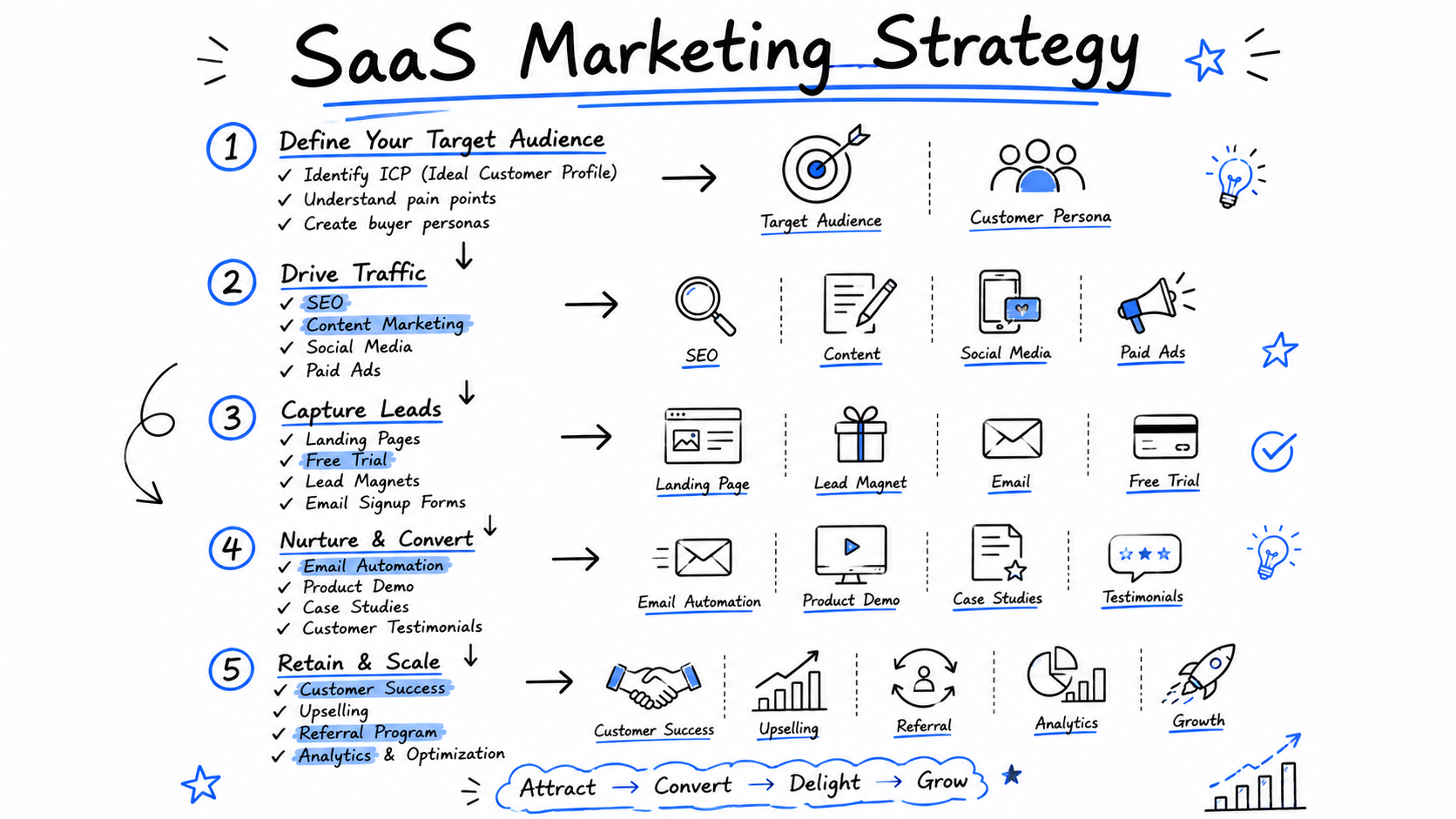
Launching a SaaS product is exciting, but getting people to discover, trust, and pay for it is often the hardest part. Many founders spend months building features only to realize that a great product alone isn't enough to generate consistent sign-ups. Without a clear marketing strategy, even excellent software can struggle to gain traction.
The most successful SaaS companies don't rely on a single source of traffic. Instead, they build a marketing system that combines SEO, content marketing, social media, online communities, email campaigns, partnerships, referrals, paid advertising, and customer retention. While some channels can deliver results quickly, others create long-term growth that continues bringing in customers for months or even years.
The challenge is knowing which marketing strategies are worth your time, how each channel fits into your growth journey, and when to invest in organic marketing versus paid campaigns. Choosing the right approach can help you acquire customers more efficiently while avoiding common mistakes that waste both time and budget.
In this guide, you'll discover more than 150 proven SaaS marketing strategies covering both free and paid channels. We'll explore everything from SEO and community marketing to social media, video content, influencer partnerships, paid advertising, conversion optimization, retention, and AI-powered workflows. You'll also learn practical frameworks, real-world examples, and actionable tactics that you can adapt whether you're trying to land your first 10 customers, grow to 100 paying users, or scale beyond 1,000.
By the end of this guide, you'll have a complete SaaS marketing playbook that helps you build a repeatable growth engine instead of relying on unpredictable bursts of traffic or one-time launches.
What Is SaaS Marketing?
SaaS marketing is the process of attracting, converting, and retaining customers for a Software-as-a-Service (SaaS) product. Unlike traditional software marketing, the goal isn't just to generate a one-time sale but to acquire long-term subscribers who continue using and paying for the product over time.
While both B2B and B2C SaaS businesses rely on similar marketing channels, their messaging, sales cycles, and customer expectations often differ. Because most SaaS products use a subscription-based pricing model, successful marketing focuses not only on acquiring new users but also on improving customer retention and lifetime value.
In this guide, we'll focus on practical SaaS marketing strategies rather than theory.
How SaaS Marketing Actually Works
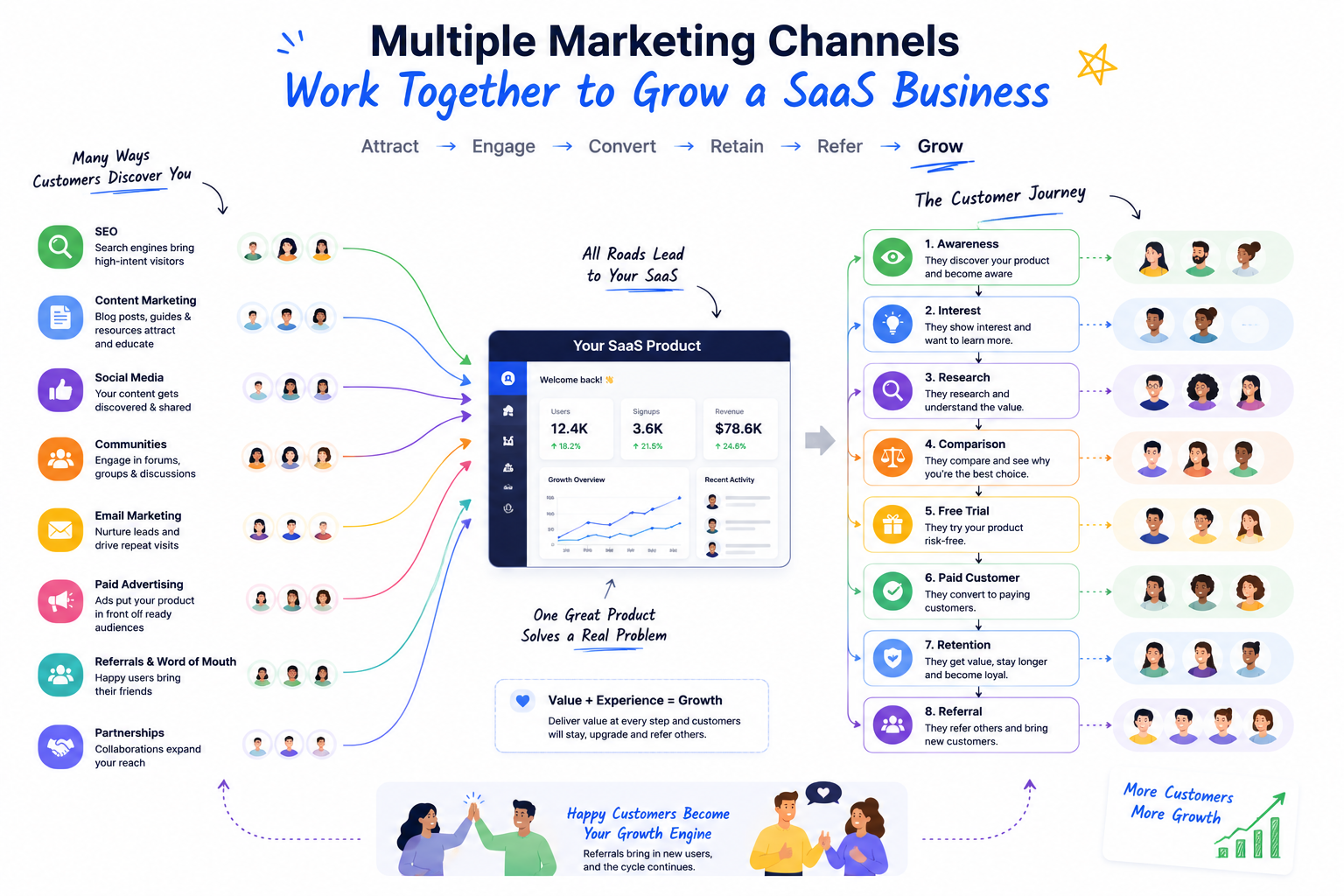
SaaS marketing isn't about convincing someone to buy your product after seeing a single advertisement. Most customers go through a journey before making a purchase. They first discover they have a problem, explore possible solutions, compare different products, try the software, and only then decide whether it's worth paying for. Even after becoming a customer, the journey continues through retention, upgrades, and referrals.
Understanding this customer journey helps you choose the right marketing strategy for each stage instead of expecting one channel to do everything. For example, SEO and social media can create awareness, comparison pages and case studies help users evaluate their options, while onboarding emails and customer support improve retention and encourage long-term subscriptions.
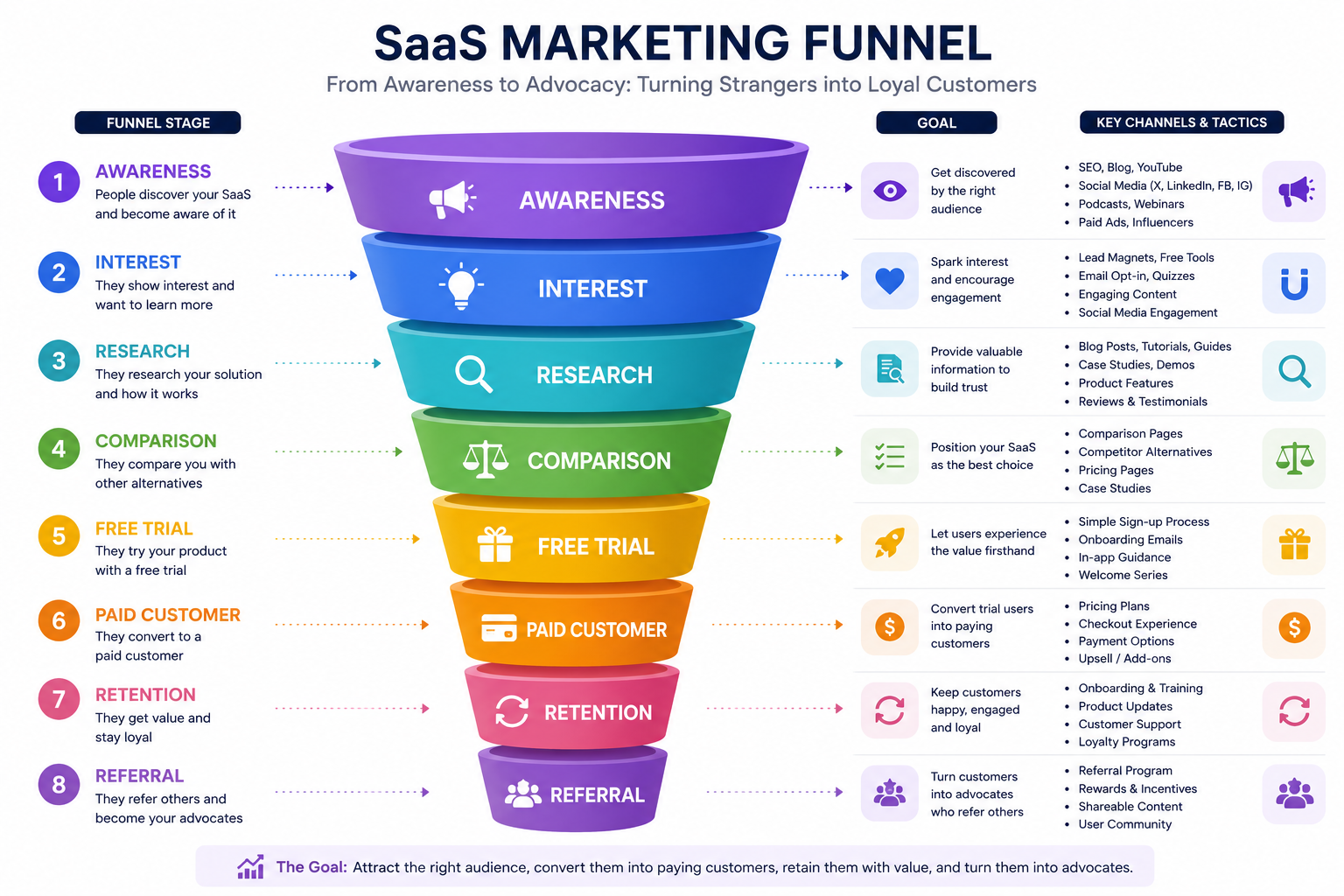
Throughout this guide, we'll break down the best marketing channels and tactics for each stage of this funnel so you can build a complete growth system instead of relying on a single source of traffic. If you'd like to dive deeper into the concepts behind customer acquisition.
Build Your SaaS Marketing Foundation
Before investing time in SEO, paid advertising, social media, or community marketing, you need a strong foundation. Many SaaS products fail to gain traction because they promote the wrong message to the wrong audience. A clear understanding of your ideal customer, competitors, positioning, and value proposition makes every marketing channel more effective and improves your chances of turning visitors into paying customers.
Think of this section as preparing the groundwork before scaling your marketing efforts. Once these fundamentals are in place, every strategy discussed later in this guide becomes easier to execute and delivers better long-term results.
Identify Your Ideal Customer Profile (ICP)
Your Ideal Customer Profile (ICP) defines exactly who your SaaS is built for. Instead of trying to reach everyone, identify the people or businesses most likely to benefit from your product. Consider factors such as industry, company size, job role, pain points, goals, budget, and the problems your software solves. The more specific your audience, the easier it becomes to create content, ads, and messaging that convert.
Research Your Competitors
Study competitors to understand how they position their products, attract traffic, price their plans, and communicate with customers. Analyze their websites, blogs, social media, SEO strategy, reviews, and community engagement to identify opportunities where your SaaS can stand out.
Position Your SaaS
Positioning explains why customers should choose your software instead of competing products. Highlight your unique value, focus on the specific problems you solve, and communicate the benefits that matter most to your target audience rather than simply listing features.
Create a Clear Marketing Message
Your messaging should immediately explain what your SaaS does, who it's for, and why it's better than the alternatives. A clear headline, compelling value proposition, and strong call-to-action make it easier for potential customers to understand your product and take the next step.
The SaaS Marketing Funnel
Every successful SaaS business guides potential customers through a series of stages before they become loyal users. Different marketing channels work better at different points in this journey. Understanding the funnel helps you invest in the right strategies at the right time instead of expecting one channel to generate awareness, conversions, and retention all on its own.
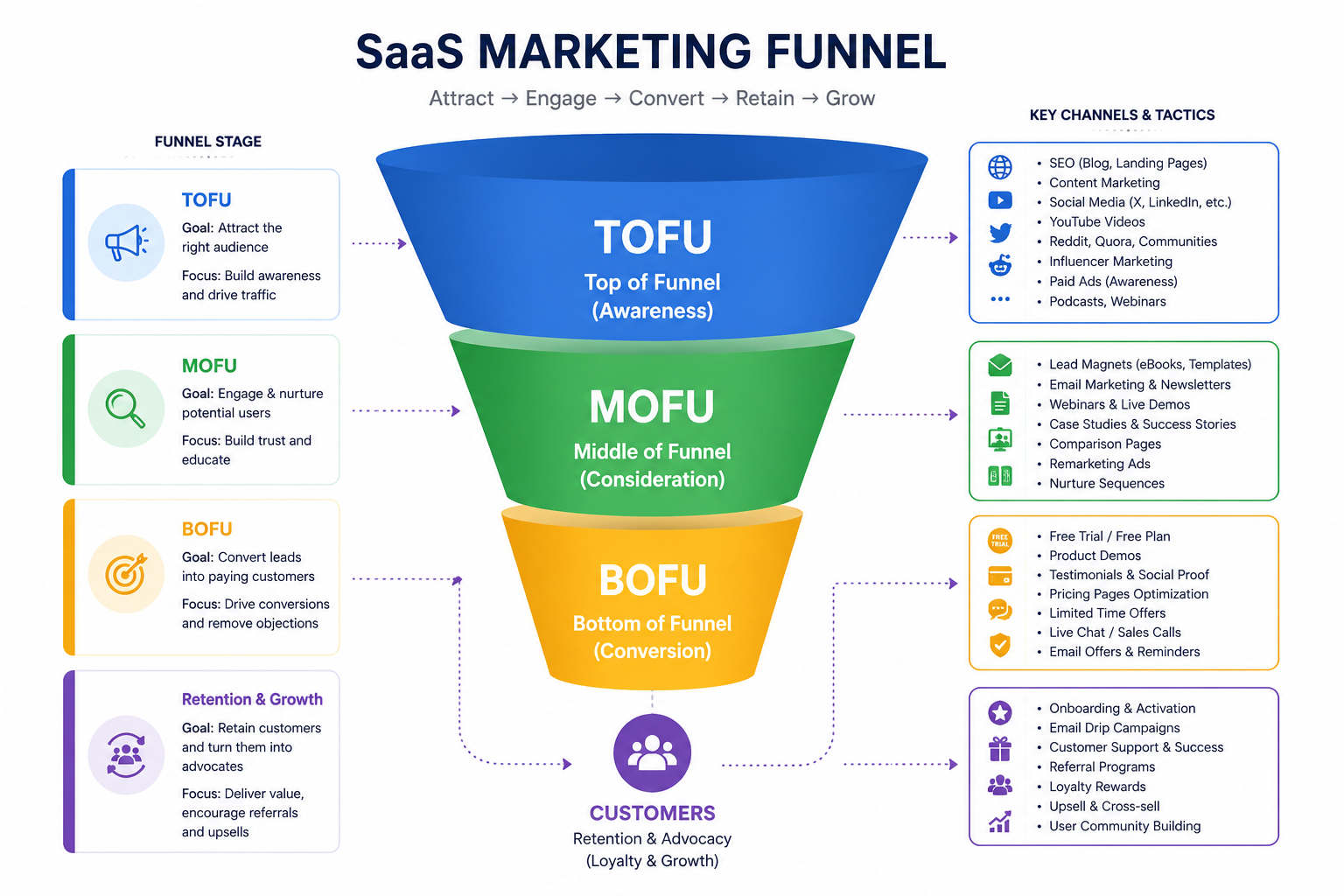
TOFU (Top of Funnel)
At the awareness stage, your goal is to help potential customers discover your product. Educational content, search engines, social media, and online communities introduce your SaaS to people who may not even know your solution exists.
MOFU (Middle of Funnel)
Once visitors know about your product, they begin evaluating whether it's the right solution. This stage focuses on building trust, educating prospects, and demonstrating why your SaaS is worth trying.
BOFU (Bottom of Funnel)
At the decision stage, prospects are ready to choose a solution. Your objective is to remove hesitation, answer final questions, and make it easy for users to become paying customers.
Want to improve your conversion rate? Read our Landing Page Guide .
Organic Marketing Channels
Organic marketing focuses on attracting customers without paying for every click or impression. Instead of relying on advertising budgets, businesses earn visibility by creating valuable content, building authority, engaging with communities, and optimizing their online presence. Although organic strategies usually take longer to produce results, they often generate consistent traffic, higher trust, and lower customer acquisition costs over the long term.
Unlike paid campaigns that stop generating leads when the budget runs out, successful organic marketing continues to attract potential customers months or even years after the content is published. A well-written blog article, helpful YouTube video, popular Reddit discussion, or highly ranked comparison page can become a long-term source of qualified traffic.
In the following sections, we'll explore the most effective organic marketing channels for SaaS businesses, including SEO, content marketing, online communities, social media platforms, email marketing, partnerships, and referral strategies that can help you build sustainable, long-term growth.
1. SEO Marketing (Search Engine Optimization)
Search Engine Optimization (SEO) is one of the most effective long-term marketing strategies for SaaS businesses. Instead of paying for every visitor, SEO helps your website appear in search engine results when potential customers are actively looking for solutions. A strong SEO strategy can generate qualified traffic, increase brand authority, reduce customer acquisition costs, and continue delivering leads long after your content is published.
Keyword Research
Keyword research is the foundation of every successful SEO strategy. It helps you understand what your target audience is searching for and allows you to create content that matches those searches. Focus on keywords with clear search intent, realistic competition, and strong relevance to your SaaS product rather than chasing only high-volume terms.
Understanding Search Intent
Not every search has the same purpose. Some users want to learn, while others are ready to compare products or make a purchase. Understanding search intent helps you create content that answers the right questions and improves your chances of ranking for keywords that actually convert.
Content Marketing
Publishing valuable content builds trust and attracts potential customers throughout the buying journey. Tutorials, guides, case studies, comparisons, and educational articles help establish your expertise while generating consistent organic traffic from search engines.
Blog SEO
Optimizing your blog posts improves visibility in search results and increases the likelihood of attracting qualified visitors. Well-structured articles with clear headings, optimized metadata, internal links, helpful visuals, and valuable information generally perform better over time.
Programmatic SEO
Programmatic SEO involves creating large numbers of high-quality pages using structured data and templates. This approach is commonly used for location pages, comparison pages, templates, directories, and other scalable content that targets long-tail keywords.
Comparison Pages
Comparison pages help potential customers evaluate your SaaS against competing products. These pages attract users with strong buying intent and provide an opportunity to highlight your software's strengths in an honest and transparent way.
Alternative Pages
Alternative pages target users searching for replacements to existing software. Creating helpful comparison content for popular competitors can attract highly qualified visitors who are actively looking to switch solutions.
Template Pages
Template pages provide ready-to-use resources such as invoices, proposals, resumes, contracts, checklists, and planners. They often generate significant organic traffic because users are searching for practical solutions they can use immediately.
Statistics Pages
Statistics pages compile accurate industry data, research findings, and market trends into a single resource. These pages frequently earn backlinks from journalists, bloggers, and researchers looking for reliable information to reference.
Glossary Pages
Glossary pages explain industry terms in simple language, making complex topics easier to understand. They also help capture informational searches while strengthening your website's topical authority.
Free Tools
Free online tools like calculators, generators, validators, converters, and checkers are excellent lead-generation assets for SaaS companies. They solve real user problems instantly, which increases engagement and encourages users to return whenever they need the tool. Over time, these resources can rank for high-intent keywords, drive recurring organic traffic, earn natural backlinks, and introduce potential customers to your SaaS product without relying heavily on paid advertising.
Internal Linking
Internal links connect related pages across your website, helping both users and search engines discover additional content. A well-planned internal linking strategy improves navigation, distributes page authority, and strengthens your overall SEO performance.
Link Building
High-quality backlinks remain an important ranking factor. Earning links through valuable content, digital PR, guest posting, original research, and useful free tools helps improve your website's authority and visibility in search results.
2. Community Marketing
Community marketing helps SaaS businesses build trust by participating in conversations where their target audience already spends time. Instead of directly promoting your product, the focus is on providing helpful answers, sharing expertise, and becoming a valuable member of online communities. Over time, this approach generates brand awareness, qualified traffic, and highly engaged customers.
Reddit allows you to connect with niche communities discussing problems your SaaS solves. Sharing helpful advice instead of promotional content can establish credibility and generate highly targeted traffic.
Quora
Quora is an excellent platform for answering industry-related questions and demonstrating your expertise. High-quality answers can continue driving organic traffic for months or even years.
Product Hunt
Product Hunt is one of the best places to launch new SaaS products, gather early feedback, and reach technology enthusiasts, founders, and early adopters.
Indie Hackers
Indie Hackers is a community where founders share growth strategies, product updates, revenue milestones, and lessons learned while building online businesses.
Hacker News
Hacker News can generate significant exposure for technical SaaS products by sharing useful articles, product launches, and engineering insights with developers and entrepreneurs.
Discord Communities
Industry-focused Discord servers provide opportunities to answer questions, collect user feedback, and build relationships with potential customers in real time.
Facebook Groups
Active Facebook Groups remain valuable for connecting with business owners, professionals, and niche audiences by sharing educational content and participating in meaningful discussions.
4. Video Marketing
Video marketing has become one of the fastest-growing ways to promote SaaS products. Short-form videos, product demonstrations, tutorials, webinars, and customer success stories help explain complex software in a simple and engaging format. Whether you're creating YouTube tutorials or Instagram Reels, video content can increase brand awareness, improve engagement, and drive qualified leads.
Product Demo Videos
Show potential customers how your SaaS works by demonstrating key features, solving common problems, and highlighting the benefits users receive from your product.
Tutorial Videos
Educational tutorials help users learn your software while establishing your brand as a trusted source of knowledge. They also perform well in search engines and on YouTube.
Live Webinars
Hosting webinars allows you to demonstrate your expertise, answer questions in real time, and build stronger relationships with potential customers before they purchase.
Customer Success Stories
Sharing real customer experiences builds credibility and shows how your software solves practical business problems, making it easier for prospects to trust your solution.
Short-Form Videos
Short videos published on YouTube Shorts, Instagram Reels, TikTok, and LinkedIn are ideal for sharing tips, product updates, feature highlights, and educational content that quickly captures attention.
5. Email Marketing
Email marketing remains one of the highest-converting marketing channels for SaaS businesses. Unlike social media, where algorithms control visibility, email gives you direct access to your audience. It can be used to nurture leads, onboard new users, promote new features, reduce churn, and encourage long-term customer retention through personalized communication.
Lead Magnets
Offer valuable resources such as eBooks, templates, checklists, webinars, or free tools in exchange for email addresses. This helps you build a qualified email list of potential customers.
Welcome Email Sequence
Introduce new subscribers to your product with a series of welcome emails that explain your value proposition, highlight key features, and encourage users to take the next step.
Product Updates
Keep customers informed about new features, improvements, bug fixes, and upcoming releases to increase engagement and demonstrate continuous product development.
Email Newsletters
Share educational content, industry insights, company news, and helpful resources regularly to maintain customer relationships and stay top of mind.
Free Trial Nurturing
Guide trial users with onboarding emails, feature tips, and success stories that encourage them to experience your product's value before the trial expires.
Customer Retention Emails
Send personalized recommendations, renewal reminders, feature announcements, and re-engagement campaigns to reduce churn and increase customer lifetime value.
6. Influencer Marketing
Influencer marketing allows SaaS companies to reach highly engaged audiences by collaborating with creators, industry experts, and thought leaders. Unlike traditional advertising, influencer recommendations often feel more authentic, helping build trust and generate qualified leads. Choosing influencers whose audience closely matches your target customers usually delivers the best results.
Micro Influencers
Micro influencers typically have smaller but highly engaged communities, making them ideal for SaaS businesses with limited marketing budgets.
Industry Experts
Partnering with respected professionals helps establish credibility while introducing your product to an audience that already trusts their recommendations.
YouTube Creators
Product reviews, tutorials, and software comparisons created by YouTubers can generate long-term traffic and influence purchasing decisions.
LinkedIn Creators
LinkedIn creators are particularly effective for B2B SaaS products because they reach founders, executives, and business decision-makers.
User-Generated Content (UGC)
Encourage customers and creators to share genuine experiences, tutorials, and success stories using your SaaS product to build trust and social proof.
7. Affiliate Marketing
Affiliate marketing is one of the most cost-effective ways to grow a SaaS business because you only pay when affiliates generate results. Instead of relying solely on your own marketing efforts, you can partner with creators, bloggers, agencies, educators, and industry professionals who promote your software to their audiences in exchange for a commission. A well-managed affiliate program can continuously generate qualified leads while expanding your brand's reach.
Affiliate Programs
An affiliate program allows individuals or businesses to promote your SaaS using unique referral links. Whenever someone signs up or purchases through those links, the affiliate earns a commission. Offering competitive rewards, reliable tracking, and timely payouts encourages affiliates to actively recommend your product.
Commission Models
Choose a commission structure that aligns with your business model. Some SaaS companies offer a one-time payment for each successful referral, while others provide recurring commissions for as long as the referred customer remains subscribed. The right model should be attractive to affiliates while remaining profitable for your business.
Recruiting Affiliates
Focus on recruiting affiliates whose audience closely matches your target customers. Bloggers, YouTubers, educators, consultants, agencies, newsletter owners, and industry influencers often make excellent partners because they already have the trust of potential buyers.
Tracking Sales
Accurate tracking is essential for running a successful affiliate program. Use affiliate software to monitor clicks, conversions, commissions, and payouts in real time. Transparent reporting builds trust with affiliates and helps you measure which partners deliver the highest-quality customers.
8. Referral Marketing
Referral marketing encourages existing customers to recommend your SaaS product to friends, colleagues, and business contacts. Since people naturally trust recommendations from those they know, referral programs often produce higher conversion rates and lower customer acquisition costs than many traditional marketing channels.
Referral Programs
A referral program rewards customers for inviting others to try your SaaS. Offering clear incentives encourages more users to share your product while helping you grow through word-of-mouth marketing.
Double-Sided Rewards
Rewarding both the referrer and the new customer creates a win-win experience. This approach increases participation because both people receive value, making referrals feel more beneficial and motivating.
Invite Friends
Make it simple for users to invite friends by providing shareable referral links, email invitations, QR codes, or one-click social sharing options. Reducing friction leads to higher referral activity.
Customer Advocacy
Happy customers often become your strongest advocates. Encourage them to share reviews, testimonials, success stories, and recommendations that demonstrate the real value of your SaaS product.
Viral Loops
A viral loop occurs when new customers naturally invite additional users, creating continuous organic growth. Well-designed referral incentives and seamless sharing features can help your customer base expand with minimal ongoing marketing costs.
Popular Referral Marketing Platforms
9. Partnership Marketing
Partnership marketing helps SaaS businesses grow by collaborating with other companies, creators, and industry experts who serve a similar audience. Instead of competing for attention, both partners work together to create valuable content, share audiences, and generate high-quality leads. Strong partnerships often produce long-term growth while reducing customer acquisition costs.
Strategic Partnerships
Partner with businesses that complement your SaaS rather than compete with it. These relationships can include product integrations, bundled offers, referral agreements, or joint promotions that benefit both companies and their customers.
Co-Marketing Campaigns
Co-marketing allows two brands to create and promote content together. Joint blog posts, downloadable resources, videos, and email campaigns help both businesses reach new audiences while sharing marketing efforts.
Guest Blogging
Writing guest articles for trusted industry websites helps establish authority, build valuable backlinks, and introduce your SaaS to readers who may become future customers.
Joint Webinars
Hosting webinars with complementary businesses allows both brands to educate their audiences, answer questions, demonstrate expertise, and generate qualified leads through live engagement.
Podcast Interviews
Appearing as a guest on podcasts helps you share your expertise, tell your business story, and reach listeners who are already interested in your industry or niche.
Newsletter Swaps
Newsletter swaps involve two businesses recommending each other's products or content to their email subscribers. This simple strategy expands your reach while introducing your SaaS to a highly engaged audience.
10. Marketplace Marketing
Marketplace marketing helps SaaS businesses reach users who are already searching for software solutions. Publishing your product on trusted app marketplaces increases visibility, builds credibility, generates qualified traffic, and gives customers another way to discover, install, and evaluate your software.
Chrome Web Store
If your SaaS includes a browser extension, listing it on the Chrome Web Store makes it easier for users to discover, install, and review your product directly from Google's marketplace.
Shopify App Store
Shopify apps reach thousands of online store owners looking for tools that improve sales, marketing, customer support, shipping, analytics, and store management.
WordPress Plugin Directory
If your SaaS integrates with WordPress, publishing a plugin in the official directory can generate consistent downloads while helping website owners discover your product.
Figma Community
Designers actively browse Figma Community for plugins, templates, widgets, and UI resources. It's an excellent platform for SaaS products focused on design and productivity.
Visual Studio Marketplace
Developer-focused SaaS products can publish extensions for Visual Studio Code to increase visibility among programmers and technical teams.
Salesforce AppExchange
AppExchange helps businesses discover Salesforce integrations and enterprise applications that extend the capabilities of their CRM ecosystem.
Atlassian Marketplace
Jira, Confluence, and Trello users rely on Atlassian Marketplace to find apps that improve collaboration, project management, and workflow automation.
Popular SaaS Marketplaces
11. Paid Advertising
Paid advertising helps SaaS businesses generate traffic and acquire customers much faster than organic marketing. While SEO and content marketing take time to build momentum, paid campaigns can immediately place your product in front of highly targeted audiences. The key is to invest in channels that match your ideal customers and continuously optimize campaigns based on performance data.
Google Ads
Google Ads helps you reach users actively searching for software solutions. Search campaigns are particularly effective for capturing high-intent traffic that is already looking for products similar to yours.
Microsoft Ads
Microsoft Ads provides access to Bing search users and can often deliver lower competition and reduced advertising costs compared to other search platforms.
Meta Ads
Facebook and Instagram advertising are excellent for increasing brand awareness, generating leads, and retargeting previous website visitors with highly targeted campaigns.
LinkedIn Ads
LinkedIn Ads are ideal for B2B SaaS companies targeting professionals based on job title, industry, company size, seniority, and other business-focused criteria.
Reddit Ads
Reddit Ads allow you to promote your SaaS directly within niche communities where users actively discuss relevant problems, tools, and purchasing decisions.
Quora Ads
Quora Ads target users based on the questions they read, making them useful for reaching audiences researching solutions before making purchasing decisions.
X Ads
X Ads help promote product launches, announcements, and educational content while reaching founders, developers, marketers, and technology enthusiasts.
TikTok Ads
TikTok Ads are effective for increasing brand awareness through engaging short-form videos that introduce your SaaS to new audiences.
YouTube Ads
YouTube Ads allow you to demonstrate your software using video while reaching potential customers before, during, or after the content they watch.
Pinterest Ads
Pinterest Ads work well for visually appealing SaaS products, templates, productivity tools, and educational resources that users frequently save for future reference.
Retargeting Campaigns
Most visitors won't convert on their first visit. Retargeting campaigns remind previous visitors about your SaaS through personalized ads, helping increase conversions and recover potential customers who left without signing up.
12. Cold Outreach
Cold outreach is a proactive marketing strategy where you directly contact potential customers who haven't interacted with your SaaS before. When done with proper research and personalization, it can generate qualified leads, schedule product demos, and start meaningful conversations with decision-makers. The goal isn't to send thousands of generic messages but to provide genuine value to the right people.
Cold Email
Personalized cold emails remain one of the most effective ways to reach business owners and decision-makers. Focus on solving a specific problem, keep your message concise, and include a clear call-to-action rather than sending lengthy sales pitches.
LinkedIn Outreach
Connect with professionals on LinkedIn by engaging with their content before sending personalized connection requests or messages. Building relationships first often leads to better response rates than immediately promoting your product.
X (Twitter) Outreach
Engage with founders, creators, and industry experts through meaningful replies and discussions. Consistent participation helps build visibility and creates opportunities for natural conversations about your SaaS.
Cold Calling
Although less common for many SaaS businesses, cold calling can still be highly effective for high-value B2B products. Keep conversations focused on understanding the prospect's challenges rather than delivering a scripted sales presentation.
Personalized Outreach
Personalization significantly improves response rates. Mention the prospect's company, recent achievements, published content, or specific business challenges to demonstrate that your outreach is genuine and relevant.
Personalized Video Messages
Recording short personalized videos helps your outreach stand out in crowded inboxes. A quick product walkthrough or tailored introduction can build trust and increase the likelihood of receiving a response.
13. Landing Page Optimization
Driving traffic to your website is only half the battle. A well-optimized landing page turns visitors into free trial users, demo requests, or paying customers. Every element on the page should guide users toward a single goal while clearly communicating the value of your SaaS product.
Hero Section
Your hero section is the first thing visitors see. Use a clear headline, supporting description, product screenshot, and a strong call-to-action that immediately explains why your software is worth trying.
Value Proposition
Explain what your SaaS does, who it's built for, and the primary benefit users receive. Keep your messaging simple, specific, and focused on solving customer problems rather than listing technical features.
Call-to-Action (CTA)
Every landing page should include a clear and highly visible call-to-action. Whether you want visitors to start a free trial, book a demo, or create an account, the next step should always be obvious.
Highlight Key Features
Showcase the features that matter most to your target audience. Focus on how each feature solves a real problem instead of presenting a long list of technical capabilities.
Focus on Benefits
Visitors care more about outcomes than features. Explain how your software saves time, increases productivity, reduces costs, or improves business results.
Social Proof
Build trust by displaying customer testimonials, reviews, ratings, case studies, client logos, or success stories that demonstrate the value of your SaaS.
Transparent Pricing
Make pricing easy to understand by clearly explaining plans, included features, billing cycles, and any free trial or money-back guarantees.
Frequently Asked Questions
Answer common objections before users ask them. Cover topics such as pricing, security, integrations, onboarding, cancellations, and support to help visitors make confident purchasing decisions.
Lead Capture Forms
Keep forms short and simple. Only request the information you truly need to reduce friction and increase conversion rates.
Useful Landing Page Resources
14. SaaS Analytics & Key Performance Indicators (KPIs)
Successful SaaS marketing isn't based on guesswork—it's driven by data. Tracking the right metrics helps you understand which marketing channels generate customers, how efficiently you're spending your budget, and where improvements are needed. Monitoring key performance indicators (KPIs) allows you to make informed decisions that support sustainable business growth.
Monthly Recurring Revenue (MRR)
MRR measures the predictable monthly income generated from subscriptions. It is one of the most important metrics for understanding business growth and forecasting future revenue.
Annual Recurring Revenue (ARR)
ARR represents the total recurring subscription revenue expected over one year. It provides a broader view of long-term business performance.
Customer Acquisition Cost (CAC)
CAC shows how much it costs to acquire a new customer after considering marketing and sales expenses. Lower acquisition costs generally improve profitability.
Customer Lifetime Value (LTV)
LTV estimates the total revenue a customer generates during their relationship with your business. Increasing lifetime value often has a greater impact than simply acquiring more customers.
Churn Rate
Churn rate measures how many customers cancel their subscriptions during a specific period. Reducing churn is essential for maintaining recurring revenue and long-term growth.
Activation Rate
Activation rate tracks how many new users successfully experience your product's core value after signing up. Strong onboarding usually improves this metric.
Customer Retention Rate
Customer retention measures how effectively your business keeps existing customers over time. Higher retention typically leads to stronger recurring revenue.
Trial-to-Paid Conversion Rate
This metric shows the percentage of trial users who become paying customers. Improving onboarding, product education, and support can significantly increase conversions.
Overall Conversion Rate
Conversion rate measures how many visitors complete your desired action, such as signing up, booking a demo, or purchasing a subscription. It helps evaluate the effectiveness of your marketing campaigns.
Popular Analytics Tools
15. AI for SaaS Marketing
Artificial intelligence has transformed how SaaS businesses create content, automate workflows, analyze customer behavior, and improve marketing performance. Instead of replacing marketers, AI helps teams work faster by generating ideas, producing content, personalizing campaigns, and automating repetitive tasks. When combined with human creativity and strategy, AI can significantly improve productivity and accelerate business growth.
AI Content Writing
AI writing assistants can help generate blog ideas, landing page copy, email campaigns, social media posts, product descriptions, and marketing outlines in minutes. They are especially useful for brainstorming and producing first drafts that can later be refined by human editors.
AI for SEO
AI can speed up keyword research, optimize content, generate metadata, identify content gaps, cluster keywords, and suggest internal linking opportunities that improve search engine visibility.
AI Image Generation
Marketing teams can quickly create blog illustrations, social media graphics, ad creatives, thumbnails, product mockups, and promotional visuals using AI-powered image generation tools.
AI Video Creation
AI video tools simplify script writing, voiceovers, subtitles, editing, and short-form video production, making it easier to publish educational and promotional content across multiple platforms.
AI Marketing Automation
AI-powered automation can qualify leads, personalize emails, respond to customer inquiries, schedule marketing tasks, and connect multiple applications without manual intervention.
AI Customer Support
AI chatbots and virtual assistants provide instant responses to common customer questions, reducing support workload while improving response times and user satisfaction.
AI Analytics
AI analyzes customer behavior, campaign performance, and business metrics to uncover trends, predict outcomes, and recommend marketing improvements based on real data.
Popular AI Marketing Tools
16. 90-Day SaaS Marketing Plan
Marketing a SaaS product becomes much easier when you follow a structured plan instead of trying every strategy at once. The first 90 days should focus on building a strong foundation, attracting qualified traffic, validating your messaging, and creating repeatable systems that can scale over time. Rather than chasing every marketing channel, concentrate on consistent execution and measurable progress.
Days 1–30: Build Your Foundation
Launch your website, optimize your landing pages, define your ideal customer profile, research competitors, publish your first SEO articles, create social media profiles, and begin collecting email subscribers. Focus on building a solid marketing foundation before investing heavily in promotion.
Days 31–60: Generate Traffic
Increase content production, participate in online communities, publish videos, answer questions on Reddit and Quora, launch your affiliate or referral program, and start experimenting with small paid advertising campaigns while tracking performance carefully.
Days 61–90: Optimize and Scale
Analyze your marketing data, improve high-performing campaigns, optimize landing pages, strengthen email automation, expand successful content, build partnerships, and invest more in the channels that consistently generate qualified customers.
| Timeline | Primary Goal | Recommended Activities |
|---|---|---|
| Days 1–30 | Build Your Foundation | Website, SEO, landing pages, ICP, branding, content, analytics. |
| Days 31–60 | Increase Visibility | Community marketing, videos, social media, email marketing, partnerships, small ad campaigns. |
| Days 61–90 | Scale What Works | Optimize campaigns, improve conversions, automate marketing, expand successful channels, measure KPIs. |
17. SaaS Marketing Budget
You don't need a massive marketing budget to grow a SaaS business. Many successful companies start with organic marketing and gradually invest more as revenue increases. The key is to spend money on strategies that provide measurable returns instead of trying every marketing channel at once. Whether your budget is zero or several thousand dollars per month, consistency matters more than spending.
$0 Budget
Focus on SEO, blogging, social media, Reddit, Quora, LinkedIn, Product Hunt, email marketing, partnerships, and free AI tools. Invest your time instead of money while building long-term organic traffic.
Up to $100 per Month
Upgrade to essential software such as email marketing, analytics, landing page tools, and AI assistants. Allocate a small amount toward testing paid advertising or promoting your highest-performing content.
$100–$500 per Month
Expand your marketing with Google Ads, LinkedIn Ads, video production, content writing, outreach campaigns, affiliate software, and conversion optimization tools while continuing to grow organic traffic.
$500–$2,000 per Month
Scale successful campaigns, hire freelancers or agencies, produce high-quality content consistently, launch influencer partnerships, improve SEO, and increase investment in the channels with the best return on investment.
$2,000+ per Month
Build a complete growth engine with dedicated marketers, paid advertising, marketing automation, advanced analytics, PR campaigns, partnerships, webinars, customer success initiatives, and continuous experimentation across multiple acquisition channels.
| Monthly Budget | Primary Focus | Recommended Channels |
|---|---|---|
| $0 | Organic Growth | SEO, blogs, communities, social media, email marketing. |
| Up to $100 | Essential Tools | AI tools, email software, analytics, basic paid promotion. |
| $100–$500 | Growth | Paid ads, outreach, affiliate marketing, landing page optimization. |
| $500–$2,000 | Scaling | SEO expansion, partnerships, influencer marketing, automation. |
| $2,000+ | Full Growth Engine | Team building, paid acquisition, PR, advanced analytics, enterprise marketing. |
Personal Recommendation: Build an Audience Before Selling Your SaaS
If I could give only one piece of advice to first-time SaaS founders, it would be this: don't wait until your product is finished to start building an audience. One of the biggest mistakes founders make is spending months developing a great product and only thinking about marketing after launch. By then, nobody knows who they are, nobody trusts their brand, and getting the first few customers becomes much harder than it needs to be.
Instead, build an audience around the problems your SaaS solves. Create educational content, share practical tips, answer common questions, and become a trusted source of information within your niche. When people repeatedly see your helpful content, they naturally begin recognizing your name and associating it with expertise. Later, when you introduce your SaaS, it feels like a logical solution rather than a random advertisement.
Keep Your Brand Page and Audience Page Separate
Rather than relying only on your official SaaS account, consider creating a separate niche-focused content page. Your SaaS page should remain professional and focus on product announcements, feature releases, customer stories, company updates, and documentation. The audience page, on the other hand, should exist to educate, entertain, and help people solve everyday problems related to your industry.
This separation makes your marketing feel much more authentic. People follow educational pages because they expect valuable content—not constant sales pitches. As a result, occasional posts featuring your SaaS often feel like helpful recommendations instead of advertisements.
A Simple Example
Imagine you've created a CRM software for small businesses. Instead of trying to grow only your official CRM page, you could build an Instagram page dedicated to business growth, sales tips, productivity, customer retention, and marketing strategies. Every day, you publish valuable posts, short videos, and practical advice that helps business owners improve their companies.
After several months, your page has thousands of followers who trust your recommendations. When you occasionally publish a video saying, "Here's how I organize all my leads using my CRM," people see it as a practical workflow instead of a sales advertisement. Many followers become curious, visit your website, and some eventually become paying customers because the recommendation comes from a source they've already learned from.
Build Trust Before You Sell
Modern customers rarely purchase software after seeing it only once. They usually discover a brand, consume its content, compare alternatives, read reviews, and only then decide to sign up. Building an audience first shortens this trust-building process because many people already know who you are before they ever visit your website.
Think of every helpful post, tutorial, or video as a small investment in your future product. Even if someone doesn't need your SaaS today, they may remember your brand months later when the problem becomes relevant. Consistent educational content creates familiarity, and familiarity often leads to trust.
Where You Can Build an Audience
Choose one or two platforms where your ideal customers already spend time instead of trying to be active everywhere. Focus on consistently publishing high-quality content before expanding to additional platforms.
| Platform | Best Content | Ideal Audience |
|---|---|---|
| Business tips, case studies, founder insights | B2B companies and professionals | |
| Reels, carousels, educational graphics | Creators, freelancers, startups | |
| YouTube | Tutorials, reviews, long-form guides | Users researching software |
| X (Twitter) | Quick insights, product updates, discussions | Founders and tech communities |
| Helpful answers and discussions | Problem-aware users |
Final Thought
Great SaaS companies don't just build products—they build communities. An engaged audience won't automatically guarantee sales, but it gives every product launch, feature update, and announcement a much stronger starting point. By consistently helping people before asking them to buy, you create trust that paid advertisements alone often can't achieve. Over time, your educational content, personal brand, and SaaS product begin reinforcing one another, making customer acquisition easier and more sustainable.
3. Social Media Marketing
Social media is one of the fastest ways to build brand awareness, engage with potential customers, and showcase your SaaS product. Each platform attracts a different audience, so the most successful SaaS companies focus on the channels that best match their target market instead of trying to be active everywhere. Consistently sharing valuable content, product updates, educational posts, and customer success stories can help drive traffic, generate leads, and build long-term trust.
LinkedIn
LinkedIn is the leading platform for B2B SaaS marketing. Sharing industry insights, founder stories, customer success posts, and educational content helps establish authority while reaching decision-makers and business professionals.
X (Twitter)
X is ideal for sharing product updates, engaging with industry conversations, building in public, and connecting with founders, developers, marketers, and early adopters in real time.
Instagram
Instagram helps SaaS brands increase visibility through Reels, carousel posts, stories, and behind-the-scenes content. Educational visuals and short videos are particularly effective for reaching new audiences.
YouTube
YouTube is an excellent platform for publishing product tutorials, feature demonstrations, case studies, webinars, and educational videos that continue attracting traffic long after publication.
Pinterest
Pinterest can drive consistent long-term traffic by promoting blog articles, infographics, templates, checklists, and visual guides that users frequently save and revisit.
TikTok
TikTok enables SaaS businesses to reach a broad audience through short educational videos, software tips, quick demonstrations, and trending content that increases brand awareness.
Facebook
Facebook remains valuable for building communities, sharing blog content, running live sessions, and connecting with niche groups interested in your industry or software solution.