
Introduction
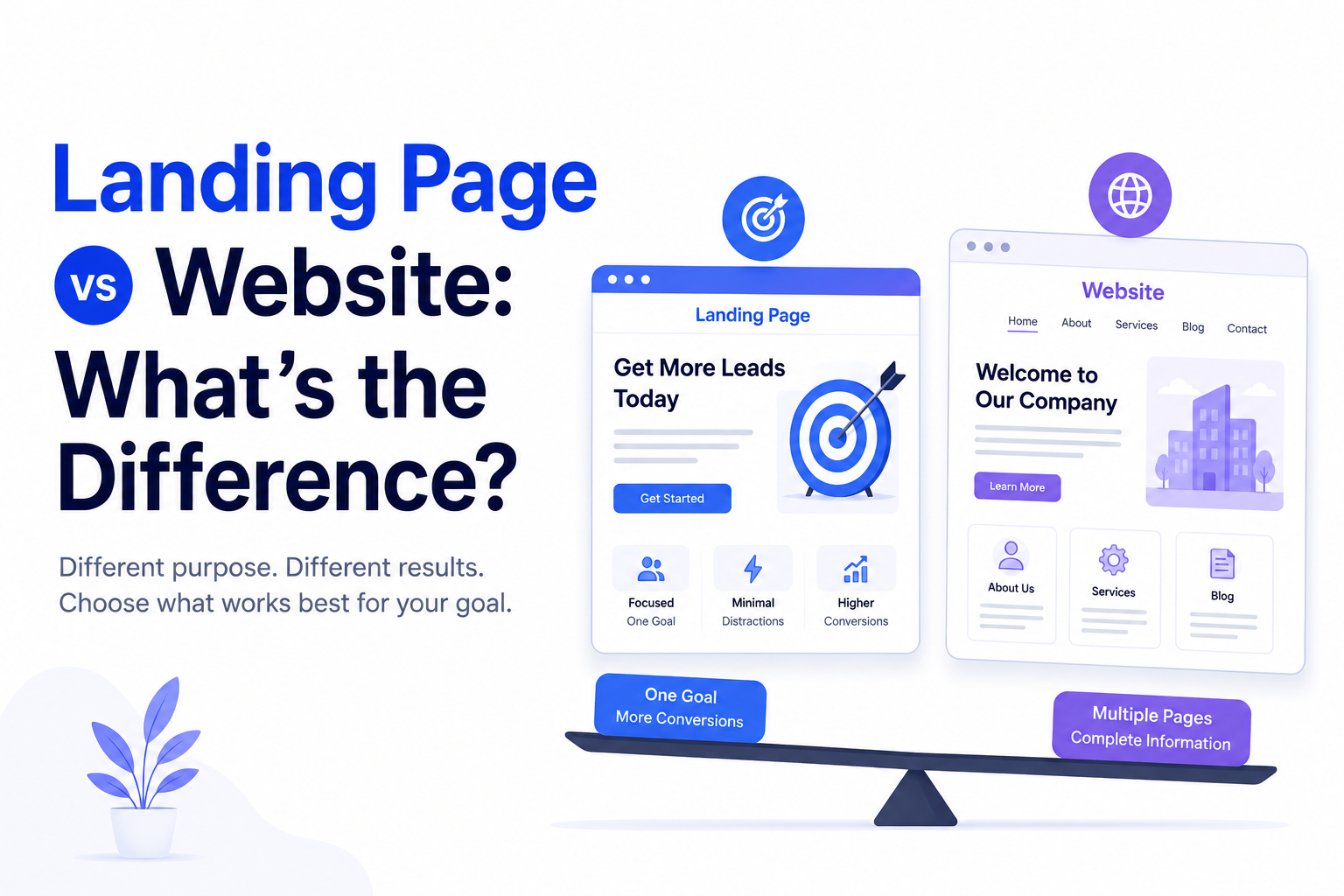
If you've been researching how to build an online presence, you've probably come across the terms landing page and website. Although they're often used interchangeably, they aren't the same thing. Both play an important role in digital marketing, but they're designed to achieve completely different goals.
A landing page is built to encourage visitors to complete one specific action, such as filling out a contact form, signing up for a newsletter, downloading a free guide, or purchasing a product. A website, on the other hand, provides a broader online presence where visitors can explore your business, learn about your services, read blog articles, browse products, and contact you through multiple pages.
Choosing the wrong option can affect your results. Sending paid advertising traffic to a general homepage may reduce conversions, while relying only on a single landing page can limit your ability to build long-term search engine visibility and brand authority. Understanding when to use each one helps you attract the right audience, generate more leads, and create a better experience for your visitors.
In this guide, you'll learn the key differences between landing pages and websites, their advantages and disadvantages, how they impact SEO and conversions, when each option works best, and why many successful businesses use both together instead of choosing only one.
What Is a Landing Page?
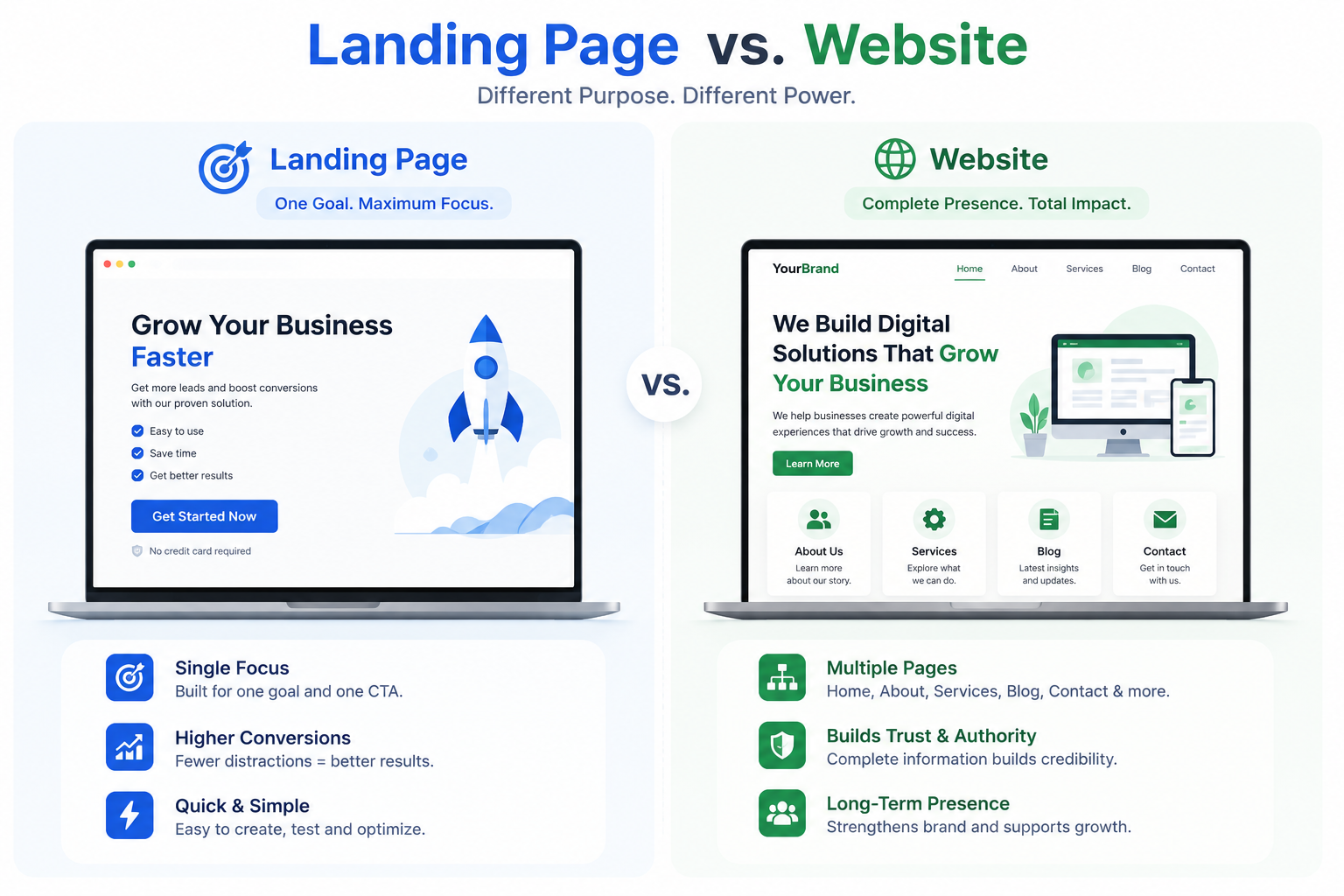
A landing page is a standalone web page designed with one specific goal in mind. Unlike a traditional website, it removes unnecessary distractions and encourages visitors to complete a single action, such as signing up, making a purchase, booking an appointment, or downloading a resource.
Definition
A landing page is a focused page created to convert visitors into leads or customers through one clear call-to-action.
How a Landing Page Works
Visitors usually arrive from ads, emails, or social media. Instead of browsing multiple pages, they are guided toward completing one specific action.
Key Features
- Single goal or objective.
- Strong call-to-action (CTA).
- Minimal navigation.
- Focused content.
- Optimized for conversions.
Common Types of Landing Pages
- Lead generation pages.
- Product sales pages.
- Event registration pages.
- App download pages.
- Coming soon pages.
Advantages
- Higher conversion rates.
- Less distraction for visitors.
- Perfect for paid advertising.
- Easy to track results.
Disadvantages
- Limited SEO potential.
- Usually focuses on one offer only.
- Not suitable for showcasing an entire business.
- Requires additional pages for long-term growth.
What Is a Website?
A website is a collection of connected web pages that provide information about a business, brand, person, or organization. Unlike a landing page, a website allows visitors to explore multiple pages and learn more before taking action.
Definition
A website is a multi-page online presence designed to inform, build trust, and support long-term business growth.
How a Website Works
Visitors navigate through different pages such as Home, About, Services, Blog, and Contact to find the information they need.
Essential Pages
- Home
- About
- Services or Products
- Blog
- Contact
Advantages
- Better for SEO.
- Builds trust and credibility.
- Supports multiple services or products.
- Easy to scale over time.
Disadvantages
- Takes longer to build.
- Requires regular maintenance.
- May have lower conversion rates than a focused landing page.
Comparison: Landing Page vs Website
Landing pages and websites may seem similar, but they're designed for different goals. A landing page is built to maximize conversions for a single campaign, while a website helps establish your brand, improve SEO, and provide visitors with comprehensive information about your business.
| Feature | Landing Page | Website |
|---|---|---|
| Primary Goal | Drive one specific action or conversion. | Build an online presence and share information. |
| Number of Pages | Usually a single page. | Multiple interconnected pages. |
| Navigation | Minimal or removed. | Full navigation menu. |
| Call-to-Action | One clear CTA. | Multiple CTAs across different pages. |
| SEO Potential | Limited long-term SEO. | Excellent for long-term organic traffic. |
| Conversion Rate | Typically higher. | Depends on user journey. |
| Content | Focused on one offer. | Covers multiple topics and services. |
| Traffic Sources | Paid ads, email campaigns, social media. | Google Search, direct visitors, referrals, and social media. |
| Maintenance | Simple and quick to update. | Requires ongoing updates and maintenance. |
| Best For | Lead generation, product launches, promotions, and paid campaigns. | Businesses, portfolios, blogs, e-commerce, and long-term growth. |
Can a Business Have Both?
Absolutely. In fact, many successful businesses use both a website and landing pages together. Instead of competing with each other, they serve different purposes. A website builds trust, improves SEO, and showcases your business, while landing pages are designed to convert visitors into leads or customers.
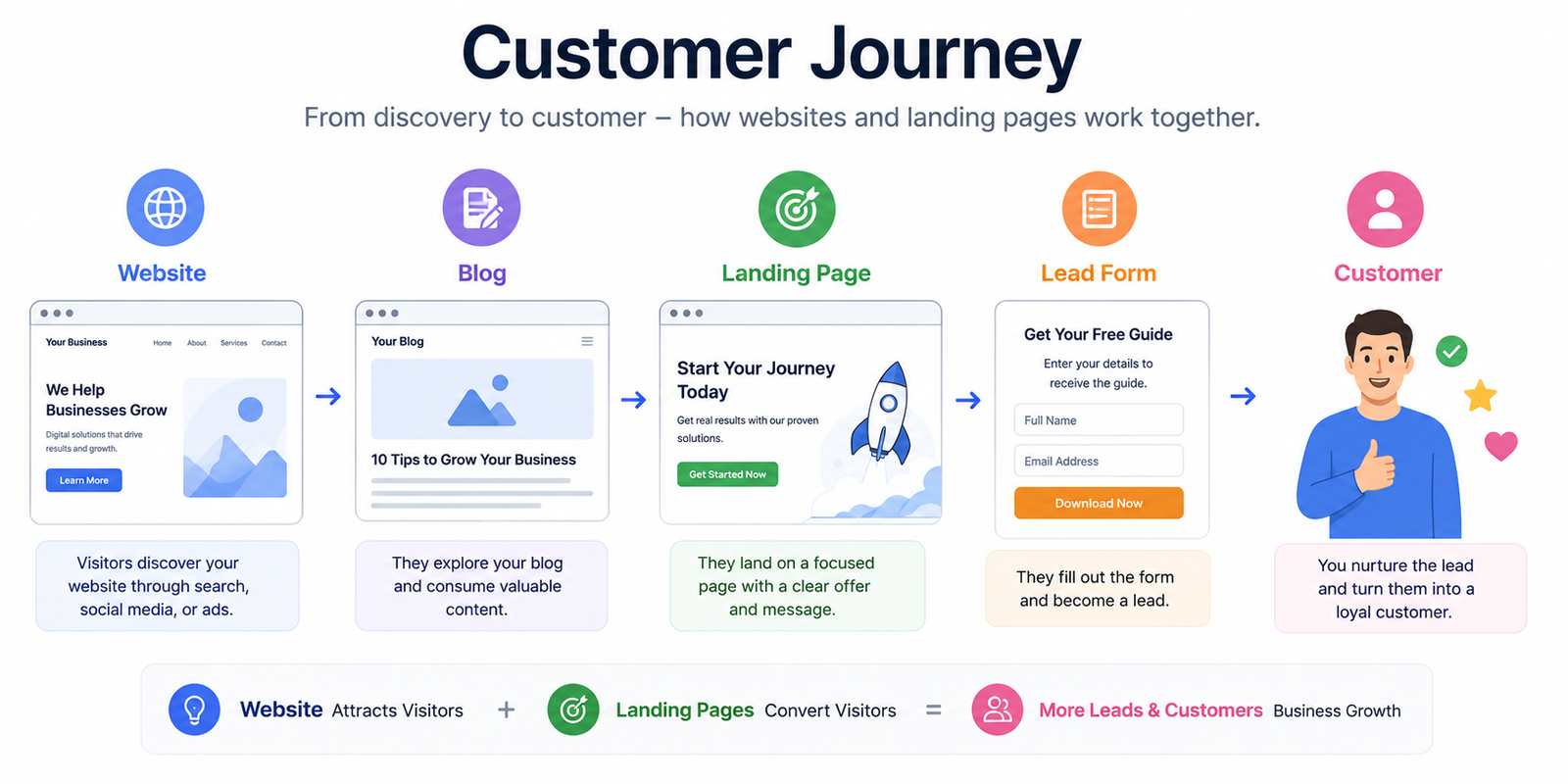
Think of your website as your online headquarters and your landing pages as focused marketing campaigns. Together, they create a better customer journey and improve your overall marketing results.
For example, your website can attract visitors through search engines, blog posts, service pages, and helpful resources. Once visitors become interested in a specific product or service, they can be directed to a dedicated landing page that removes distractions and encourages them to take the next step, such as requesting a quote, booking an appointment, or making a purchase.
This combination gives businesses the best of both worlds. Your website works continuously to build credibility and generate long-term organic traffic, while landing pages maximize the effectiveness of marketing campaigns by focusing on conversions. Rather than choosing one over the other, integrating both into your digital strategy often leads to better user experiences, higher conversion rates, and sustainable business growth.
Why They Work Better Together
- Your website builds credibility and trust.
- Your blog attracts organic traffic from Google.
- Landing pages convert visitors from ads and campaigns.
- Together, they generate more leads and sales.
Example
A digital marketing agency may have a website with pages like Home, Services, About, and Blog. When they run a Google Ads campaign for SEO services, they send visitors to a dedicated landing page focused only on booking a free consultation. This improves conversions while the website continues building long-term SEO and brand authority.
Landing Page vs Website for SEO
Search Engine Optimization (SEO) helps your pages appear in search results when people look for products, services, or information online. While both landing pages and websites can rank on Google, they play different roles in an SEO strategy. Understanding these differences allows you to build a stronger online presence while increasing traffic and conversions.
A website is generally designed for long-term organic growth. It contains multiple pages, blog posts, service pages, and internal links that help search engines understand your business. Landing pages, on the other hand, are usually built around one specific keyword, product, or campaign and are optimized to encourage visitors to take immediate action.
Which One Ranks Better?
In most situations, websites have a better chance of ranking because they provide more content, cover multiple topics, and continuously build authority over time. Search engines often reward websites that regularly publish helpful content and maintain a clear site structure.
A website can rank for hundreds or even thousands of different keywords, making it an excellent choice for businesses that want consistent organic traffic instead of relying solely on advertising.
Can a Landing Page Rank on Google?
Yes. A landing page can rank well when it's built around a specific search intent and provides valuable information. Optimizing the page title, headings, content, page speed, images, and metadata improves its chances of appearing in search results.
Landing pages often perform well for local services, product launches, event registrations, and location-specific keywords where visitors already know what they want.
When Should You Use Landing Pages for SEO?
Landing pages work best when targeting a single service, product, offer, or location. Because the content is highly focused, visitors are more likely to convert after arriving from Google Search or paid advertising campaigns.
- Local service pages.
- Product launch campaigns.
- Free trial or demo pages.
- Seasonal promotions.
- Location-based services.
Why Websites Win Long-Term SEO
Websites naturally grow over time. Every new blog article, service page, or case study creates another opportunity to rank for additional keywords. As your content library expands, search engines gain more confidence in your expertise, increasing your visibility across a wider range of searches.
This is why businesses investing in SEO usually prioritize building a content-rich website instead of relying only on standalone landing pages.
The Best SEO Strategy
The strongest digital marketing strategy combines both. Use your website to publish valuable content, answer customer questions, and attract organic traffic through search engines. Then guide interested visitors to dedicated landing pages where they can request a quote, book an appointment, start a free trial, or complete a purchase.
This approach allows your website to generate consistent traffic while your landing pages focus on converting that traffic into measurable business results. Instead of choosing between SEO and conversions, you benefit from both.
SEO Best Practice
Think of your website as the engine that attracts visitors through search engines and your landing pages as the destination that turns those visitors into customers. Businesses that combine both often achieve stronger SEO performance, higher conversion rates, and more sustainable long-term growth.
Landing Page vs Website for Conversions
Getting visitors to your website is only half the battle. The real goal is turning those visitors into leads or customers. This process is known as conversion, and it's where landing pages often outperform traditional websites.
Both landing pages and websites can generate conversions, but they do so in different ways. Understanding these differences helps you choose the right tool for your marketing campaigns.
Why Landing Pages Usually Convert Better
Landing pages are designed around one clear objective. With fewer distractions, a strong headline, persuasive content, and a single call-to-action, visitors are more likely to complete the desired action.
Why Websites Build More Trust
Websites allow visitors to explore your business, read testimonials, learn about your services, and view your portfolio or blog. This extra information builds confidence before someone decides to contact you or make a purchase.
Reduce Distractions
Every extra menu link, button, or page gives visitors another reason to leave. A focused landing page keeps attention on the primary action, increasing the likelihood of conversion.
Use Strong Calls-to-Action
Whether it's "Book a Free Consultation", "Get Started", or "Download Now", a clear and visible CTA helps guide visitors toward the next step.
Best Practice
Use your website to educate and build trust, then send visitors to a dedicated landing page whenever you want them to take a specific action. This combination often delivers the highest conversion rates.
Common Mistakes People Make
Whether you're building a landing page or a website, small mistakes can reduce traffic, lower conversions, and hurt your marketing efforts. Avoiding these common problems can significantly improve your results.
Sending Ad Traffic to the Homepage
Visitors from ads expect a page that matches the advertisement. Sending them to a generic homepage often reduces conversions.
Too Many Navigation Links
Every extra menu item or button gives visitors another reason to leave instead of completing your main goal.
Trying to Sell Everything
A landing page should promote one offer, not every product or service your business provides.
Ignoring Mobile Users
Most visitors browse on smartphones. A slow or poorly designed mobile experience can cost valuable leads.
Not Tracking Conversions
Without analytics, you won't know which pages, ads, or campaigns are generating results.
Building Without a Clear Goal
Every page should have a purpose. Decide whether you want visitors to learn, contact you, subscribe, or make a purchase.
Avoid This
The biggest mistake isn't choosing a landing page or a website—it's using the wrong one for your goal. Match your page to your marketing objective for the best results.
Which One Is Right for Different Businesses?
There's no one-size-fits-all answer. The best choice depends on your business goals, how you attract customers, and what action you want visitors to take. Here are some practical recommendations for different types of businesses.
Small Business
Start with a website to build trust and showcase your services. Use landing pages later for seasonal promotions, special offers, or advertising campaigns.
Freelancer
A portfolio website helps display your work and experience, while a landing page is ideal for promoting one service or collecting project inquiries.
Consultant
Build a professional website to establish authority, then use landing pages to generate consultation bookings or webinar registrations.
Coach
Use a website to share your story, testimonials, and resources. Create dedicated landing pages for coaching programs, workshops, or free discovery calls.
Restaurant
A website should include your menu, location, and contact details. Landing pages work well for special events, festive offers, and online reservations.
Real Estate
Maintain a website for property listings and company information, while using landing pages to promote individual properties or collect buyer leads.
Agency
An agency website builds credibility and showcases case studies. Landing pages are perfect for promoting specific services like SEO, PPC, or web design.
E-commerce Store
Your online store should be the primary website, while landing pages can increase sales for individual products, flash sales, and holiday campaigns.
SaaS Company
Use a website to explain features, pricing, documentation, and support. Create landing pages for free trials, product launches, and paid advertising campaigns.
Content Creator
A website helps organize your blog, videos, and resources, while landing pages are ideal for newsletter signups, digital products, online courses, or exclusive content.
Quick Recommendation
If your goal is long-term growth, SEO, and brand building, start with a website. If your goal is getting more leads or sales from a specific campaign, use a landing page. For most businesses, combining both delivers the best results.
Best Practices
Whether you're creating a landing page, building a complete website, or using both together, following proven best practices can significantly improve user experience, search engine visibility, and conversion rates. Small improvements in design, content, and performance often have a bigger impact than adding more features.
The goal isn't simply to publish a page—it's to create an experience that helps visitors find information quickly, trust your business, and confidently take the next step. The following practices are used by many successful businesses to improve both traffic and conversions.
Keep the Goal Clear
Every page should focus on one primary objective. If visitors don't immediately understand what they're supposed to do, they're more likely to leave without taking action. Whether your goal is generating leads, selling a product, booking appointments, or collecting email subscribers, make that objective obvious from the headline through the final call-to-action.
Avoid mixing multiple offers on the same page. A focused page is easier to understand and usually converts better than one trying to accomplish several goals at once.
Design for Mobile First
Mobile devices now account for a large share of web traffic. Your pages should be easy to read, load quickly, and allow visitors to complete actions comfortably on smaller screens.
Use readable font sizes, generous spacing, touch-friendly buttons, responsive layouts, and optimized images to create a smooth mobile experience.
Optimize Page Speed
Slow-loading pages frustrate visitors and often lead to higher bounce rates. They can also affect your search engine rankings since page speed is an important part of user experience.
Compress images, enable browser caching, minimize unnecessary scripts, reduce large media files, and choose reliable hosting to keep your pages fast and responsive.
Use Strong Calls-to-Action
Your CTA should clearly tell visitors what to do next. Instead of vague phrases like "Submit," use action-focused text such as "Get Your Free Quote," "Start Your Free Trial," or "Book a Consultation."
Position your CTA where visitors naturally expect it, use contrasting colors to make it stand out, and repeat it strategically throughout longer pages.
Build Trust with Social Proof
Visitors are more likely to trust your business when they see evidence that others have had positive experiences. Social proof reduces uncertainty and helps people feel confident about taking action.
Include customer testimonials, Google reviews, client logos, success stories, awards, certifications, media mentions, or case studies wherever appropriate.
Measure Everything
Even a well-designed page can be improved through data. Monitor traffic, bounce rates, conversions, form submissions, and visitor behavior to understand what's working and what needs improvement.
Regularly test different headlines, images, button text, layouts, and offers. Small improvements over time can produce significant increases in conversions without increasing your marketing budget.
Best Practices Checklist
- ✓ Give every page one clear purpose.
- ✓ Design for mobile users first.
- ✓ Keep loading times as fast as possible.
- ✓ Use strong, action-oriented CTAs.
- ✓ Build trust with reviews and testimonials.
- ✓ Track performance and improve continuously.
Real-World Examples
Different businesses have different goals, which means the right choice between a landing page and a website varies. Here are a few real-world examples to help you decide what works best.
A Local Dentist
A professional website helps patients learn about treatments, clinic hours, pricing, and contact information. A landing page is useful for promoting services like teeth whitening or free dental consultations through Google Ads.
An Online Course Creator
The website hosts course information, blog articles, and student resources, while dedicated landing pages are used to increase enrollments for individual courses or limited-time offers.
A Software Company
The website explains product features, pricing, documentation, and support. Landing pages focus on encouraging visitors to start a free trial, request a demo, or download the software.
A Clothing Store
An e-commerce website displays the complete product catalog, while landing pages promote seasonal sales, new arrivals, or exclusive discount campaigns.
A Freelance Designer
A portfolio website showcases previous work, testimonials, and services. A landing page can be created for a specific service, such as logo design or website design, to generate more client inquiries.
The Common Pattern
Successful businesses rarely rely on just one. They use a website to build trust, attract organic traffic, and showcase their brand, while using landing pages to convert visitors from advertising campaigns, email marketing, and special promotions.
Final Thoughts
Choosing between a landing page and a website isn't about deciding which one is better—it's about selecting the right tool for your business goals. Each serves a different purpose, and understanding when to use each one can significantly improve your marketing results.
If your priority is generating leads, promoting a single product, or running paid advertising campaigns, a landing page is often the most effective solution. Its focused design minimizes distractions and encourages visitors to take one specific action.
If your goal is to build credibility, attract organic traffic, showcase multiple services, or grow your brand over time, a website provides the flexibility and depth needed for long-term success.
A Simple Way to Remember
- ✓ Landing Page: Best for one campaign and one clear call-to-action.
- ✓ Website: Best for building your brand, SEO, and long-term growth.
- ✓ Use Both: The ideal strategy for most businesses that want more traffic, leads, and sales.
Whether you're a freelancer, small business owner, agency, online store, consultant, or startup, combining a well-designed website with high-converting landing pages gives you the best chance of attracting visitors, earning their trust, and turning them into loyal customers.