
Introduction
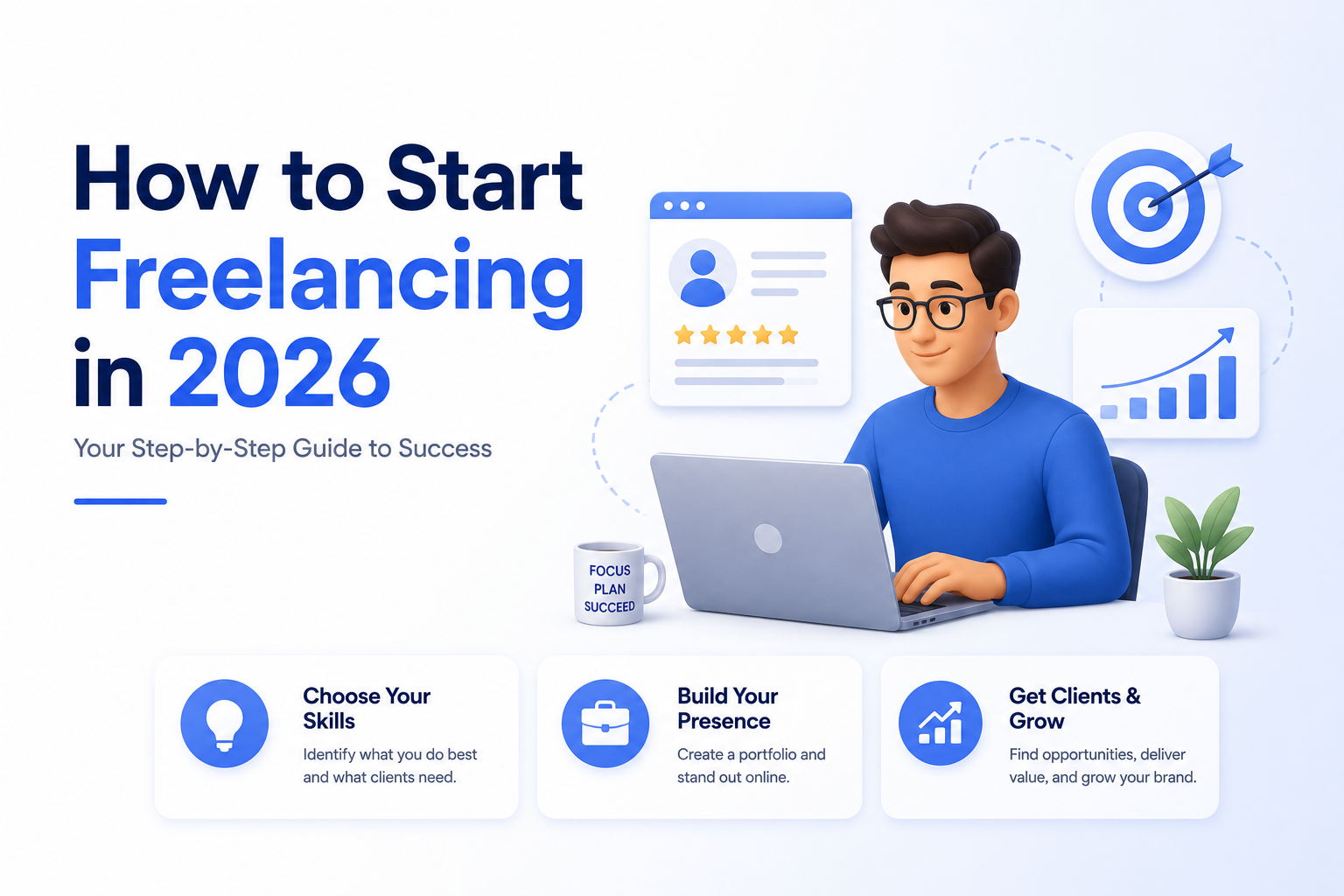
Freelancing has evolved from a side hustle into a legitimate career path for millions of professionals around the world. In 2026, businesses of every size are increasingly hiring independent specialists instead of building large in-house teams. Whether it's creating content, designing websites, managing social media, editing videos, improving SEO, or building AI-powered workflows, companies are looking for skilled freelancers who can deliver results quickly and efficiently. This shift has created more opportunities than ever for people who want greater flexibility, control over their income, and the freedom to work with clients from anywhere.
Many beginners assume they need years of experience, an impressive resume, or dozens of client testimonials before they can start freelancing. In reality, most successful freelancers begin with a single valuable skill, a small portfolio of practice projects, and a willingness to keep learning. Clients care far more about whether you can solve their problems than whether you've worked at a famous company. By developing practical skills, demonstrating your abilities through real examples, and communicating professionally, it's entirely possible to land your first freelance client even if you're starting from scratch.
At the same time, freelancing in 2026 is more competitive than ever. Artificial intelligence is changing the way work gets done, remote collaboration has become the norm, and clients have access to talented professionals from around the world. Rather than replacing freelancers, these changes reward those who continuously improve their skills, embrace new technology, build a personal brand, and consistently deliver high-quality work. The freelancers who succeed are the ones who treat their services like a business rather than simply completing individual tasks.
This guide will walk you through every stage of the freelancing journey—from choosing your first skill and building a portfolio to finding clients, writing proposals, setting your rates, using AI responsibly, and turning one successful project into a long-term freelance business. Whether you're a student, a working professional looking for extra income, or someone planning to become a full-time freelancer, you'll learn practical strategies that can help you move confidently from complete beginner to landing your first client.
What Is Freelancing?
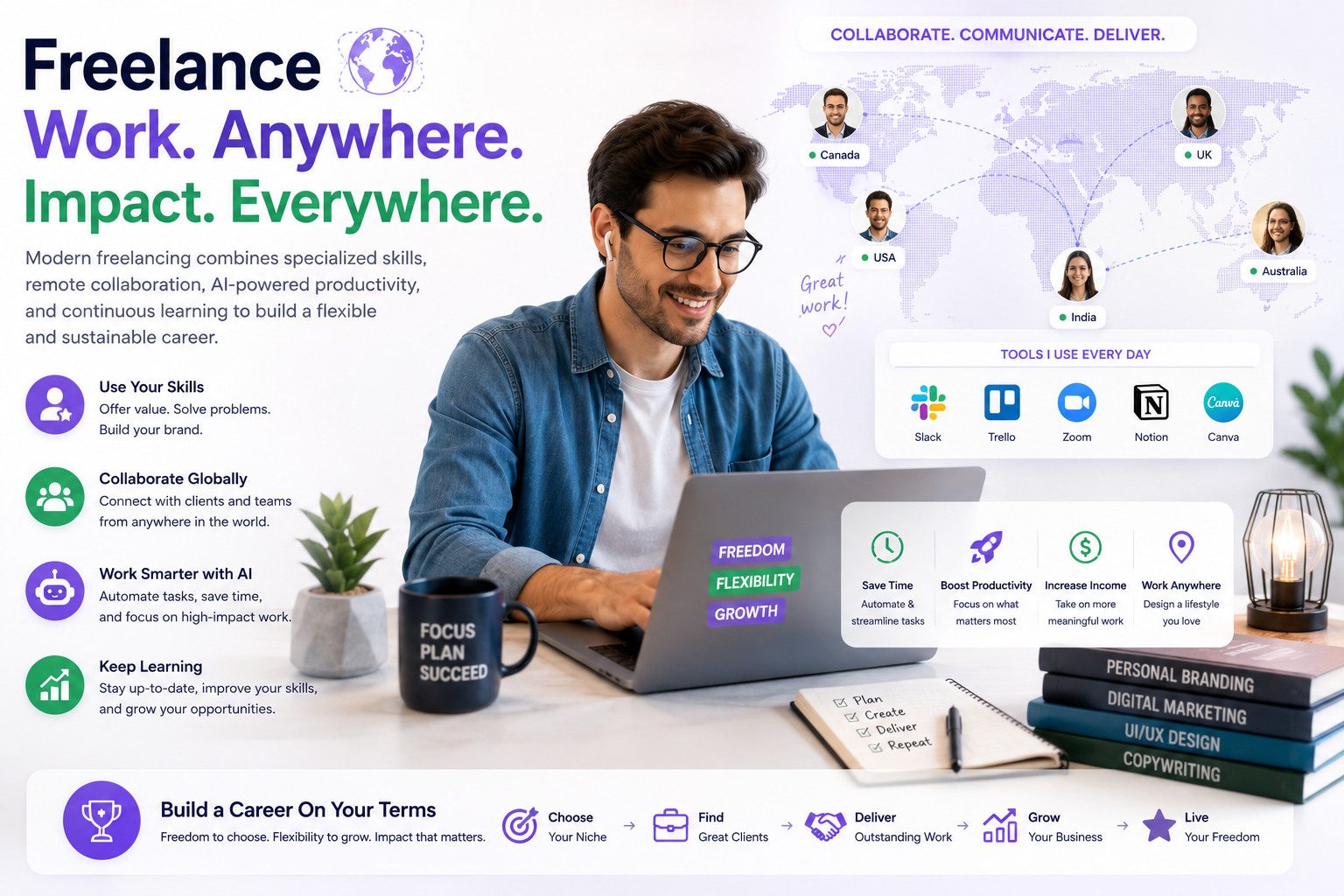
Freelancing is a way of working where you offer your skills or services directly to clients instead of being employed by a single company. Rather than receiving a fixed monthly salary, freelancers earn income by completing projects, providing ongoing services, or working under long-term agreements with multiple clients. This flexibility allows freelancers to choose the type of work they enjoy, decide who they work with, and often determine their own schedule and pricing.
Today's freelancers work across almost every industry, including writing, graphic design, web development, digital marketing, video editing, consulting, accounting, AI automation, and many other specialized fields. Some work independently from home, while others collaborate remotely with businesses around the world. Regardless of the service they provide, successful freelancers focus on solving problems and delivering measurable value to their clients.
How Freelancers Make Money
Unlike traditional employment, freelancers can earn money in several different ways depending on the services they offer and the clients they work with. Some charge by the hour, others charge a fixed fee for each project, while experienced freelancers often move toward value-based pricing or recurring monthly retainers. As their reputation grows, many also create additional income streams through digital products, consulting, online courses, or subscription-based services.
| Income Model | Best For |
|---|---|
| Hourly Rate | Ongoing support, consulting, and time-based work. |
| Fixed Project Price | Websites, logos, articles, videos, and one-time projects. |
| Monthly Retainer | Long-term services such as SEO, content marketing, or social media management. |
| Value-Based Pricing | Projects where your work directly helps clients increase revenue or save significant time. |
Freelancer vs Employee vs Entrepreneur
Although these career paths can overlap, they are not the same. Employees earn a regular salary while following company policies and schedules. Freelancers provide specialized services to multiple clients and have greater flexibility over how they work. Entrepreneurs build businesses, products, or teams that can continue operating independently of their direct involvement. Many successful freelancers eventually grow into entrepreneurs by building agencies, hiring team members, or creating scalable digital products.
| Employee | Freelancer | Entrepreneur |
|---|---|---|
| Works for one employer. | Works with multiple clients. | Builds a business or company. |
| Fixed salary. | Flexible income based on projects or services. | Income comes from business growth and systems. |
| Limited control over work. | Chooses clients, pricing, and schedule. | Creates products, services, and teams to scale. |
Is Freelancing Still Worth It in 2026?
Yes—but freelancing has changed significantly over the past few years. Businesses are no longer hiring freelancers simply because they cost less than full-time employees. Instead, they want specialists who can solve problems quickly, communicate effectively, and deliver measurable results. Companies increasingly rely on remote professionals for marketing, software development, design, customer support, content creation, video production, and AI implementation, making freelancing a practical career option for people with valuable skills and a professional approach.
At the same time, competition has increased because clients can now hire talented freelancers from almost anywhere in the world. This means succeeding in 2026 isn't about offering every possible service—it's about becoming known for solving a specific problem better than others. Freelancers who continue learning, adapt to new technology, build trust through their work, and consistently deliver quality are far more likely to build long-term careers than those relying only on low prices or outdated skills.
What's Changing in Freelancing?
| Trend | Why It Matters |
|---|---|
| Remote-First Businesses | Companies increasingly hire freelancers regardless of location, creating access to a global client base. |
| AI-Assisted Work | AI helps professionals work faster, but clients still expect human creativity, strategy, communication, and quality control. |
| Specialized Services | Specialists often attract better clients than freelancers who try to offer every possible service. |
| Personal Branding | Clients frequently review portfolios, websites, and social profiles before deciding whom to hire. |
| Results Over Experience | Demonstrating your ability to solve problems often matters more than the number of years you've been freelancing. |
Will AI Replace Freelancers?
Artificial intelligence has transformed many freelance workflows by making research, brainstorming, drafting, automation, and repetitive tasks faster. However, clients don't hire freelancers simply to generate content—they hire them to understand business goals, solve unique challenges, communicate clearly, make informed decisions, and deliver reliable outcomes. AI is becoming a powerful productivity tool, but it still depends on human judgment, creativity, and expertise to produce work that truly meets a client's needs.
Rather than viewing AI as competition, successful freelancers are learning how to use it responsibly to improve efficiency while focusing their own time on strategy, problem-solving, quality assurance, and building stronger client relationships. Those who combine technical skills with AI-assisted productivity are likely to have a significant advantage in the years ahead.
Step 1 — Choose a Freelance Skill
Every successful freelance career begins with one valuable skill. One of the biggest mistakes beginners make is trying to offer everything at once, believing that more services will attract more clients. In reality, clients usually prefer specialists who solve a specific problem rather than generalists who claim to do everything. Choosing one primary service allows you to learn faster, build a stronger portfolio, improve your marketing, and become easier for potential clients to remember.
Your first freelance skill doesn't have to be perfect or permanent. Many experienced freelancers started with one service and expanded later as they gained confidence and experience. The goal is to become genuinely good at solving one problem before adding additional services. A focused approach makes it easier to find clients, improve your expertise, and increase your rates over time.
Popular Freelance Skills in 2026
| Skill | Typical Clients | Beginner Friendly |
|---|---|---|
| Content Writing | Blogs, businesses, agencies | ★★★★★ |
| SEO | Businesses, publishers, agencies | ★★★★☆ |
| Social Media Management | Brands, creators, local businesses | ★★★★★ |
| Graphic Design | Startups, agencies, businesses | ★★★★☆ |
| Video Editing | Creators, YouTubers, brands | ★★★☆☆ |
| Web Development | Businesses, startups, agencies | ★★★☆☆ |
| Virtual Assistance | Entrepreneurs, executives | ★★★★★ |
| Email Marketing | Online businesses, SaaS companies | ★★★★☆ |
| Digital Advertising | E-commerce, agencies, local businesses | ★★★☆☆ |
| AI Automation | Businesses looking to improve productivity | ★★★☆☆ |
Choose One Primary Skill and One Supporting Skill
Instead of learning five different services at the same time, build your freelance business around one core skill and one complementary skill. Your primary skill becomes the service clients hire you for, while your supporting skill helps you deliver better results and increases the value of your work. This combination makes your service more attractive without overwhelming you as a beginner.
| Primary Skill | Supporting Skill | Why It Works |
|---|---|---|
| SEO | Content Writing | Optimize and create search-friendly content. |
| Video Editing | Motion Graphics | Deliver more engaging videos. |
| Web Development | UI/UX Design | Build websites that look and perform better. |
| Social Media Management | Graphic Design | Create complete social content for clients. |
| AI Automation | No-Code Tools | Deliver complete workflow automation solutions. |
Step 2 — Learn Your Skill
Choosing a freelance skill is only the beginning. The next step is developing enough practical knowledge to confidently solve real client problems. You don't need a university degree or years of professional experience before you start freelancing, but you do need a solid understanding of your chosen skill and the ability to produce work that meets professional standards. Clients care far more about the quality of your results than where or how you learned the skill.
Learning should focus on practical application rather than endless preparation. Many beginners spend months watching tutorials without ever creating anything. The fastest way to improve is by combining learning with action—study a concept, apply it immediately, identify mistakes, improve your work, and repeat the process. Every completed project teaches lessons that theory alone never can.
Free vs Paid Learning Resources
Both free and paid resources can help you build valuable skills. Free tutorials, documentation, blogs, podcasts, and YouTube videos are excellent for understanding fundamentals and staying updated with industry trends. Paid courses often provide a more structured learning path, assignments, downloadable resources, and community support that can help you progress faster. The best option depends on your learning style, budget, and commitment—not the price of the course.
| Free Resources | Paid Resources |
|---|---|
| YouTube tutorials, blogs, official documentation, podcasts, community forums, and practice websites. | Structured online courses, mentorship programs, bootcamps, certification programs, and premium communities. |
Practice Through Personal Projects
You don't need paying clients to begin building experience. Create personal projects that demonstrate your ability to solve realistic problems. Write blog articles, design logos for fictional companies, build sample websites, edit practice videos, optimize public websites for SEO, create marketing campaigns, or automate simple business workflows. These projects become valuable portfolio pieces while helping you gain confidence before working with real clients.
Build Proof Before You Build a Client List
One of the smartest things you can do before landing your first client is create visible proof of your skills. Publish your work on a portfolio website, LinkedIn, Behance, GitHub, Dribbble, Medium, or your own blog depending on your profession. You can also share case studies, before-and-after improvements, walkthrough videos, or educational posts on social media. Clients often research freelancers before making contact, and seeing consistent, high-quality work builds trust long before the first conversation begins.
How Do You Know You're Ready?
Many beginners believe they need to know everything before charging for their services, but that's rarely true. You're ready to start when you can complete real projects independently, explain your decisions clearly, meet reasonable quality standards, and confidently solve the type of problems your target clients are hiring for. Every freelancer continues learning throughout their career, so don't wait for perfection before taking action.
Signs You're Ready to Start Freelancing
- ✓ You can complete projects without following step-by-step tutorials.
- ✓ You have at least 3–5 strong portfolio projects.
- ✓ You understand the common problems your clients face.
- ✓ You can explain your work and the value it provides.
- ✓ You're confident enough to keep learning while working with real clients.
Step 3 — Choose Your Niche
Learning a valuable skill is important, but knowing who you help is what separates successful freelancers from everyone else. A niche is the specific market or type of client you serve. Instead of marketing yourself to every business in every industry, focusing on a well-defined audience allows you to better understand their challenges, communicate more effectively, and position yourself as a specialist rather than a generalist.
Clients rarely search for someone who simply offers a service. They're usually looking for someone who understands their industry and can solve a particular problem. The more clearly you define your niche, the easier it becomes for potential clients to recognize that you're the right person for the job. A focused niche also helps you build stronger case studies, improve referrals, and increase your rates as your expertise grows.
Build Your Niche Around Four Questions
| Question | Example |
|---|---|
| Which industry do you want to work with? | Healthcare, restaurants, SaaS, e-commerce, education, real estate, fitness, finance. |
| Who is your ideal client? | Small business owners, startups, agencies, coaches, creators, local businesses. |
| What problem do they need solved? | More leads, better branding, improved SEO, faster websites, higher conversions. |
| Which service solves that problem? | SEO, web development, content writing, video editing, automation, design. |
Generalist vs Specialist
Clients often trust specialists because they understand the industry's unique challenges. Compare these two introductions:
❌ Generalist
"I provide social media marketing for everyone."
✅ Specialist
"I help local restaurants grow their business through Instagram content and short-form videos."
Examples of Strong Freelance Niches
| Service | Better Niche Positioning |
|---|---|
| SEO | SEO for local service businesses. |
| Content Writing | Blog writing for SaaS companies. |
| Video Editing | Short-form videos for YouTube creators. |
| Graphic Design | Brand identity for startups. |
| Web Development | WordPress websites for healthcare clinics. |
| AI Automation | AI workflow automation for small businesses. |
Don't spend weeks trying to find the "perfect" niche. Choose an industry you're interested in, understand the problems businesses in that industry face, and position your service as a clear solution. As you gain experience, you'll naturally refine your niche based on the clients you enjoy working with and the results you consistently deliver. A focused niche makes your marketing clearer, your portfolio stronger, and your freelance business easier to grow.
Step 4 — Build a Freelance Portfolio
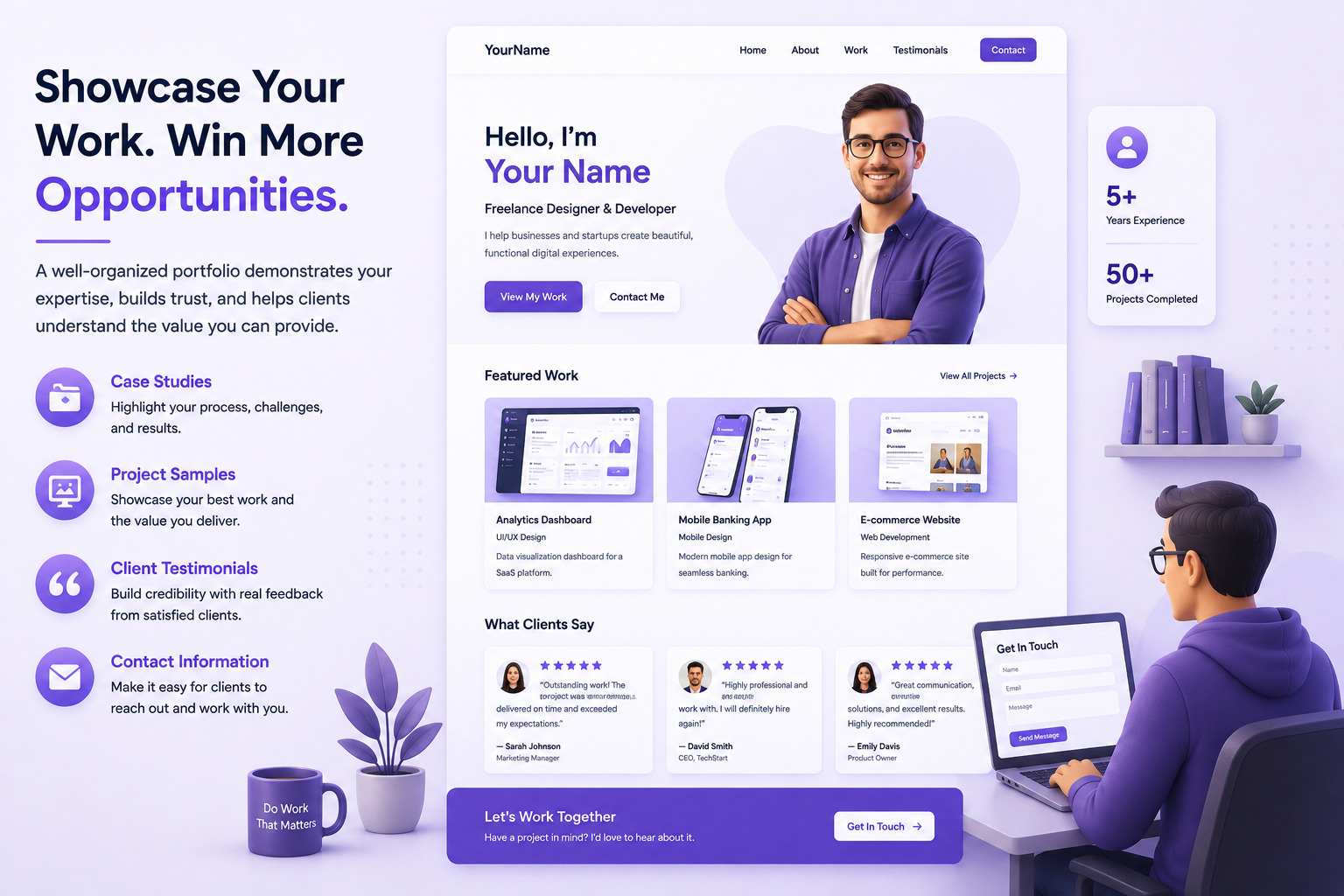
Your portfolio is often the first thing potential clients evaluate before deciding whether to contact you. It acts as proof of your skills, experience, and ability to solve real problems. While many beginners believe they need paid clients before creating a portfolio, that's not true. A strong portfolio can be built using personal projects, practice work, mock assignments, and detailed case studies that demonstrate your knowledge and professional approach. Clients are ultimately looking for confidence that you can deliver quality results, regardless of whether the work was completed for a paying customer or as a self-initiated project.
Focus on quality rather than quantity. Five outstanding portfolio projects that clearly explain the problem, your approach, and the final outcome are far more convincing than dozens of unfinished or low-quality examples. Every project should help a potential client understand not only what you created but also how your work adds value to a business.
What Should Your Portfolio Include?
| Portfolio Section | Why It Matters |
|---|---|
| About You | Briefly explain who you are, your specialization, and the type of clients you help. |
| Portfolio Projects | Show your strongest work with clear descriptions and visuals. |
| Case Studies | Explain the challenge, your solution, and the outcome for each project. |
| Skills & Tools | List the software, technologies, and platforms you use professionally. |
| Testimonials | Add client or mentor feedback whenever available to increase credibility. |
| Contact Information | Make it easy for potential clients to contact you. |
No Clients Yet? Create Your Own Projects
Waiting for your first client before building a portfolio can delay your freelance journey. Instead, create realistic projects that showcase your abilities. Redesign an existing website, optimize a public webpage for SEO, write blog articles, edit sample videos, design logos for fictional brands, build landing pages, create social media campaigns, or automate common business tasks. These projects demonstrate your practical skills and often become the work that attracts your very first paying clients.
| Freelance Skill | Sample Portfolio Project |
|---|---|
| SEO | Perform a complete SEO audit for a public website. |
| Content Writing | Write several in-depth blog articles on your chosen niche. |
| Graphic Design | Create a complete brand identity for a fictional business. |
| Video Editing | Produce a before-and-after edit demonstrating your editing style. |
| Web Development | Design and develop a responsive business website. |
| Social Media | Create a 30-day content calendar with sample posts. |
Turn Every Project Into a Case Study
Instead of simply uploading screenshots, explain the story behind each project. Describe the objective, the challenges involved, your process, the tools you used, and the final outcome. Clients appreciate understanding how you think because it helps them imagine how you'll approach their own projects. A well-written case study often creates more trust than displaying the final design alone.
Case Study Structure

Project Overview
        ↓
Client or Business Goal
        ↓
Problem or Challenge
        ↓
Your Solution
        ↓
Tools & Skills Used
        ↓
Final Result
        ↓
Key Takeaways
Where Should You Host Your Portfolio?
Your portfolio should be easy to access, mobile-friendly, and professionally presented. A personal website provides the greatest flexibility because you control the design, branding, and contact information. Depending on your profession, you can also showcase work on platforms such as Behance, Dribbble, GitHub, LinkedIn, Medium, or other industry-specific communities. Regardless of where it's hosted, keep your portfolio updated as your skills improve and replace older work with stronger projects over time.
Step 5 — Build Your Personal Brand
Many freelancers believe they should wait until they have paying clients before creating an online presence, but that's one of the biggest mistakes beginners make. In reality, your personal brand starts the moment you begin sharing your knowledge and work publicly. When potential clients search your name, they should immediately find evidence that you're skilled, active, and passionate about your profession. A strong personal brand helps build trust long before someone contacts you for a project.
Think of your social media profiles as an extension of your portfolio rather than a place for self-promotion. Every useful post, project breakdown, tutorial, design, article, or case study becomes another example of your expertise. Even if you haven't worked with a single client yet, consistently sharing valuable work demonstrates that you're serious about your career and continuously improving your skills.
Start Posting Before You Get Clients
Don't wait for permission to showcase your abilities. Share personal projects, redesign concepts, website improvements, SEO audits, blog articles, video edits, automation workflows, marketing ideas, or anything else that reflects your expertise. Clients are far more interested in seeing what you can do today than hearing promises about what you might be able to deliver in the future.
Show Proof Instead of Making Claims
Anyone can write "I'm an expert" in their profile, but very few people consistently publish work that proves it. Replace generic statements with screenshots, case studies, before-and-after improvements, short educational videos, design mockups, code snippets, writing samples, or practical demonstrations. The more visible proof you provide, the easier it becomes for potential clients to trust your abilities.
| Instead of Posting... | Share Something Like... |
|---|---|
| "I'm available for work." | A project walkthrough explaining the problem, your solution, and the final result. |
| "I'm learning SEO." | An SEO audit showing practical improvements for a real website. |
| "I edit videos." | A before-and-after editing comparison with your editing decisions explained. |
| "I'm a web developer." | A completed landing page with a short explanation of its design and functionality. |
Share Educational Content Consistently
Educational content is one of the fastest ways to build credibility. Share practical tips, answer frequently asked questions, explain common mistakes, discuss industry trends, or demonstrate how you solve problems. Over time, people begin associating your name with valuable information, making them more likely to trust you when they eventually need your services.
Choose One or Two Platforms
You don't need to be active on every social media platform. Focus on one or two platforms where your ideal clients spend time and publish consistently. Building a recognizable presence on a few platforms is far more effective than posting occasionally across many different networks.
| Platform | Best For |
|---|---|
| B2B services, consultants, marketers, developers, and business professionals. | |
| Designers, photographers, video editors, and content creators. | |
| X (Twitter) | Developers, founders, AI professionals, and marketers. |
| YouTube | Tutorials, case studies, software demonstrations, and educational content. |
| Bloggers, designers, educators, DIY creators, and businesses publishing evergreen content. |
Build Trust Before You Sell
Clients rarely hire someone after seeing a single post. Trust is built through consistent proof, valuable content, and professional communication over time. Every article you write, every project you complete, every tip you share, and every case study you publish strengthens your reputation. By the time a potential client reaches out, they should already have confidence in your expertise because they've seen your work repeatedly—not because you claimed to be an expert.
Step 6 — Set Your Freelance Rates
Pricing is one of the biggest challenges for new freelancers. Many beginners either charge too little because they lack confidence or set unrealistic prices without understanding the value they provide. Your rate should reflect the complexity of the work, the results you can deliver, the time involved, and the client's needs—not simply the number of hours you'll spend on a project. Remember that clients aren't buying your time alone; they're paying for your knowledge, problem-solving ability, experience, and the outcome you help them achieve.
Your pricing will naturally evolve as your skills, portfolio, and reputation grow. Rather than worrying about finding the perfect rate from the beginning, focus on delivering excellent work, collecting testimonials, improving your processes, and increasing the value you bring to clients. As demand for your services grows, your rates should grow with it.
Common Freelance Pricing Models
| Pricing Model | Best Used For | Advantages |
|---|---|---|
| Hourly Rate | Consulting, maintenance, ongoing support. | Easy to calculate and suitable for changing project scopes. |
| Fixed Project Price | Websites, branding, writing, design, video editing. | Clients know the total cost upfront and freelancers can earn more through efficiency. |
| Monthly Retainer | SEO, content marketing, social media management, ongoing services. | Creates predictable monthly income and stronger client relationships. |
| Value-Based Pricing | High-impact business projects that increase revenue or reduce costs. | Rewards expertise and focuses on business outcomes instead of time spent. |
Why Competing on Price Is a Mistake
Winning clients by being the cheapest often leads to difficult projects, unrealistic expectations, and lower profits. Price-sensitive clients usually compare freelancers based only on cost rather than quality or results. Instead of competing with hundreds of low-cost freelancers, focus on demonstrating your expertise, building a strong portfolio, communicating professionally, and clearly explaining the value your work provides. Clients who understand the benefits of your service are often willing to pay more for reliability and quality.
When Should You Increase Your Rates?
Your rates shouldn't remain the same forever. As you gain experience, complete successful projects, collect testimonials, improve your skills, and become more efficient, your pricing should reflect the additional value you provide. If clients regularly accept your proposals without negotiation, you're consistently booked in advance, or you've developed specialized expertise, these are strong signs that it may be time to review and increase your rates.
Signs You're Ready to Charge More
- ✓ You consistently deliver high-quality results.
- ✓ You have multiple positive client testimonials.
- ✓ New clients come through referrals or repeat business.
- ✓ You're booked weeks or months in advance.
- ✓ You've developed expertise in a specific niche.
- ✓ Your work produces measurable business results.
Step 7 — Create Your Freelancer Profile
Your freelancer profile is often the first impression potential clients have of your business. Before sending a message or scheduling a call, many clients review your profile to understand your expertise, communication style, portfolio, and professionalism. A well-structured profile should quickly answer three important questions: What do you do? Who do you help? Why should someone trust you? If these answers aren't immediately clear, clients may continue searching for another freelancer.
Instead of treating your profile like an online résumé, think of it as a sales page for your services. Every section should focus on how you solve client problems rather than simply listing your skills. A clear headline, professional photo, compelling bio, relevant portfolio, and strong call-to-action work together to increase trust and encourage potential clients to contact you.
Essential Elements of a Professional Freelancer Profile
| Profile Section | Why It Matters |
|---|---|
| Professional Headline | Clearly explain your specialty and the value you provide in one short sentence. |
| Profile Photo | A clear, professional photo helps build trust and makes your profile feel more authentic. |
| About Me | Explain who you help, the problems you solve, and what clients can expect when working with you. |
| Skills | Highlight your strongest skills and keep them relevant to the services you offer. |
| Portfolio | Showcase your best projects, case studies, and practical examples of your work. |
| Testimonials | Positive feedback from clients, mentors, or collaborators increases credibility and trust. |
| Services | Clearly list what you offer so clients immediately understand how you can help. |
| Call-to-Action | Encourage potential clients to contact you, schedule a consultation, or request a quote. |
Write a Client-Focused Headline
Your headline is one of the first things clients notice, so make it clear and benefit-driven. Instead of listing a generic job title, explain what you do and who you help. A specific headline instantly communicates your expertise and attracts the right type of clients.
| Generic Headline | Better Alternative |
|---|---|
| Graphic Designer | Graphic Designer Helping Startups Build Strong Brand Identities |
| SEO Expert | SEO Specialist Helping Local Businesses Generate More Organic Traffic |
| Video Editor | Video Editor Creating High-Retention Content for YouTube Creators |
| Web Developer | Web Developer Building Fast and Conversion-Focused Business Websites |
Focus on Results Instead of Features
Clients are usually less interested in the software you know and more interested in the outcomes you can deliver. Instead of filling your profile with technical jargon or long lists of tools, explain how your work helps businesses save time, increase sales, improve efficiency, strengthen their brand, or solve specific challenges. When your profile focuses on business results rather than features, it becomes much more persuasive.
Step 8 — Find Your First Freelance Clients
Finding your first client is often the most challenging part of freelancing, but it's also where many beginners overcomplicate the process. There isn't a single "best" place to get clients because every business looks for freelancers differently. Some companies post jobs on freelance marketplaces, while others hire through LinkedIn, referrals, social media, email outreach, or by discovering helpful content online. Instead of relying on one platform, build a client acquisition system that gives you multiple opportunities to be discovered.
The biggest mistake new freelancers make is creating a profile and waiting for clients to appear. Successful freelancers actively market themselves, build relationships, share valuable content, send personalized outreach messages, and continuously improve their visibility. The more places people can discover your work, the greater your chances of landing quality clients consistently rather than depending on luck.
Best Places to Find Freelance Clients
| Platform or Method | Best For | Why It Works |
|---|---|---|
| Upwork | Beginners and experienced freelancers | Thousands of businesses actively post freelance opportunities every day. |
| Fiverr | Productized freelance services | Clients search directly for specific services instead of posting projects. |
| B2B professionals and business owners | Great for networking, publishing content, and attracting inbound leads. | |
| Cold Email | Direct outreach to businesses | Allows you to contact companies before they advertise freelance jobs. |
| Social Media | Personal branding and lead generation | Consistent educational content builds trust and attracts potential clients. |
| Personal Network | Friends, colleagues, local businesses | Referrals often lead to your first paid opportunities. |
| Freelance Communities | Networking and collaboration | Communities frequently share projects, referrals, and advice. |
| Direct Outreach | Businesses that need improvement | Personalized outreach often faces less competition than public job listings. |
Don't Depend on a Single Platform
Building your freelance business on only one platform creates unnecessary risk. Algorithms change, marketplaces become more competitive, and client demand can fluctuate. Instead, create multiple ways for clients to discover you. Maintain an updated portfolio, stay active on professional social media, build relationships through networking, publish helpful content, and continue improving your online presence. Diversifying your client acquisition channels creates a more stable and sustainable freelance business.
Focus on Solving Problems, Not Selling Services
Businesses rarely wake up thinking, "I need to hire a freelancer." They think about problems they need solved—such as generating more leads, improving their website, increasing sales, creating better content, or saving time. Position yourself as someone who solves those problems instead of simply listing your services. When your messaging focuses on outcomes, potential clients immediately understand the value you bring.
Client Acquisition System

Build Your Portfolio
        ↓
Share Valuable Content
        ↓
Optimize Your Profile
        ↓
Network Consistently
        ↓
Apply for Relevant Projects
        ↓
Send Personalized Outreach
        ↓
Follow Up Professionally
        ↓
Land Your First Client
        ↓
Request Testimonials
        ↓
Generate Referrals & Repeat Business
Consistency Wins More Clients Than Luck
Finding freelance clients is rarely about sending one perfect proposal or publishing one viral post. It's the result of consistently improving your skills, sharing valuable work, reaching out to potential clients, building relationships, and following up professionally. Every portfolio update, educational post, networking conversation, and proposal increases your visibility and creates another opportunity for someone to discover your services. The freelancers who stay consistent are usually the ones who build long-term businesses.
Step 9 — Write Freelance Proposals That Get Responses
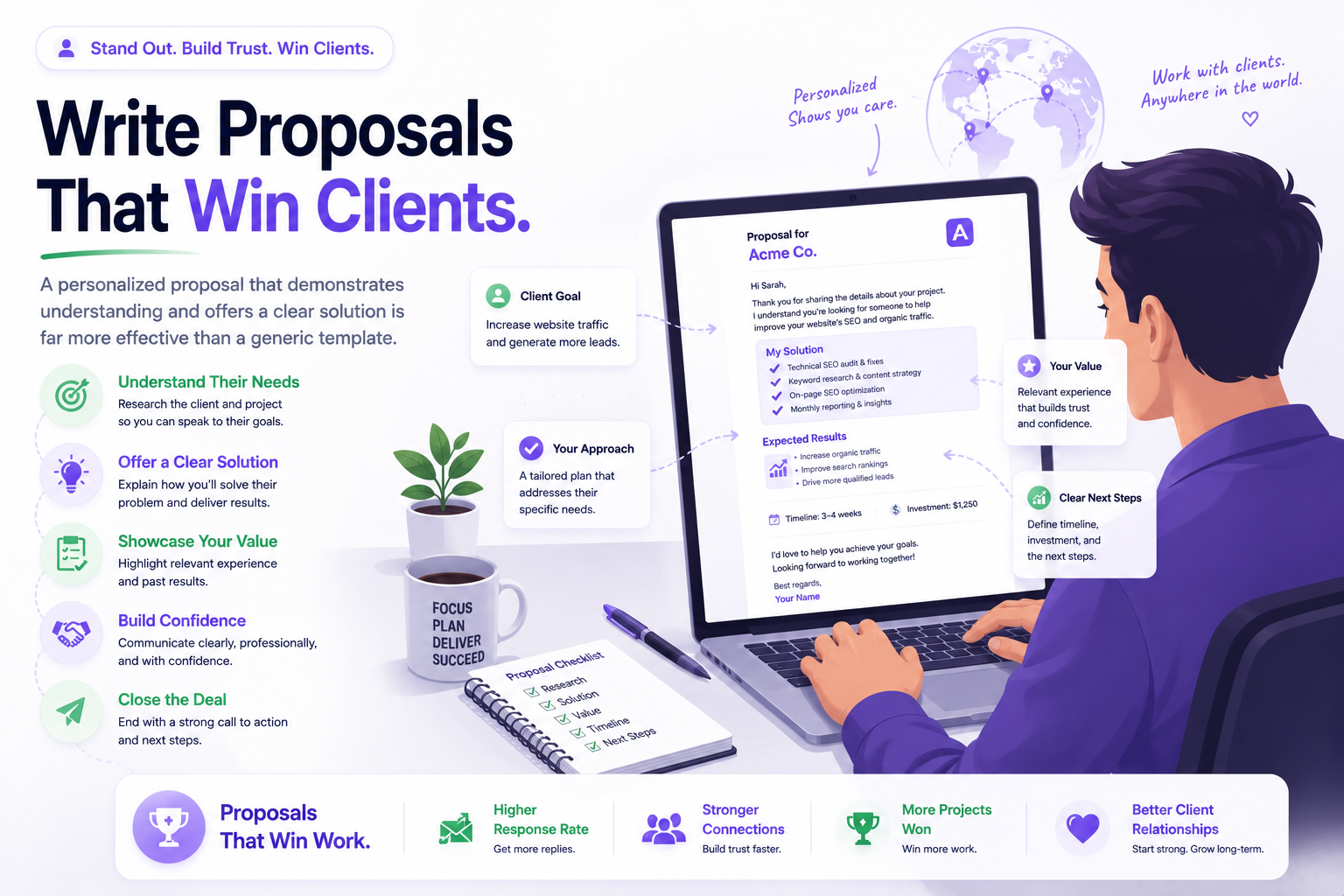
A strong portfolio helps clients trust your abilities, but a well-written proposal is often what convinces them to start a conversation. Many beginners lose opportunities because they send the same generic message to every job posting without demonstrating that they understand the client's business or goals. Clients receive dozens of proposals, so taking a few extra minutes to personalize your response can dramatically improve your chances of getting noticed.
Your proposal shouldn't focus on everything you've done in the past. Instead, it should explain that you understand the client's problem, briefly outline how you would approach the project, provide relevant proof of your abilities, and make it easy for the client to continue the conversation. A proposal is the beginning of a business relationship—not a complete sales presentation.
A Simple Proposal Structure
Understand the Client's Problem
                ↓
Show That You Understand It
                ↓
Explain Your Solution
                ↓
Share Relevant Proof
                ↓
Invite the Client to Continue the Conversation
What Makes a Proposal Stand Out?
| Weak Proposal | Strong Proposal |
|---|---|
| Generic copy-and-paste message. | Personalized for the client's business and project. |
| Talks mostly about yourself. | Focuses on the client's goals and challenges. |
| Lists every skill you have. | Highlights only the experience relevant to the project. |
| Ends without a clear next step. | Invites the client to discuss the project further. |
Personalization Matters
Before writing your proposal, spend a few minutes researching the client's business, website, social media presence, or project description. Mentioning something specific about their business immediately shows that you've invested time in understanding their needs rather than sending the same message to dozens of companies. Even a small observation can make your proposal feel more thoughtful and professional.
Use AI to Improve, Not Replace
AI writing assistants can help generate ideas, improve grammar, refine structure, and make proposals more concise. However, avoid sending AI-generated proposals without reviewing and personalizing them. Clients can often recognize generic responses, and they rarely create meaningful conversations. Use AI as an editing partner while ensuring your final proposal reflects your own understanding of the client's goals and your unique approach to solving their problem.
Step 10 — Deliver Your First Project Professionally
Winning your first client is an important milestone, but how you manage and deliver the project determines whether that client hires you again or recommends you to others. Professional freelancers don't simply complete tasks—they create a smooth experience from the first conversation to the final delivery. Clear communication, organized workflows, realistic timelines, and attention to detail often matter just as much as technical skills.
Every project is an opportunity to build your reputation. A satisfied client can become a long-term customer, leave a valuable testimonial, refer you to other businesses, or recommend your services within their network. Treat every project, no matter how small, as if it's the beginning of a long-term business relationship rather than a one-time transaction.
Start Every Project with Clear Expectations
Before beginning any work, make sure both you and the client clearly understand what will be delivered, when it will be completed, how communication will take place, and what is included in the agreed price. Misunderstandings about project scope are one of the most common reasons freelance projects become stressful. A written agreement helps both sides stay aligned throughout the project.
Keep Communication Professional
Clients appreciate freelancers who communicate consistently. Share progress updates, ask questions whenever requirements are unclear, and notify clients early if unexpected delays occur. Even when challenges arise, honest and timely communication builds confidence and demonstrates professionalism. Many clients continue working with freelancers they trust, even if occasional problems occur.
Meet Deadlines and Deliver Quality Work
Delivering projects on time while maintaining high quality is one of the fastest ways to build a strong freelance reputation. Before submitting your work, review everything carefully, test your deliverables where appropriate, and confirm that all agreed requirements have been completed. Taking a little extra time to perform quality checks can prevent unnecessary revisions and leave a much stronger impression on your client.
| Professional Habit | Why It Matters |
|---|---|
| Define the Project Scope | Prevents misunderstandings and unexpected requests. |
| Agree on Deadlines | Helps both you and the client plan effectively. |
| Communicate Regularly | Builds trust and reduces uncertainty throughout the project. |
| Review Your Work | Reduces mistakes and demonstrates professionalism. |
| Deliver Everything Clearly | Makes it easier for clients to review and approve the final work. |
Handle Feedback Professionally
Feedback is a normal part of freelance work and shouldn't be viewed as criticism. Listen carefully to your client's suggestions, ask clarifying questions if necessary, and approach revisions with a positive attitude. Responding professionally to feedback demonstrates that you're committed to delivering the best possible outcome rather than simply finishing the project as quickly as possible.
Ask for Testimonials and Referrals
After successfully completing a project and ensuring your client is satisfied, ask whether they would be willing to provide a short testimonial or review. Positive testimonials strengthen your portfolio, improve your credibility, and help future clients feel more confident about hiring you. Satisfied clients are also one of the best sources of referrals, making every successful project an opportunity to grow your business.
Professional Project Workflow

Client Agreement
        ↓
Define Scope & Timeline
        ↓
Begin Project
        ↓
Share Progress Updates
        ↓
Quality Review
        ↓
Deliver Final Work
        ↓
Receive Feedback
        ↓
Make Approved Revisions
        ↓
Request Testimonial
        ↓
Build Long-Term Relationship
Step 11 — Turn One Client Into Long-Term Work
Finding a new client usually takes far more time, effort, and marketing than keeping an existing one. That's why experienced freelancers don't treat every project as a one-time transaction. Instead, they focus on building long-term relationships by consistently delivering excellent work, communicating professionally, and looking for opportunities to provide additional value. One satisfied client can generate repeat projects, referrals, testimonials, and a predictable monthly income, making your freelance business far more stable than constantly searching for new clients.
The goal is to become more than someone who completes individual tasks. Position yourself as a trusted partner who understands the client's business, identifies new opportunities, and helps them achieve their long-term goals. When clients see you as someone who contributes to their success, they are much more likely to continue working with you instead of searching for another freelancer every time they need help.
Ways to Build Long-Term Client Relationships
| Strategy | Benefit |
|---|---|
| Deliver Beyond Expectations | Small improvements and attention to detail leave a lasting impression. |
| Communicate Regularly | Builds trust and keeps clients informed throughout every project. |
| Offer Monthly Retainers | Creates recurring income while providing ongoing support to clients. |
| Recommend Additional Improvements | Shows initiative and helps clients continue growing their business. |
| Follow Up After Delivery | Keeps relationships active and opens the door for future work. |
Offer Retainer Packages
Instead of completing one project and moving on, think about services your client will continue needing every month. Businesses regularly require fresh content, website maintenance, SEO improvements, social media management, advertising support, email marketing, analytics reporting, and design updates. Packaging these services into a monthly retainer creates predictable income for you while giving clients consistent support without searching for a new freelancer every time.
| One-Time Project | Possible Monthly Service |
|---|---|
| Website Development | Website maintenance, updates, backups, and security monitoring. |
| SEO Audit | Ongoing SEO optimization and monthly reporting. |
| Logo Design | Complete branding support and future marketing materials. |
| Video Editing | Weekly YouTube Shorts, Instagram Reels, or promotional videos. |
| Content Writing | Monthly blog articles, newsletters, and website updates. |
Upsell and Cross-Sell Naturally
After completing a successful project, look for opportunities to provide additional value instead of immediately searching for another client. For example, after building a website, you could offer SEO optimization, website maintenance, speed improvements, analytics setup, blog management, or conversion optimization. These recommendations should always solve genuine business problems rather than simply increasing your invoice. Clients appreciate freelancers who proactively identify ways to improve their business.
Stay in Touch Even After the Project Ends
Many freelancers disappear after delivering a project, missing opportunities for repeat work. A simple follow-up message after a few weeks or months can strengthen relationships and remind clients that you're available whenever they need additional support. Sharing useful ideas, industry updates, or suggestions for improvement keeps you top of mind without feeling overly promotional.
Long-Term Client Growth

Deliver Outstanding Work
            ↓
Build Trust
            ↓
Request Testimonial
            ↓
Offer Ongoing Support
            ↓
Create Monthly Retainer
            ↓
Suggest New Opportunities
            ↓
Receive Repeat Projects
            ↓
Get Referrals
            ↓
Grow Predictable Income
Think Like a Business Partner
The most successful freelancers aren't remembered because they completed a task—they're remembered because they consistently helped businesses grow. Always look beyond the immediate project and think about the client's long-term goals. By solving problems, offering practical ideas, communicating professionally, and becoming someone clients can rely on, you'll spend less time searching for new work and more time building lasting relationships that support a sustainable freelance career.
How to Use AI as a Freelancer in 2026
Artificial intelligence has become one of the most valuable productivity tools for freelancers, but it's important to understand what it can and cannot do. AI doesn't replace creativity, strategic thinking, business experience, or client relationships. Instead, it helps eliminate repetitive tasks, speeds up research, generates ideas, improves workflows, and allows freelancers to spend more time solving complex problems. The freelancers who embrace AI responsibly can often complete projects faster, deliver more value, and serve more clients without sacrificing quality.
Think of AI as your assistant rather than your replacement. It can help you brainstorm ideas, organize information, draft content, write code, summarize meetings, and automate repetitive work, but every output should still be reviewed using your own expertise. Clients hire freelancers because they need judgment, communication, creativity, and business thinking—qualities that AI alone cannot provide. Your goal is to combine AI efficiency with human experience to deliver better results than either could achieve independently.
Practical Ways Freelancers Can Use AI
| Task | How AI Helps | Human Responsibility |
|---|---|---|
| Research | Summarizes information, explains concepts, and gathers ideas quickly. | Verify facts, check sources, and apply critical thinking. |
| Brainstorming | Generates ideas, headlines, campaign concepts, and creative directions. | Select the strongest ideas and adapt them to client goals. |
| First Drafts | Produces outlines, articles, emails, scripts, and documentation. | Edit, improve tone, verify accuracy, and add original insights. |
| Coding Assistance | Explains code, finds bugs, writes snippets, and speeds up development. | Test thoroughly, optimize performance, and ensure security. |
| Design Inspiration | Suggests layouts, color palettes, branding ideas, and visual concepts. | Create unique designs that match the client's identity. |
| SEO Research | Organizes keywords, content ideas, and optimization suggestions. | Validate search intent, competition, and search demand. |
| Client Communication | Drafts professional emails and improves writing clarity. | Personalize every message before sending. |
| Proposal Writing | Generates proposal structures and improves formatting. | Tailor proposals to each client's business and project. |
| Meeting Summaries | Summarizes discussions and extracts action items. | Confirm decisions and clarify anything that may be missing. |
| Automation | Automates repetitive workflows and routine business tasks. | Monitor workflows and ensure they continue working correctly. |
| Productivity | Saves time by handling repetitive and administrative work. | Use the extra time to improve quality and strengthen client relationships. |
| Quality Control | Reviews grammar, formatting, readability, and consistency. | Perform the final review and never submit AI-generated work without checking it. |
AI Makes You Faster—Not More Valuable
The biggest competitive advantage in 2026 isn't simply knowing how to use AI—it's knowing when not to rely on it. Businesses don't pay freelancers to generate generic content or automate every decision. They hire professionals who understand customers, solve business problems, communicate effectively, and make thoughtful decisions. AI can dramatically reduce the time spent on repetitive tasks, but your expertise, creativity, and judgment remain the qualities that clients truly value.
Key Takeaway
Use AI to automate repetitive work, speed up research, improve productivity, and generate ideas—but always rely on your own knowledge to review, refine, and deliver the final result. The most successful freelancers in 2026 won't compete against AI; they'll combine AI with human expertise to produce work that's faster, smarter, and more valuable for their clients.
Best Freelance Skills to Learn in 2026
One of the biggest advantages of freelancing is that you can build a career around almost any valuable skill. However, not every skill offers the same level of demand, earning potential, or long-term growth. As businesses continue investing in digital transformation, automation, online marketing, and remote collaboration, freelancers with practical, results-driven skills are expected to remain in high demand. Choosing the right skill can significantly influence the types of clients you attract, the projects you work on, and how quickly you're able to grow your freelance business.
The comparison below highlights some of the most sought-after freelance skills in 2026. Rather than chasing trends, focus on learning a skill that matches your interests, strengths, and long-term goals. Becoming highly skilled in one area is usually more valuable than having basic knowledge across many unrelated disciplines.
| Skill | Beginner Friendly | Demand | Income Potential | Remote Friendly |
|---|---|---|---|---|
| SEO | ★★★★★ | High | High | ✅ |
| Content Writing | ★★★★★ | High | Medium | ✅ |
| Copywriting | ★★★★☆ | High | High | ✅ |
| Graphic Design | ★★★★☆ | High | High | ✅ |
| UI/UX Design | ★★★☆☆ | High | Very High | ✅ |
| Video Editing | ★★★☆☆ | High | High | ✅ |
| Motion Graphics | ★★★☆☆ | High | Very High | ✅ |
| Web Development | ★★★☆☆ | Very High | Very High | ✅ |
| Mobile App Development | ★★☆☆☆ | Very High | Very High | ✅ |
| WordPress Development | ★★★★☆ | High | High | ✅ |
| Social Media Management | ★★★★★ | High | Medium-High | ✅ |
| Email Marketing | ★★★★☆ | High | High | ✅ |
| Google Ads | ★★★☆☆ | High | High | ✅ |
| Meta Ads | ★★★☆☆ | High | High | ✅ |
| AI Automation | ★★★☆☆ | Very High | Very High | ✅ |
| Data Analysis | ★★★☆☆ | High | Very High | ✅ |
| Cybersecurity | ★★☆☆☆ | Very High | Very High | ✅ |
| Virtual Assistance | ★★★★★ | High | Medium | ✅ |
Which Freelance Skill Should You Choose?
The highest-paying skill isn't always the best choice for everyone. Consider your interests, learning curve, available time, and the type of work you enjoy doing every day. A skill that keeps you motivated is far more likely to lead to long-term success than chasing a trend simply because it appears profitable. Many successful freelancers begin with beginner-friendly services such as content writing, SEO, WordPress, virtual assistance, or social media management before gradually expanding into higher-value specialties like AI automation, web development, or UI/UX design.
Pro Tip
Don't try to master every skill at once. Choose one primary skill, build a strong portfolio, get your first few clients, and then learn complementary skills that increase the value of your services. Specialists are usually easier to market, charge higher rates, and build stronger reputations than freelancers who offer everything.
How Much Can You Earn as a Freelancer?
One of the first questions aspiring freelancers ask is, "How much money can I earn?" The honest answer is that there is no fixed income because freelancing isn't a traditional job with a standard salary. Your earnings depend on the value you provide, the problems you solve, the quality of your clients, and how effectively you run your freelance business. Some freelancers earn a modest side income, while others build six or seven-figure businesses by specializing in high-demand services and working with premium clients.
Rather than focusing on income promises, concentrate on the factors you can control. Improving your skills, building a strong portfolio, choosing a profitable niche, delivering exceptional work, increasing your rates over time, and developing long-term client relationships will have a far greater impact on your income than simply working more hours. Successful freelancers treat their work as a business, not just a series of individual projects.
What Determines Your Freelance Income?
| Factor | How It Affects Your Income |
|---|---|
| Skills | Specialized, high-value skills generally command higher rates than general services. |
| Experience | Proven results, testimonials, and case studies increase client confidence and pricing power. |
| Niche | Serving a specific industry often leads to premium pricing and repeat business. |
| Client Quality | Businesses focused on long-term growth usually value expertise more than the lowest price. |
| Country | Client budgets and market demand vary across different countries and industries. |
| Pricing Model | Project-based, retainer, or value-based pricing can significantly increase earnings compared to hourly work. |
| Repeat Clients | Existing clients reduce marketing time and create a more stable income. |
| Monthly Retainers | Recurring services provide predictable monthly revenue and improve financial stability. |
| Business Systems | Efficient workflows, automation, referrals, and repeatable processes help you scale without constantly working longer hours. |
Freelance Income Formula
Freelance income isn't determined by a single project—it's the result of consistently attracting quality clients, charging appropriately, encouraging repeat business, and building recurring revenue. Instead of asking how much a freelancer earns, ask how many reliable systems they have in place to generate income month after month.
Income

Clients
    ×
Average Project Value
    ×
Repeat Business
    ×
Monthly Retainers

=
Freelance Revenue
Build a Business, Not Just an Income
Freelancers who rely entirely on finding a new client every month often experience inconsistent income. The most successful professionals focus on creating a sustainable business by improving client retention, increasing prices as their expertise grows, automating repetitive tasks, requesting referrals, and developing systems that generate opportunities consistently. This approach creates more predictable revenue and reduces the pressure of constantly searching for the next project.
Key Takeaway
There is no fixed earning limit in freelancing. Your income grows as your skills improve, your reputation strengthens, your client relationships deepen, and your business systems become more efficient. Focus on becoming valuable, delivering measurable results, and building long-term partnerships—the income naturally follows.
Common Freelancing Mistakes to Avoid
Every freelancer makes mistakes, especially in the beginning. The good news is that most of them are avoidable. By recognizing these common pitfalls early, you can build a stronger reputation, attract better clients, and grow your freelance business with fewer setbacks.
Trying to Learn Everything
Focus on mastering one valuable skill before expanding into additional services.
Charging Too Little
Competing only on price often attracts low-quality clients and limits long-term growth.
Having No Portfolio
Clients need proof of your abilities before they trust you with their projects.
Building a Weak Personal Brand
Regularly sharing your work and expertise helps clients discover and trust you.
Sending Copy-Paste Proposals
Personalized proposals demonstrate genuine interest and usually receive better responses.
Missing Deadlines
Delivering work on time is one of the fastest ways to earn trust and repeat business.
Poor Communication
Keep clients informed with regular updates and respond professionally throughout every project.
Ignoring Contracts
Always define the project scope, timeline, payment terms, and responsibilities in writing.
Depending on One Platform
Diversify your client sources through networking, referrals, content, and multiple platforms.
Not Asking for Testimonials
Positive client feedback builds credibility and helps you win future projects.
Never Increasing Your Prices
As your skills, experience, and demand grow, your pricing should grow as well.
Relying Completely on AI
AI is a powerful assistant, but your expertise, creativity, and final review remain essential.
30-Day Freelancing Action Plan
Starting a freelance career can feel overwhelming when you don't know where to begin. Instead of trying to do everything at once, follow this simple 30-day roadmap. Each week builds on the previous one, helping you develop valuable skills, create a professional online presence, attract potential clients, and land your first freelance opportunities.
Week 1 — Build Your Foundation
- Choose one freelance skill to focus on.
- Learn the fundamentals through quality learning resources.
- Practice daily by completing small personal projects.
Week 2 — Build Your Professional Presence
- Create a professional portfolio with your best work.
- Start building your personal brand by sharing useful content.
- Optimize your LinkedIn and other professional social profiles.
Week 3 — Start Finding Clients
- Reach out to potential clients through email and networking.
- Create professional profiles on freelance marketplaces.
- Write personalized proposals instead of using generic templates.
Week 4 — Deliver and Grow
- Attend discovery calls and client interviews confidently.
- Complete your first freelance projects professionally.
- Request testimonials from satisfied clients.
- Build long-term relationships to generate repeat work and referrals.
Success Tip
Don't wait until everything is perfect before taking action. Consistent progress over 30 days is far more valuable than spending months preparing without launching your freelance career. Learn, build, publish, apply, improve, and repeat.
Final Thoughts
Freelancing in 2026 offers more opportunities than ever before, but long-term success isn't built by chasing every trend or applying to hundreds of jobs. It starts with developing one valuable skill, consistently improving your expertise, and using that knowledge to solve real business problems. Clients don't hire freelancers simply because they know a particular tool—they hire professionals who deliver reliable results, communicate effectively, and make their businesses more successful.
Don't wait until you feel like an expert before taking action. Build proof through personal projects, create a portfolio that showcases your abilities, publish your work consistently, and continue learning from every project you complete. Every article you write, website you build, design you create, campaign you optimize, or client you help strengthens your reputation and opens the door to new opportunities.
Remember These Principles
- ✓ Master one valuable skill before expanding into others.
- ✓ Build proof of your abilities through a strong portfolio and case studies.
- ✓ Publish consistently to strengthen your personal brand and attract clients.
- ✓ Focus on solving business problems instead of simply selling services.
- ✓ Keep learning because industries, technology, and client expectations continue to evolve.
- ✓ Think long-term by building relationships rather than chasing one-time projects.
- ✓ Create systems for marketing, client acquisition, referrals, and recurring revenue instead of depending on luck.
Every successful freelancer started as a beginner with no clients, no testimonials, and plenty of uncertainty. What separates those who succeed is consistent action. Learn your craft, share your work, improve with every project, and treat freelancing like a real business from day one. If you stay committed to delivering value and continuously refining your skills and systems, you'll be well positioned to build a rewarding freelance career for years to come.