
Introduction: Why Every Business Needs a Sales Funnel
Many businesses invest significant time and money attracting visitors through Google, social media, paid advertising, or referrals, only to see very few of those visitors become paying customers. The problem usually isn't the traffic itself—it's what happens after someone lands on the website. Without a clear path that guides visitors toward taking action, most people leave without making a purchase, requesting a quote, or even joining an email list.
This is where a sales funnel makes the difference. Instead of expecting every visitor to buy immediately, a sales funnel gradually moves people from discovering your business to becoming interested, building trust, making a purchase, and eventually turning into loyal customers. Every stage is designed to answer questions, overcome objections, and encourage the next step.
One of the biggest misconceptions in online marketing is believing that visitors are ready to buy the first time they arrive on your website. In reality, most people compare options, read reviews, evaluate pricing, and think carefully before making a decision—especially when purchasing expensive products or professional services. A well-designed sales funnel nurtures that decision-making process instead of trying to force an immediate sale.
In this guide, you'll learn how a high-converting sales funnel works, the psychology behind each stage, how to build one from scratch, and the practical strategies businesses use to turn more visitors into leads and customers. Whether you're selling products, services, software, online courses, or digital downloads, the principles remain remarkably similar.
Whether you're a freelancer, consultant, agency owner, e-commerce seller, SaaS founder, coach, creator, or small business owner, this guide will help you understand how to create a sales funnel that doesn't just generate traffic—it generates meaningful business results.
What Is a Sales Funnel?
A sales funnel is a structured process that guides potential customers from discovering your business for the first time to becoming paying customers and, ideally, loyal repeat buyers. Rather than expecting visitors to make an immediate purchase, a sales funnel gradually builds awareness, trust, and confidence before asking them to take the next step.
Think of a sales funnel as a roadmap. At the top, many people discover your business through search engines, social media, advertisements, referrals, or other marketing channels. As they move through the funnel, some become interested, a smaller group begins evaluating your offer, and an even smaller percentage completes a purchase. After the sale, the journey continues by encouraging repeat purchases, referrals, and long-term customer relationships.
What a Sales Funnel Means
The word "funnel" describes how large numbers of visitors gradually become a smaller number of qualified leads and customers. Not everyone who visits your website is ready to buy, and that's perfectly normal. A good sales funnel helps people make informed decisions instead of pressuring them into making an immediate purchase.
Each stage has a specific purpose. Early stages educate and build awareness, while later stages focus on trust, proof, and helping customers feel confident about choosing your product or service.
Why Every Business Needs One
Without a sales funnel, businesses often rely on luck. Visitors arrive, browse a few pages, and leave without taking action. A well-designed funnel creates a clear path that encourages visitors to subscribe, request a quote, book a consultation, download a resource, or complete a purchase.
Whether you sell physical products, digital products, software, professional services, or online courses, a sales funnel helps turn casual visitors into paying customers more consistently.
How a Sales Funnel Differs from a Traditional Website
A traditional website usually provides information about your business, services, or products through multiple pages and navigation options. Visitors can explore freely, but they may also become distracted or leave without completing an important action.
A sales funnel is intentionally focused on a single goal. Instead of presenting numerous choices, each page encourages visitors to take one specific action before moving to the next step. This focused approach often leads to higher conversion rates because it reduces confusion and keeps visitors moving toward a clear objective.
| Traditional Website | Sales Funnel |
|---|---|
| Multiple navigation options and pages. | Guides visitors through one clear path. |
| Focuses on sharing information. | Focuses on generating conversions. |
| Visitors choose where to go next. | Each step encourages a specific action. |
| Can contain many distractions. | Removes unnecessary distractions. |
Examples of Sales Funnels in Everyday Business
Sales funnels aren't limited to online businesses. Local service providers, consultants, restaurants, gyms, agencies, and retail stores all use funnels in different ways. For example, a visitor might discover a landscaping company through Google, read customer reviews, request a free estimate, receive a personalized quote, hire the company, and later recommend it to friends. That entire journey is a sales funnel.
The exact pages and steps may vary between businesses, but every successful funnel shares the same objective: guiding the right people toward becoming satisfied customers through a simple, trustworthy, and well-planned experience.
How a High-Converting Sales Funnel Works
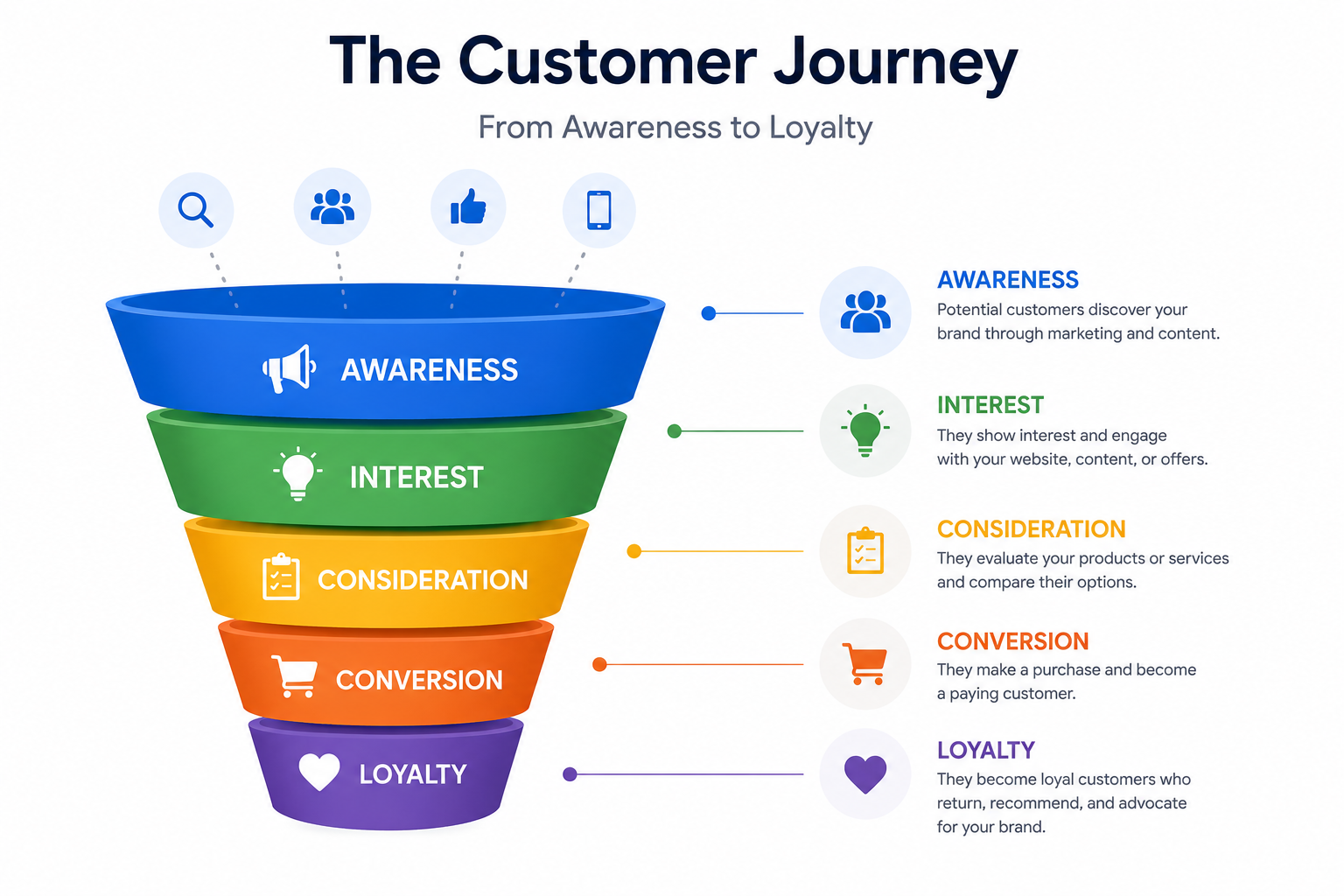
A successful sales funnel isn't about convincing every visitor to buy immediately. Instead, it guides people through a series of logical steps that build awareness, answer questions, establish trust, and reduce hesitation before asking for a purchase. Each stage serves a different purpose, and skipping one often leads to lower conversion rates.
Imagine opening a new coffee shop. You wouldn't expect someone walking past your store for the first time to instantly become a loyal customer. They might first notice your sign, then look at the menu, read reviews, try a drink, and eventually become a regular customer. A digital sales funnel follows the same principle.
Stage 1: Awareness
Every customer journey begins with awareness. At this stage, people discover your business through search engines, social media, YouTube videos, online advertisements, referrals, or other marketing channels. Most visitors aren't actively looking to buy—they're looking for information or solutions to a problem.
Your goal isn't to sell immediately. Instead, focus on capturing attention by providing useful content, answering common questions, or introducing a problem your product or service can solve.
Stage 2: Interest
Once visitors know your business exists, they begin evaluating whether it's relevant to their needs. They might explore your website, watch product demonstrations, read blog posts, browse customer reviews, or join your email list to learn more.
This is the ideal time to educate rather than sell aggressively. Helpful content builds credibility and encourages visitors to continue moving through the funnel.
Stage 3: Consideration
During the consideration stage, potential customers compare different options before making a decision. They're asking questions such as: Is this trustworthy? Does it solve my problem? Is it worth the investment? Why should I choose this over competing solutions?
Testimonials, case studies, product comparisons, FAQs, demonstrations, and transparent pricing all help reduce uncertainty and build confidence during this stage.
Stage 4: Conversion
Conversion is the point where a visitor takes the action you've been guiding them toward. Depending on your business, that action might be purchasing a product, booking a consultation, requesting a quote, starting a free trial, or subscribing to a membership.
Make this step as simple as possible. Remove unnecessary form fields, provide clear calls-to-action, display trust signals, and eliminate distractions that might cause visitors to abandon the process.
Stage 5: Loyalty and Repeat Customers
The sales funnel doesn't end after a purchase. Happy customers often become repeat buyers, recommend your business to others, and leave positive reviews that attract future customers. Building long-term relationships is usually more profitable than constantly finding new customers.
Continue delivering value through excellent customer support, helpful follow-up emails, loyalty programs, exclusive offers, educational resources, and consistent communication. A satisfied customer is much more likely to return than someone who only hears from you when you're trying to make another sale.
| Funnel Stage | Customer Goal | Your Goal |
|---|---|---|
| Awareness | Discover a solution. | Capture attention and introduce your brand. |
| Interest | Learn more about available options. | Educate and build trust. |
| Consideration | Compare products or services. | Demonstrate value and reduce objections. |
| Conversion | Make a confident buying decision. | Make purchasing quick, simple, and trustworthy. |
| Loyalty | Continue receiving value. | Encourage repeat purchases, referrals, and long-term relationships. |
Before Building Your Sales Funnel
Before designing landing pages or writing sales copy, it's important to build a strong foundation. Many sales funnels fail because businesses focus on software, page layouts, or marketing tactics before understanding who they're trying to reach and what problem they're solving. A successful funnel starts with strategy—not design.
Spending time planning your funnel can save countless hours later. When you clearly understand your audience, your offer, and your objective, every decision becomes easier—from writing headlines to choosing call-to-action buttons and creating follow-up emails.
Know Your Ideal Customer
Not everyone is your customer, and trying to appeal to everyone usually results in weak messaging. Start by defining exactly who your ideal customer is. Consider their age, profession, goals, challenges, experience level, budget, and the problem they're trying to solve.
The more specific you are about your audience, the easier it becomes to create offers and messaging that feel relevant and persuasive.
Define One Clear Goal
Every sales funnel should have one primary objective. Trying to achieve multiple goals on a single landing page often confuses visitors and reduces conversions. Decide what action you want someone to take before you begin building the funnel.
- Download a free guide.
- Book a consultation.
- Start a free trial.
- Request a quote.
- Purchase a product.
- Subscribe to your newsletter.
Once you've selected your primary goal, every page, headline, image, and button should support that single action.
Understand Customer Pain Points
People don't buy products simply because they exist—they buy solutions to problems. Understanding what frustrates your audience helps you position your offer as the answer they're looking for.
Ask yourself questions such as:
- What problem keeps my customers searching online?
- What goals are they trying to achieve?
- What concerns or objections might stop them from buying?
- What outcome do they ultimately want?
When your messaging speaks directly to these pain points, visitors are much more likely to continue through your funnel.
Research Your Competitors
Competitor research isn't about copying someone else's funnel. It's about understanding industry standards and identifying opportunities to create something better. Visit competitors' websites, subscribe to their email lists, analyze their landing pages, and study how they present their offers.
Pay attention to:
- Headlines and value propositions.
- Call-to-action buttons.
- Lead magnets and free offers.
- Customer testimonials and reviews.
- Pricing structure.
- Page layout and user experience.
The goal isn't to imitate their funnel but to identify areas where you can provide a clearer message, a stronger offer, or a better customer experience.
Step 1: Create an Irresistible Offer
The foundation of every high-converting sales funnel is the offer. You can have an attractive landing page, persuasive copy, and thousands of visitors, but if your offer doesn't solve a meaningful problem or provide enough value, your funnel will struggle to convert. Before thinking about headlines, colors, or call-to-action buttons, ask yourself one simple question: "Why should someone choose this instead of doing nothing or buying from a competitor?"
An irresistible offer isn't necessarily the cheapest option. It's the option that clearly communicates value, solves a specific problem, reduces risk, and makes the next step feel worthwhile. When visitors immediately understand what they'll gain, they're much more likely to continue through your funnel.
Solve One Specific Problem
Strong offers focus on solving one clear problem instead of trying to appeal to everyone. The more specific your solution is, the easier it becomes for potential customers to understand why it's relevant to them.
For example, an offer like "Improve Your Marketing" is broad and difficult to visualize. On the other hand, "Generate More Qualified Leads Using a One-Page Sales Funnel" immediately tells visitors what they'll achieve.
| Weak Offer | Strong Offer |
|---|---|
| Grow your business. | Build a sales funnel that converts more visitors into paying customers. |
| Learn digital marketing. | Learn how to generate qualified leads using organic SEO. |
| Website services. | Get a professional business website delivered within seven days. |
Increase the Perceived Value
Customers compare what they receive with what they have to invest. Increasing perceived value doesn't always mean lowering your price—it often means adding benefits that make your offer more attractive. Consider including bonuses, templates, downloadable resources, onboarding support, or extended customer assistance.
When people feel they're receiving more value than expected, hesitation naturally decreases.
Reduce Customer Risk
Every purchase involves uncertainty. Visitors may wonder whether your product will work, whether it's worth the investment, or whether they'll receive support if something goes wrong. Reducing these concerns increases confidence and makes purchasing decisions easier.
Depending on your business, you can reduce perceived risk by offering:
- Free trials or demo access.
- Money-back guarantees.
- Free consultations.
- Transparent pricing.
- Customer testimonials and case studies.
- Clear refund and support policies.
Make Your Value Proposition Clear
Visitors should understand your offer within a few seconds of landing on your page. Avoid vague marketing language and explain exactly what your product or service does, who it's designed for, and the outcome customers can expect.
A simple formula is: We help [target audience] achieve [desired result] without [common frustration]. This keeps your messaging clear, focused, and easy to understand.
Examples of Strong Offers
Great offers look different depending on the business, but they all solve a clear problem and provide immediate value.
| Business Type | Example Offer |
|---|---|
| Freelancer | Free 30-minute strategy consultation. |
| SaaS | 14-day free trial with no credit card required. |
| E-commerce | Free shipping and easy returns on every order. |
| Online Course | Complete course plus downloadable templates and lifetime updates. |
| Local Service Business | Free on-site inspection and personalized quote. |
Remember, people rarely buy because of features alone. They buy because they believe your offer will help them achieve a desired result or solve a frustrating problem. If you spend time creating an offer that's genuinely valuable, every other part of your sales funnel becomes significantly easier to optimize.
Step 2: Build a Landing Page That Converts
Once you have a compelling offer, the next step is presenting it in a way that encourages visitors to take action. This is the purpose of a landing page. Unlike a traditional homepage filled with menus, links, and distractions, a landing page focuses on a single objective—whether that's collecting leads, booking appointments, or completing a purchase.
Every section of your landing page should answer an important question visitors naturally have: What is this? Why should I care? Can I trust it? What should I do next? If your page answers those questions clearly, conversions usually improve.
Write a Powerful Headline
Your headline is usually the first thing visitors read. Within a few seconds, they should understand what you're offering and why it's valuable. A vague headline creates confusion, while a clear, benefit-focused headline encourages visitors to keep reading.
Instead of describing your product, focus on the outcome customers want to achieve.
| Weak Headline | Strong Headline |
|---|---|
| Professional Marketing Services | Generate More Qualified Leads with a High-Converting Sales Funnel |
| Website Design | Launch a Professional Business Website That Converts Visitors into Customers |
Focus on Benefits Instead of Features
Visitors care more about how your offer improves their lives than about technical specifications. Features describe what your product includes, while benefits explain how those features solve real problems.
| Feature | Benefit |
|---|---|
| Drag-and-drop editor | Build professional pages without writing code. |
| Email automation | Save time by automatically following up with new leads. |
| Mobile-responsive design | Deliver a great experience on every device. |
Add Social Proof
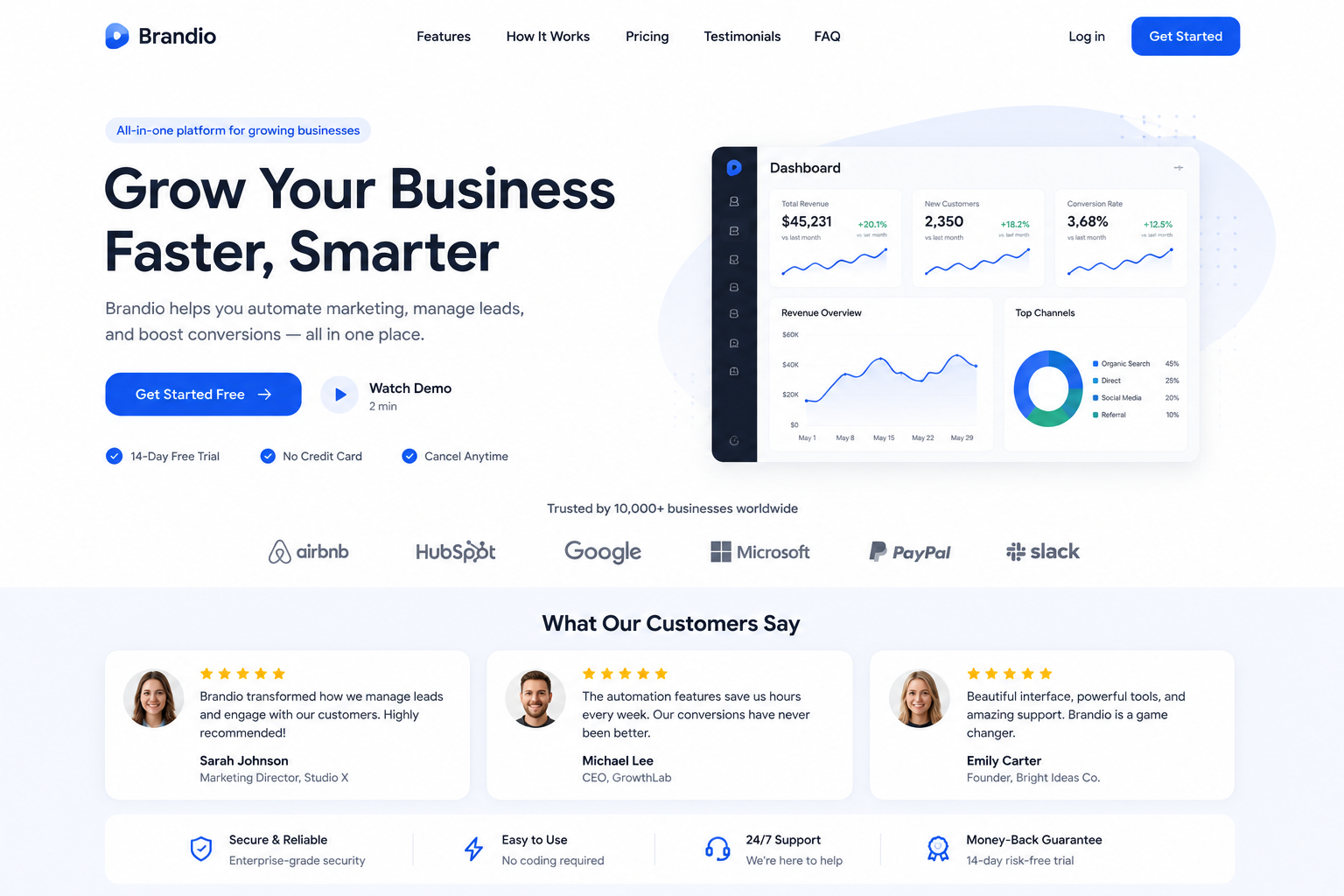
People naturally look for reassurance before making a purchase. Customer testimonials, reviews, case studies, client logos, success stories, and ratings help reduce uncertainty by showing that others have already benefited from your offer.
Whenever possible, include genuine testimonials with names, photos, or business information to make them more believable and trustworthy.
Use One Clear Call-to-Action
Every landing page should encourage visitors to complete one primary action. If your page asks people to subscribe, request a quote, download a guide, visit your blog, and follow your social media accounts simultaneously, visitors may choose none of them.
Keep your call-to-action visible throughout the page and use action-oriented wording such as:
- Start Your Free Trial
- Book Your Free Consultation
- Download the Free Guide
- Get My Custom Quote
- Create My Account
Remove Distractions
A landing page should keep visitors focused on one goal. Remove unnecessary navigation menus, unrelated links, sidebars, and promotional banners that encourage people to leave before completing the desired action.
Every section should naturally guide visitors toward your call-to-action without overwhelming them with choices. Simplicity often converts better than complexity.
| High-Converting Landing Page | Low-Converting Landing Page |
|---|---|
| One clear goal. | Multiple competing goals. |
| Strong headline focused on benefits. | Generic or confusing headline. |
| Clear call-to-action buttons. | No obvious next step. |
| Testimonials and trust signals. | No proof that the offer works. |
| Clean, distraction-free layout. | Too many links, menus, and pop-ups. |
Step 3: Capture Leads Before They Leave
One of the biggest mistakes businesses make is expecting every visitor to become a customer during their first visit. In reality, many people are still researching their options, comparing competitors, or waiting until the right time to make a purchase. If they leave without giving you a way to contact them, you may never have another opportunity to continue the conversation.
Lead generation solves this problem. Instead of focusing only on immediate sales, collect contact information from interested visitors so you can educate them, build trust, and guide them toward becoming customers over time.
Offer a Valuable Lead Magnet
A lead magnet is something valuable you give away for free in exchange for a visitor's contact information, usually an email address. The best lead magnets solve a specific problem quickly and naturally introduce your paid product or service.
Your lead magnet should be highly relevant to the audience you're trying to attract. Someone interested in website design probably won't download a fitness guide, but they may happily download a website planning checklist or conversion optimization template.
| Business Type | Example Lead Magnet |
|---|---|
| Marketing Agency | Free SEO Audit Checklist |
| Web Designer | Website Planning Workbook |
| SaaS Business | 14-Day Free Trial |
| Online Course Creator | Free Mini Course |
| Consultant | Free 30-Minute Strategy Session |
Keep Your Forms Short
Every additional field you ask visitors to complete increases the likelihood they'll abandon the form. Only request information you genuinely need at this stage. For most lead generation campaigns, asking for a first name and email address is enough.
If you need additional information, consider collecting it later after you've already established trust.
Make Your Call-to-Action Specific
Generic buttons like "Submit" or "Send" don't clearly communicate what happens next. Instead, use action-oriented text that reinforces the value visitors will receive.
- Download My Free Guide
- Get My Free SEO Checklist
- Start My Free Trial
- Book My Free Consultation
- Claim My Free Template
Offer Multiple Ways to Become a Lead
Different visitors prefer different ways of engaging with your business. While some are comfortable sharing their email address, others may prefer scheduling a call, requesting a quote, starting a live chat, or sending a message through WhatsApp. Providing multiple lead capture options can increase overall conversions without overwhelming visitors.
The key is offering choices that still support your primary business goal instead of distracting visitors with unrelated actions.
Respond Quickly
Capturing a lead is only the beginning. Responding promptly keeps prospects engaged while your business is still fresh in their minds. Whether it's an automated welcome email, a free download, or a personal follow-up call, delivering on your promise immediately helps build trust and encourages the next step in the sales funnel.
| Best Practice | Why It Improves Conversions |
|---|---|
| Offer a valuable lead magnet. | Gives visitors a compelling reason to share their contact information. |
| Keep forms short. | Reduces friction and increases completion rates. |
| Use benefit-focused CTA buttons. | Clearly explains what visitors receive. |
| Provide multiple contact options. | Accommodates different customer preferences. |
| Follow up immediately. | Maintains momentum and builds trust. |
Step 4: Build Trust Before Asking for the Sale
Even if someone is interested in your offer, they may still hesitate before making a purchase. Questions like "Can I trust this company?", "Will this actually work?", or "What happens if I'm not satisfied?" naturally arise before spending money. A high-converting sales funnel addresses these concerns before visitors have to ask them.
Trust isn't created by flashy designs or bold marketing claims. It's earned through transparency, proof, and consistently demonstrating that real customers have achieved real results. The more uncertainty you remove, the easier it becomes for visitors to move confidently toward becoming customers.
Showcase Customer Testimonials
Testimonials provide social proof by showing that other people have already benefited from your product or service. They help reduce skepticism and reassure potential customers that they're making a safe decision.
Whenever possible, include the customer's name, business, role, and a genuine photo or company logo. Authentic testimonials are significantly more persuasive than anonymous quotes.
Share Case Studies and Success Stories
While testimonials express opinions, case studies demonstrate measurable outcomes. Explain the customer's situation before using your solution, the steps you took, and the results they achieved. Concrete examples help visitors understand what they can realistically expect.
Instead of making broad claims like "Our service delivers amazing results," show exactly how a customer solved a problem, increased revenue, saved time, or improved efficiency.
Display Reviews and Ratings
Public reviews on trusted platforms help reinforce credibility because they're often viewed as independent opinions rather than marketing material. Positive ratings can reassure visitors that your business consistently delivers a good experience.
If your business has collected reviews on platforms like Google Business Profile, Trustpilot, or other industry-specific review sites, consider highlighting them on your landing page.
Add Trust Badges and Security Signals
Visitors are more comfortable sharing personal information or completing online payments when they see clear security indicators. SSL certificates, secure payment icons, privacy commitments, industry certifications, and recognized partner logos all contribute to a greater sense of confidence.
Trust badges should support your message rather than overwhelm it. Place them near forms, checkout buttons, or pricing sections where visitors are making important decisions.
Reduce Risk with Guarantees
Every purchase involves some level of perceived risk. A clear guarantee reassures customers that they're protected if your product or service doesn't meet expectations. Depending on your business, this could include a money-back guarantee, satisfaction guarantee, free revisions, or a risk-free trial period.
Guarantees don't just reduce fear—they demonstrate confidence in the value you're providing.
Answer Frequently Asked Questions
Visitors often leave a page because one unanswered question creates enough uncertainty to delay their decision. Including a frequently asked questions section helps address common concerns before they become obstacles.
Typical questions might include:
- How long does delivery take?
- Can I cancel anytime?
- Is customer support included?
- What's your refund policy?
- Do I need any technical experience?
- How quickly can I get started?
Trust Is Built Through Consistency
Every interaction with your business influences trust. Professional branding, clear communication, transparent pricing, responsive support, and delivering exactly what you promise all contribute to a positive customer experience. Trust isn't created by a single testimonial or guarantee—it's built through consistent actions across every stage of your sales funnel.
| Trust Element | Why It Works |
|---|---|
| Customer Testimonials | Demonstrate that real people achieved positive results. |
| Case Studies | Show measurable outcomes and practical success stories. |
| Reviews and Ratings | Reinforce credibility through independent customer feedback. |
| Trust Badges | Increase confidence during form submissions and checkout. |
| Money-Back Guarantee | Reduces perceived purchasing risk. |
| Frequently Asked Questions | Remove objections before they prevent conversions. |
Step 5: Optimize Your Checkout Process
Getting someone to add a product to their cart or click your call-to-action is a major achievement, but it doesn't guarantee a sale. Many businesses lose potential customers during the checkout process because it's confusing, time-consuming, or asks for more information than necessary. Every extra click creates another opportunity for visitors to leave without completing their purchase.
A high-converting checkout experience removes unnecessary friction. It should be fast, secure, easy to understand, and work seamlessly across desktop, tablet, and mobile devices. The goal is to help customers complete their purchase with as little effort as possible.
Keep Checkout Forms Short
Long forms often discourage customers from completing their purchase. Only request information that's absolutely necessary to process the order or deliver the service. Every unnecessary field increases the likelihood of abandonment.
If additional information is needed later, collect it after the purchase instead of delaying the checkout process.
Offer Multiple Payment Methods
Customers have different payment preferences. Limiting checkout to a single payment option can result in lost sales. Whenever possible, provide several secure payment methods that are popular with your target audience.
Credit cards, debit cards, digital wallets, online banking, and region-specific payment methods help reduce payment friction and improve completion rates.
Display Security and Trust Signals
Customers are more willing to complete a purchase when they know their personal and payment information is protected. Display SSL security indicators, secure payment logos, privacy assurances, and trusted payment providers near the checkout button.
Small trust signals often make a significant difference, especially for first-time customers who haven't purchased from your business before.
Remove Unnecessary Steps
Every additional page or confirmation screen creates another opportunity for customers to leave. Simplify your checkout by reducing unnecessary clicks, combining related steps where appropriate, and keeping the process easy to follow from beginning to end.
If possible, allow guest checkout so customers don't feel forced to create an account before making a purchase.
Optimize for Mobile Devices
A growing percentage of online purchases are completed on smartphones. Small buttons, difficult forms, slow loading pages, and poor mobile layouts can dramatically reduce conversions. Test your checkout process on multiple devices to ensure it's fast, responsive, and easy to complete with one hand.
Mobile-friendly checkout isn't optional—it's an essential part of delivering a positive customer experience.
Recover Abandoned Carts
Not every visitor who begins checkout will complete it immediately. Some become distracted, compare competitors, or simply need more time to decide. Cart abandonment doesn't always mean the sale is lost.
Consider using abandoned cart reminders through email or SMS to encourage customers to return. These messages often include helpful reminders, answers to common concerns, or limited-time incentives that motivate customers to complete their purchase.
| Checkout Best Practice | Benefit |
|---|---|
| Short checkout forms | Reduces friction and increases completion rates. |
| Multiple payment options | Accommodates different customer preferences. |
| Security badges | Builds trust during payment. |
| Guest checkout | Removes unnecessary barriers to purchase. |
| Mobile optimization | Improves conversions on smartphones and tablets. |
| Abandoned cart recovery | Recovers potential customers who didn't complete checkout. |
Step 6: Follow Up After the Sale
Many businesses believe the sales funnel ends when a customer completes a purchase. In reality, that's only the beginning of the relationship. The period immediately after a sale is one of the best opportunities to build trust, encourage repeat purchases, and turn first-time buyers into loyal customers. A thoughtful follow-up strategy not only improves customer satisfaction but also increases the lifetime value of every customer you acquire.
Instead of focusing only on acquiring new customers, successful businesses invest in keeping existing customers engaged. Selling to someone who already trusts your business is usually easier and more cost-effective than constantly finding new prospects.
Create a Helpful Thank You Page
Don't waste your thank you page with a simple confirmation message. Use it to reassure customers that their order or request has been received successfully and clearly explain what happens next. This helps reduce uncertainty and improves the overall customer experience.
A thank you page can also introduce helpful resources, onboarding guides, support information, or relevant product recommendations without overwhelming the customer.
Send a Welcome Email
Your first email should arrive shortly after the purchase or signup. Instead of immediately promoting another product, welcome the customer, thank them for choosing your business, explain what they can expect next, and provide useful information to help them get started.
A professional welcome email sets the tone for your relationship and demonstrates that your business continues providing value after the sale.
Help Customers Succeed
Customers are happiest when they quickly experience the value of what they purchased. Provide onboarding guides, video tutorials, documentation, FAQs, or personalized support that helps them achieve success as soon as possible.
When customers reach positive results quickly, they're far more likely to leave positive reviews, recommend your business, and purchase additional products in the future.
Introduce Relevant Upsells and Cross-Sells
Once customers are satisfied with their initial purchase, they may be interested in complementary products or premium services. The key is relevance. Recommend products that genuinely improve the customer's experience instead of presenting unrelated offers.
For example:
- A website design service could offer ongoing website maintenance.
- An online course could recommend an advanced training program.
- An e-commerce store could suggest matching accessories.
- A software company could introduce premium features or additional user licenses.
Ask for Reviews and Testimonials
Happy customers are often willing to leave a review if you simply ask. Positive reviews strengthen your credibility, improve social proof, and help future visitors feel more confident about choosing your business.
Request feedback after customers have had enough time to experience the value of your product or service rather than immediately after the purchase.
Encourage Long-Term Customer Relationships
Customer retention should be part of every sales funnel. Stay connected through helpful newsletters, educational content, exclusive offers, product updates, loyalty programs, or community events. Consistent communication keeps your business top of mind without feeling overly promotional.
Building lasting relationships creates repeat customers, generates referrals, and often delivers more sustainable growth than relying entirely on new customer acquisition.
| Follow-Up Activity | Purpose |
|---|---|
| Thank You Page | Confirm the purchase and explain the next steps. |
| Welcome Email | Build trust and help customers get started. |
| Onboarding Resources | Help customers achieve success quickly. |
| Upsells and Cross-Sells | Increase customer value with relevant recommendations. |
| Reviews and Testimonials | Build credibility and strengthen social proof. |
| Ongoing Communication | Encourage repeat purchases and long-term loyalty. |
Common Sales Funnel Mistakes That Reduce Conversions
Even businesses with excellent products can struggle to generate sales if their funnel contains avoidable mistakes. Small issues at different stages of the customer journey often combine to create significant conversion problems. Fortunately, most of these mistakes are easy to identify and fix once you know what to look for.
Instead of constantly increasing your advertising budget, improving your existing sales funnel can often produce better results. Fixing conversion bottlenecks helps more visitors become customers without requiring additional traffic.
Driving Traffic Without a Clear Strategy
Many businesses spend money on SEO, paid advertising, or social media before creating a proper sales funnel. Visitors arrive, browse a few pages, and leave because there's no clear path guiding them toward the next step.
Before investing in traffic, make sure your landing pages, lead generation process, and follow-up system are already working effectively.
Weak or Confusing Headlines
Your headline determines whether visitors continue reading or leave within a few seconds. Generic statements rarely communicate value. Instead, clearly explain what problem you solve and the outcome customers can expect.
A strong headline should immediately answer the question, "Why should I care?"
Too Many Calls-to-Action
Asking visitors to subscribe, contact you, download a guide, follow your social media, browse your blog, and purchase a product on the same page creates decision fatigue. Too many choices often result in no action at all.
Focus on one primary goal for each landing page and make that action obvious throughout the page.
Asking for Too Much Information
Long forms discourage visitors from completing signups or purchases. Only request the information that's necessary for the current stage of your funnel. Simpler forms generally produce higher completion rates.
Additional details can always be collected later after you've established trust.
Ignoring Mobile Users
A large percentage of visitors now browse and shop using smartphones. If your landing pages load slowly, buttons are difficult to tap, or forms are frustrating to complete on smaller screens, you're likely losing valuable conversions.
Always test your funnel on multiple devices before launching marketing campaigns.
Missing Trust Signals
Visitors naturally hesitate when they don't see evidence that your business is trustworthy. Missing testimonials, reviews, guarantees, security badges, or customer success stories can increase uncertainty and reduce conversions.
Every important decision point in your funnel should reinforce credibility and reduce perceived risk.
Never Testing or Improving Your Funnel
A sales funnel should never remain unchanged for years. Customer behavior evolves, competitors improve, and new opportunities appear over time. Regularly testing headlines, call-to-action buttons, layouts, offers, and pricing helps identify what actually improves conversions.
Even small improvements, such as rewriting a headline or simplifying a form, can produce meaningful increases in conversion rates when measured consistently.
| Common Mistake | Better Approach |
|---|---|
| Driving traffic without a funnel. | Build and test your funnel before increasing traffic. |
| Generic headlines. | Focus on clear customer benefits. |
| Multiple competing CTAs. | Use one primary call-to-action per page. |
| Long forms. | Ask only for essential information. |
| Poor mobile experience. | Optimize every step for mobile users. |
| No testimonials or guarantees. | Build trust using social proof and security signals. |
| Never testing your funnel. | Continuously measure and optimize performance. |
Metrics Every Sales Funnel Should Track
Building a sales funnel is only half the job. To improve its performance, you need to understand how visitors move through each stage and identify where potential customers leave. Measuring the right metrics allows you to make informed decisions instead of relying on assumptions or guesswork.
You don't need to monitor dozens of reports every day. Focus on a handful of meaningful metrics that reveal how effectively your funnel attracts visitors, captures leads, converts customers, and generates revenue.
Conversion Rate
Conversion rate measures the percentage of visitors who complete your desired action, such as submitting a contact form, downloading a lead magnet, booking a consultation, or making a purchase. It is one of the most important indicators of your funnel's effectiveness.
If your conversion rate is low, review your offer, landing page, messaging, and call-to-action before investing in more traffic.
Click-Through Rate (CTR)
Click-through rate shows how many people click a button, advertisement, email link, or call-to-action after seeing it. A low CTR often suggests that your headline, design, or messaging isn't compelling enough to encourage the next step.
Testing different headlines, button text, colors, or layouts can often improve click-through rates significantly.
Bounce Rate
Bounce rate represents the percentage of visitors who leave your landing page without interacting further. While some pages naturally have higher bounce rates than others, unusually high numbers may indicate poor page relevance, slow loading times, confusing layouts, or weak messaging.
Improving page speed, matching visitor intent, and strengthening your opening content can help reduce unnecessary exits.
Cost Per Lead (CPL)
Cost Per Lead measures how much you spend to acquire each new lead. This metric is especially important if you're running paid advertising campaigns. Lowering CPL while maintaining lead quality improves your overall marketing efficiency.
Improving landing page conversions often reduces your cost per lead without increasing your advertising budget.
Customer Acquisition Cost (CAC)
Customer Acquisition Cost measures the average amount spent to acquire one paying customer. It includes marketing expenses, advertising costs, software, and sales efforts. Understanding CAC helps determine whether your marketing campaigns are financially sustainable.
Ideally, the revenue generated from each customer should significantly exceed your acquisition cost.
Average Order Value (AOV)
Average Order Value shows how much customers spend during a typical purchase. Increasing AOV through relevant upsells, bundles, or premium options can grow revenue without attracting additional visitors.
Even modest improvements in average order value can have a significant impact on long-term profitability.
Customer Lifetime Value (CLV)
Customer Lifetime Value estimates the total revenue a customer generates throughout their relationship with your business. Focusing only on the first purchase often underestimates the true value of acquiring loyal customers.
Strong customer service, repeat purchases, subscriptions, and loyalty programs all contribute to increasing lifetime value.
Funnel Drop-Off Rate
Funnel drop-off rate measures where visitors leave before completing your desired action. If a large percentage abandon the checkout page, the problem may lie in payment options or checkout complexity. If visitors leave immediately after landing on your page, your headline or offer may need improvement.
Identifying these drop-off points allows you to focus your optimization efforts where they'll have the greatest impact.
| Metric | What It Measures | Why It Matters |
|---|---|---|
| Conversion Rate | Percentage of visitors who complete your goal. | Measures overall funnel effectiveness. |
| Click-Through Rate (CTR) | Percentage of people who click a CTA. | Evaluates messaging and button performance. |
| Bounce Rate | Visitors who leave without interacting. | Identifies landing page issues. |
| Cost Per Lead (CPL) | Marketing cost for each lead. | Measures lead generation efficiency. |
| Customer Acquisition Cost (CAC) | Cost to acquire one customer. | Evaluates marketing profitability. |
| Average Order Value (AOV) | Average amount spent per purchase. | Helps increase revenue per customer. |
| Customer Lifetime Value (CLV) | Total revenue generated by a customer. | Measures long-term business growth. |
| Funnel Drop-Off Rate | Where visitors abandon the funnel. | Identifies the biggest conversion bottlenecks. |
Best Practices for Higher Conversion Rates
Creating a sales funnel is only the first step. The highest-converting funnels are rarely perfect when they're first launched. Instead, they're continuously improved using customer feedback, analytics, and testing. Even small improvements to headlines, page speed, or calls-to-action can significantly increase conversions over time.
Rather than redesigning your entire funnel every few months, focus on making one improvement at a time and measuring the results. This approach helps you understand what actually influences customer behavior instead of making decisions based on assumptions.
Run A/B Tests Regularly
A/B testing compares two versions of the same page to determine which one performs better. Instead of guessing which headline, button color, or layout converts more visitors, testing provides real data based on customer behavior.
Test only one element at a time. Changing multiple elements simultaneously makes it difficult to identify which improvement actually influenced the results.
- Headlines
- Call-to-action button text
- Button placement
- Pricing presentation
- Hero images
- Lead capture forms
Improve Page Speed
Visitors expect websites to load quickly. Slow pages increase bounce rates and reduce conversions because people often leave before your content even appears. Optimizing images, minimizing unnecessary scripts, using fast hosting, and enabling browser caching all contribute to a better experience.
Faster websites not only improve user satisfaction but can also support better search engine visibility.
Write Clear and Persuasive Copy
Good copy explains value without exaggeration. Avoid vague marketing language and focus on helping visitors understand exactly how your product or service solves their problem. Use simple language, short paragraphs, and benefit-focused messaging that answers customer questions naturally.
Every sentence should move visitors closer to making a confident decision rather than trying to impress them with complicated terminology.
Create Ethical Urgency
Encouraging visitors to take action today can improve conversions, but urgency should always be genuine. Limited-time promotions, seasonal discounts, registration deadlines, or limited availability are all legitimate reasons to act quickly.
Avoid fake countdown timers or misleading scarcity claims. Honest marketing builds long-term trust, while deceptive tactics often damage your reputation.
Personalize the Customer Experience
People respond better when your messaging feels relevant to their needs. Personalization can include recommending related products, displaying location-specific content, tailoring email sequences, or adjusting offers based on customer behavior.
Even simple personalization can make visitors feel understood and improve engagement throughout the funnel.
Remove Friction Wherever Possible
Every unnecessary step reduces conversions. Review your funnel regularly and ask whether each form field, page, confirmation screen, or navigation option is truly necessary. Simpler experiences generally convert better because visitors reach their goal faster.
Reducing friction doesn't mean removing useful information—it means eliminating anything that distracts customers from completing the next logical step.
Keep Optimizing Your Funnel
Customer behavior changes over time. New competitors enter the market, design trends evolve, and user expectations continue to increase. Regularly reviewing analytics, gathering customer feedback, and making incremental improvements helps keep your funnel effective long after it's launched.
Think of optimization as an ongoing process rather than a one-time project. The businesses with the highest conversion rates are usually the ones that continue testing, learning, and improving.
| Best Practice | Why It Helps |
|---|---|
| A/B Testing | Identifies changes that improve conversions. |
| Faster Page Speed | Reduces bounce rates and improves user experience. |
| Benefit-Focused Copy | Helps visitors understand your value quickly. |
| Ethical Urgency | Encourages timely action without damaging trust. |
| Personalization | Creates a more relevant customer experience. |
| Continuous Optimization | Keeps your funnel effective as customer behavior changes. |
Real-World Sales Funnel Examples
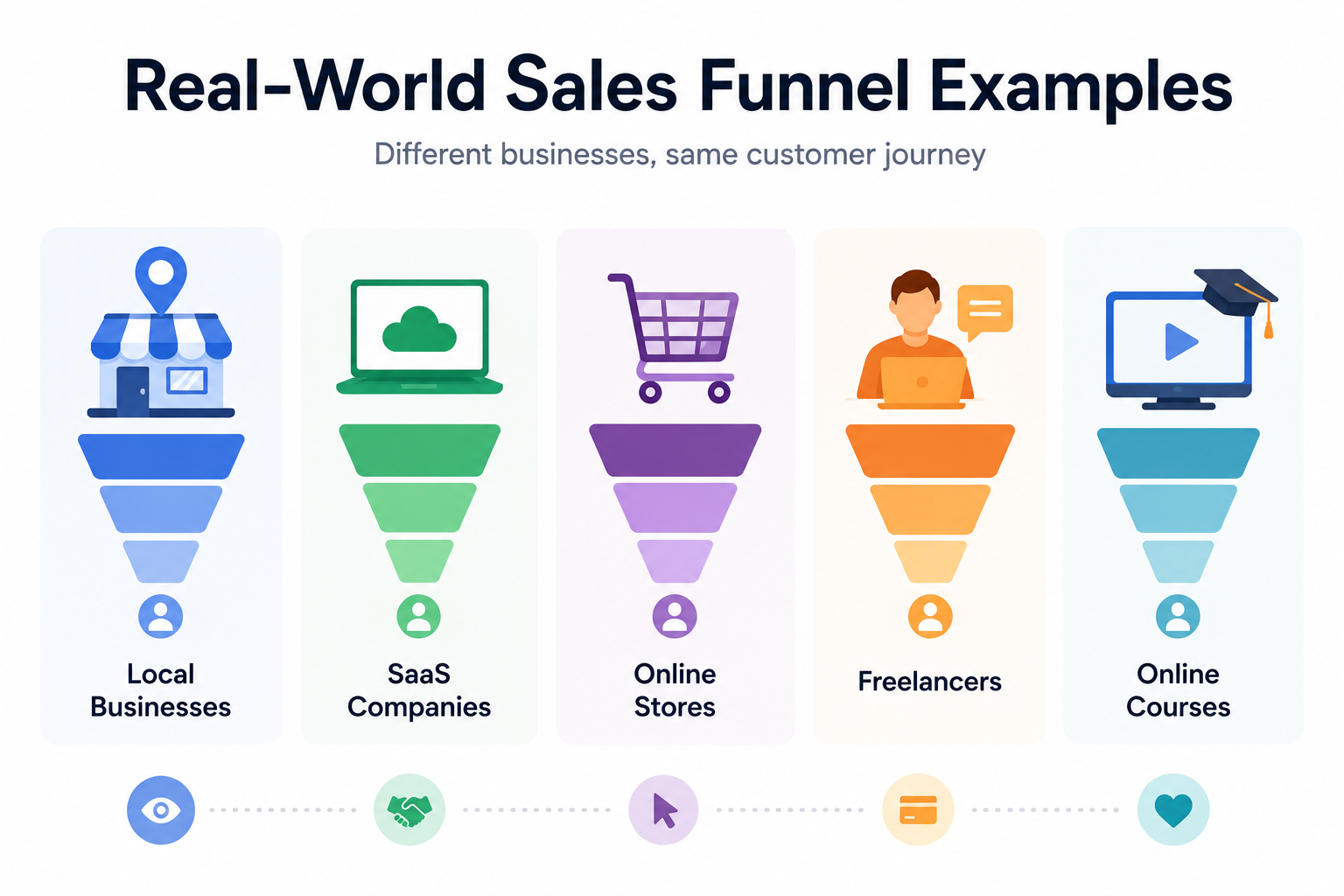
Understanding the theory behind a sales funnel is helpful, but seeing how different businesses apply it makes the concept much easier to understand. While every business has unique goals, the overall journey remains the same: attract the right audience, build trust, encourage action, and maintain the relationship after the sale.
Below are several practical examples showing how businesses in different industries build sales funnels to generate leads and increase revenue.
Local Service Business
Imagine a plumbing company that wants to generate more local customers. Instead of relying only on phone calls, the business creates a landing page offering a free plumbing inspection. Visitors arrive from Google Search, request an inspection through a short form, receive a follow-up call, and eventually book the service.
- Traffic from Google Search and Google Maps.
- Landing page offering a free inspection.
- Lead capture form.
- Phone consultation.
- Service booking.
- Follow-up review request.
SaaS Company
Software companies rarely expect visitors to purchase immediately. Instead, they often encourage prospects to start a free trial, explore the product, and experience its value before upgrading to a paid subscription.
- SEO articles and paid advertising.
- Free trial landing page.
- User onboarding emails.
- Product tutorials.
- Subscription upgrade.
- Renewal and customer retention.
E-commerce Store
An online store attracts shoppers through search engines, social media, and product advertisements. Visitors browse products, add items to their cart, complete checkout, and later receive personalized recommendations based on previous purchases.
- Product discovery.
- Product page.
- Add to cart.
- Secure checkout.
- Order confirmation.
- Upsells and loyalty offers.
Freelancer or Consultant
Freelancers often use educational content to establish expertise before asking for a consultation. Blog posts, portfolio pages, and downloadable resources help build trust before potential clients schedule a discovery call.
- Helpful blog articles.
- Portfolio or case studies.
- Free consultation booking.
- Proposal and pricing.
- Project delivery.
- Referral requests.
Online Course Creator
Course creators frequently attract visitors by offering free educational content before introducing a paid course. This approach builds trust and demonstrates expertise before asking someone to invest.
- YouTube videos or blog content.
- Free downloadable guide.
- Email sequence.
- Course sales page.
- Student onboarding.
- Advanced courses or memberships.
The Common Pattern Behind Every Successful Funnel
While these businesses operate in different industries, they all follow the same basic framework. First, they attract attention through valuable content or advertising. Next, they build trust by educating potential customers and demonstrating credibility. Finally, they present a clear offer, simplify the buying process, and continue nurturing the relationship after the purchase.
| Business | Lead Magnet or Entry Point | Primary Conversion Goal |
|---|---|---|
| Local Service Business | Free estimate or consultation. | Service booking. |
| SaaS Company | Free trial. | Paid subscription. |
| E-commerce Store | Product page. | Completed purchase. |
| Freelancer | Portfolio and consultation. | Signed client project. |
| Online Course Creator | Free lesson or guide. | Course enrollment. |
Building a Sales Funnel That Grows With Your Business
A high-converting sales funnel isn't something you build once and forget. Customer expectations change, competitors improve their marketing, and your own business evolves over time. The businesses that consistently generate leads and sales are the ones that treat their funnel as an ongoing project rather than a finished product.
Don't feel pressured to create a complicated funnel on day one. Many successful businesses begin with a simple landing page, a valuable offer, and a clear call-to-action. As they learn more about their audience, they gradually improve each stage by adding better messaging, stronger social proof, email automation, and smarter follow-up sequences.
Instead of trying to copy another company's funnel, focus on understanding your own customers. Learn what problems they're trying to solve, what questions they ask before buying, and what information gives them confidence to move forward. The more closely your funnel matches your audience's needs, the more naturally conversions will improve.
Keep Testing and Improving
Every part of your funnel can be improved over time. A better headline might increase landing page conversions, a shorter checkout process could reduce abandoned purchases, or a more compelling email sequence may generate additional sales from existing leads. Small improvements made consistently often produce significant long-term growth.
Rather than making large changes all at once, improve one element at a time and monitor the results. This approach makes it easier to understand which changes actually increase conversions.
Focus on Long-Term Relationships
The most profitable businesses don't simply chase one-time purchases. They build lasting relationships by providing outstanding customer support, publishing helpful content, and continuing to deliver value long after the initial sale. Satisfied customers often become repeat buyers, recommend your business to others, and strengthen your brand through positive reviews.
Retaining existing customers is usually more affordable than constantly acquiring new ones, making customer loyalty an essential part of every successful sales funnel.
Remember the Purpose of Your Funnel
At its core, a sales funnel exists to help people make confident decisions. It's not about pressuring visitors or using manipulative tactics. A well-designed funnel educates, answers questions, builds trust, removes uncertainty, and makes it easy for customers to take the next step when they're ready.
When every stage of your funnel focuses on solving problems and creating a positive experience, conversions become a natural result of delivering genuine value.
Quick Action Plan
- ✓ Define one clear goal for your funnel.
- ✓ Create an offer that solves a specific problem.
- ✓ Build a distraction-free landing page.
- ✓ Capture leads before visitors leave.
- ✓ Build trust using testimonials and case studies.
- ✓ Simplify your checkout or booking process.
- ✓ Follow up with customers after every conversion.
- ✓ Track important metrics and identify weak points.
- ✓ Test, optimize, and improve continuously.
- ✓ Focus on helping customers—not just making sales.
The highest-converting sales funnels aren't necessarily the most complex—they're the ones that make it easy for the right people to understand the value of an offer and confidently take the next step. Start with a simple funnel, keep learning from your data, and improve it consistently. Over time, those small improvements can transform your funnel into one of your business's most valuable assets.