
Introduction: Understanding the Next Generation of AI
Artificial intelligence is evolving faster than almost any other technology. Just a few years ago, most people were learning about chatbots and image generators. Today, new terms like Generative AI, Agentic AI, and AI Agents appear in news articles, software announcements, research papers, and business discussions almost every day. While these technologies are closely related, they represent different capabilities and serve different purposes.
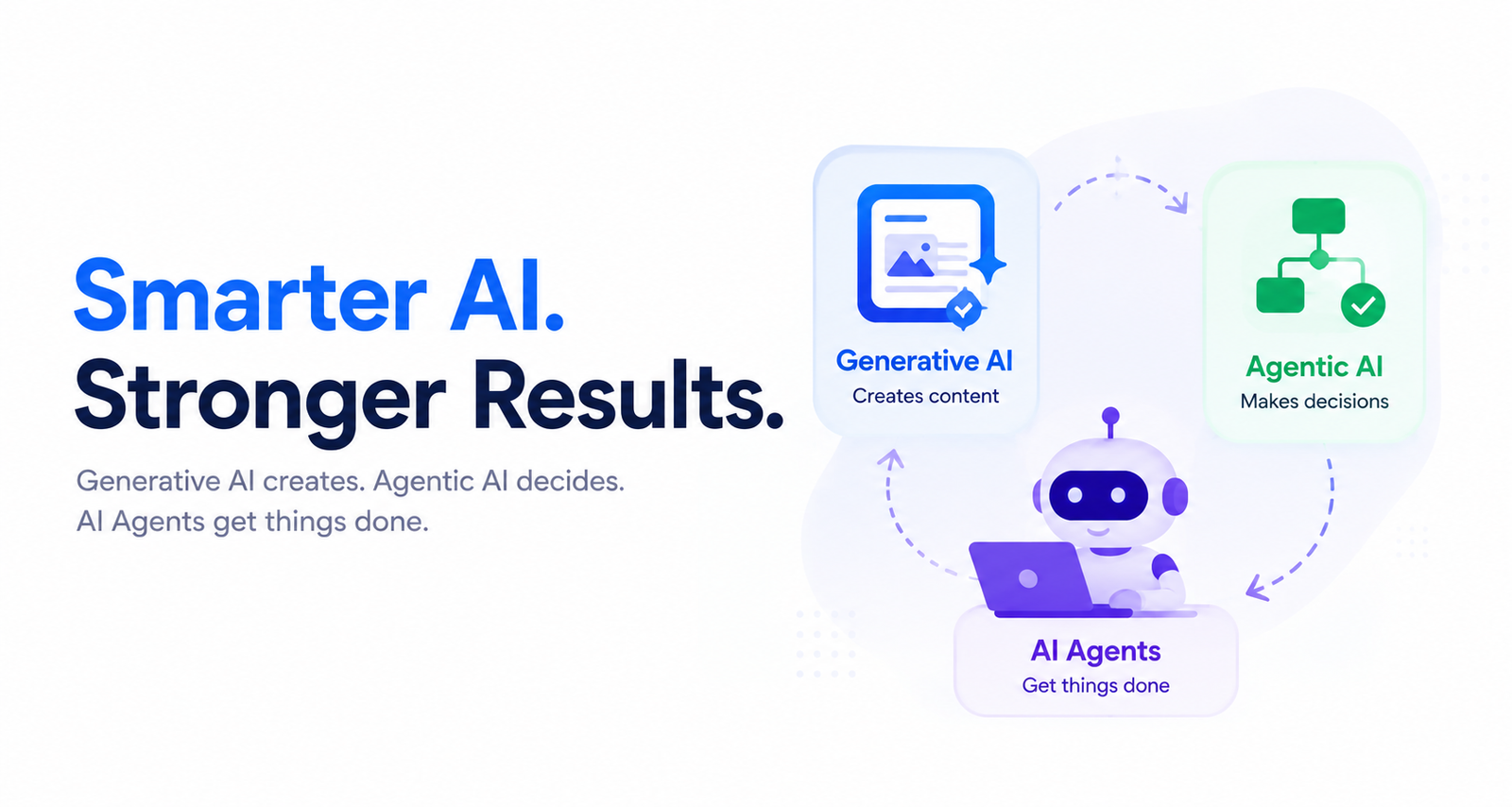
Because these terms are often used interchangeably, it's easy to assume they all describe the same thing. In reality, each one solves different types of problems. Generative AI focuses on creating new content, Agentic AI emphasizes planning and autonomous decision-making, while AI Agents combine intelligence, memory, and external tools to complete tasks with minimal human guidance.
Understanding these differences is becoming increasingly important for developers, business owners, marketers, students, and anyone working with modern AI technologies. Choosing the wrong type of AI for a project can lead to unnecessary complexity, higher costs, or disappointing results. Knowing what each technology does allows you to select the right solution for your specific goals.
In this guide, you'll learn what Generative AI, Agentic AI, and AI Agents are, how they work, where they overlap, how they differ, and when each approach makes the most sense. By the end, you'll have a clear understanding of how these technologies fit together and why they're shaping the future of artificial intelligence.
Understanding Modern Artificial Intelligence
Before comparing Generative AI, Agentic AI, and AI Agents, it's helpful to understand how modern artificial intelligence has evolved. These technologies didn't appear overnight—they represent different stages in AI's development. Each new generation builds upon previous advancements, allowing AI systems to solve increasingly complex problems with greater independence.
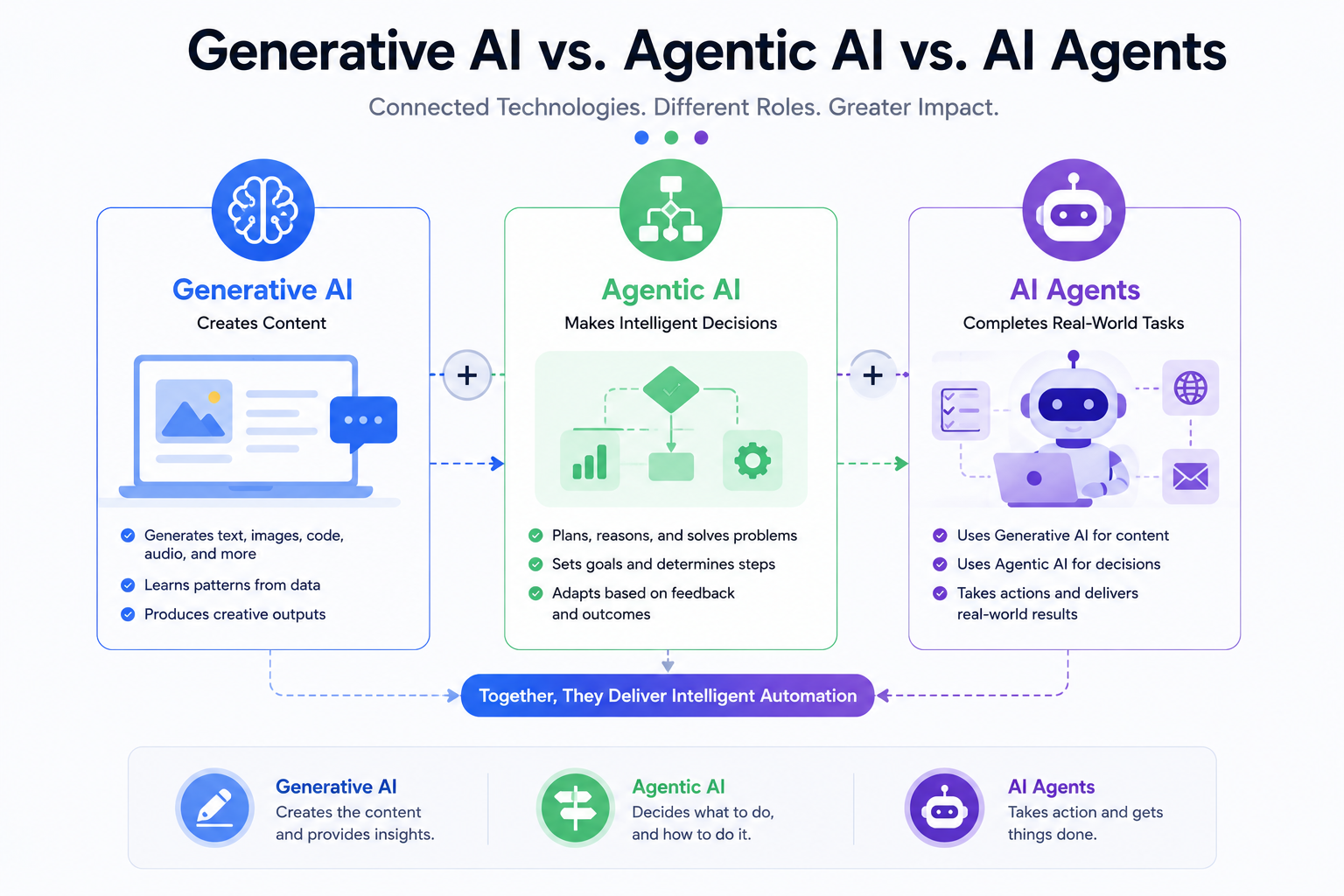
While the names may sound similar, they describe different capabilities rather than competing technologies. Generative AI specializes in creating content, Agentic AI focuses on reasoning and decision-making, and AI Agents combine intelligence with tools to perform complete tasks. Understanding this progression makes it much easier to see how they work together.
What Is Artificial Intelligence?
Artificial Intelligence (AI) is a branch of computer science that enables machines to perform tasks that normally require human intelligence. These tasks include understanding language, recognizing images, solving problems, learning from data, making predictions, and supporting decision-making.
Modern AI systems use machine learning and deep learning algorithms to identify patterns in large amounts of data. Instead of following only fixed rules written by programmers, many AI systems learn from examples and improve their performance over time.
Why AI Is Evolving So Quickly
Several factors have accelerated AI development over the past decade. More powerful computer hardware, larger datasets, improved machine learning models, and cloud computing have made it possible to train increasingly capable AI systems. At the same time, businesses across nearly every industry are investing heavily in AI to improve productivity, automate repetitive work, and deliver better customer experiences.
As AI models become more capable, they are no longer limited to answering questions or generating text. Today's systems can plan tasks, use external software, remember previous interactions, and work toward long-term goals.
The Shift from AI Tools to AI Systems
Earlier AI applications were designed to perform one specific task at a time. For example, an AI image generator created images, while a chatbot answered questions. These tools were useful, but they generally relied on direct user instructions for every action.
Modern AI systems are becoming much more capable. Instead of waiting for individual commands, they can break complex goals into smaller tasks, determine the best sequence of actions, retrieve information from external sources, and adapt their behavior based on changing conditions. This shift has led to the development of Agentic AI and AI Agents.
Where These Technologies Fit Together
Rather than replacing one another, Generative AI, Agentic AI, and AI Agents often work together as part of a larger AI ecosystem. Generative AI creates content, Agentic AI determines the best strategy to achieve a goal, and AI Agents use both capabilities while interacting with software, databases, APIs, and other digital tools.
Think of them as different layers of intelligence:
| Technology | Primary Role | Example |
|---|---|---|
| Artificial Intelligence | Broad field of intelligent computing. | Voice assistants, recommendation systems. |
| Generative AI | Creates new content. | Writing articles, generating images, creating code. |
| Agentic AI | Plans and makes autonomous decisions. | Multi-step task planning and reasoning. |
| AI Agents | Execute complete workflows using AI and external tools. | Research assistants, coding agents, customer support agents. |
Now that you understand how these technologies relate to one another, let's examine each one individually, starting with Generative AI and how it creates entirely new content from simple prompts.
What Is Generative AI?
Generative AI is a type of artificial intelligence designed to create entirely new content based on the instructions it receives. Instead of simply searching for existing information, it generates original text, images, videos, audio, computer code, and other forms of digital content by recognizing patterns learned from enormous amounts of training data.
Today, Generative AI powers many of the tools people use every day to write articles, generate marketing copy, design graphics, summarize documents, answer questions, create presentations, write software, and even produce music. Its ability to generate human-like content has made it one of the fastest-growing areas of artificial intelligence.
Definition
Generative AI refers to AI models that produce new content rather than simply analyzing existing data. After receiving a prompt from a user, the model predicts the most appropriate output based on everything it has learned during training.
Unlike traditional software that follows fixed rules, Generative AI can create unique responses for every request, making it flexible enough to assist with thousands of different tasks.
How Generative AI Works
At a high level, Generative AI works by analyzing massive datasets during training and learning relationships between words, images, sounds, or other types of information. When you provide a prompt, the model predicts what content should come next based on those learned patterns.
For example, if you ask an AI to write a product description, it doesn't search the internet for an existing paragraph. Instead, it generates a completely new description that matches your instructions, writing style, and context.
| User Prompt | Generative AI Output |
|---|---|
| Write a blog introduction. | Creates an original introduction. |
| Generate a logo concept. | Produces a unique design idea. |
| Explain quantum computing. | Generates a detailed explanation. |
| Write Python code. | Creates working code examples. |
Popular Examples of Generative AI
Over the past few years, hundreds of Generative AI applications have been released. Some specialize in writing, while others focus on image generation, programming, video creation, or voice synthesis.
- Writing articles and blog posts.
- Generating computer code.
- Creating AI-generated images.
- Summarizing long documents.
- Producing marketing copy.
- Designing presentations.
- Creating videos and voiceovers.
Common Use Cases
Businesses and individuals use Generative AI to save time, improve productivity, and automate creative work. Instead of starting with a blank page, users can generate drafts, ideas, or complete pieces of content within seconds.
| Industry | Example Use Case |
|---|---|
| Marketing | Blog posts, advertisements, email campaigns. |
| Software Development | Writing and debugging code. |
| Education | Lesson plans and study materials. |
| Design | Images, graphics, presentations. |
| Customer Support | AI-powered responses and documentation. |
Advantages of Generative AI
- Creates high-quality content in seconds.
- Boosts productivity for individuals and businesses.
- Supports writing, coding, design, and research.
- Generates personalized responses based on prompts.
- Reduces repetitive creative work.
- Helps users brainstorm new ideas quickly.
Limitations of Generative AI
Despite its impressive capabilities, Generative AI has important limitations. It typically responds only to the prompt it receives and doesn't independently pursue long-term goals or execute complex workflows. It can also generate inaccurate information, misunderstand context, or produce outdated responses if its output isn't verified.
These limitations are one reason why newer technologies such as Agentic AI and AI Agents have emerged. Instead of simply generating content, they can plan, reason, use external tools, and complete multi-step tasks with much less human guidance.
What Is Agentic AI?
While Generative AI is designed to create content, Agentic AI is designed to make decisions, plan actions, and work toward completing goals with much less human guidance. Instead of simply responding to a single prompt, Agentic AI can break complex objectives into smaller tasks, evaluate different approaches, adapt to changing conditions, and determine the next best action on its own.
This represents an important shift in artificial intelligence. Rather than acting only as a content generator, Agentic AI behaves more like an intelligent problem solver that can reason through multi-step tasks before producing a final result.
Definition
Agentic AI refers to artificial intelligence systems that can autonomously plan, reason, make decisions, and execute multiple steps to achieve a specific objective. Instead of waiting for instructions after every action, the AI continuously evaluates progress and decides what should happen next until the goal is completed.
In simple terms, Generative AI answers a question, while Agentic AI figures out how to accomplish an objective.
How Agentic AI Makes Decisions
Instead of generating one response and stopping, Agentic AI evaluates the goal, identifies the tasks required, prioritizes those tasks, and decides which action should happen first. If new information becomes available, it can adjust its plan and continue working toward the objective without restarting from the beginning.
A simplified decision-making process looks like this:
- Understand the user's goal.
- Break the goal into smaller tasks.
- Choose the best strategy.
- Complete each task in sequence.
- Evaluate the results.
- Adjust the plan if necessary.
- Finish the objective.
Planning and Goal-Oriented Behavior
One of the biggest differences between Agentic AI and traditional AI systems is long-term planning. Instead of solving only the current problem, Agentic AI focuses on achieving an overall objective. It continuously evaluates whether each action moves it closer to the desired outcome.
For example, if asked to launch a marketing campaign, Agentic AI could plan content, identify the target audience, schedule posts, analyze performance, and recommend improvements rather than simply writing one advertisement.
Real-World Examples
Agentic AI is becoming increasingly useful wherever complex decision-making is required. Instead of assisting with individual tasks, it helps coordinate complete workflows across multiple systems.
| Industry | Example of Agentic AI |
|---|---|
| Customer Support | Resolves customer issues by selecting the best solution automatically. |
| Project Management | Plans tasks, assigns priorities, and tracks deadlines. |
| Software Development | Plans implementation steps before generating code. |
| Supply Chain | Optimizes inventory and delivery decisions. |
| Business Operations | Automates multi-step business workflows. |
Advantages of Agentic AI
- Can plan multiple steps to achieve a goal.
- Adapts when conditions change.
- Requires less human intervention.
- Handles complex workflows more efficiently.
- Supports autonomous decision-making.
- Improves productivity across large processes.
Limitations of Agentic AI
Although Agentic AI is significantly more capable than traditional Generative AI, it isn't perfect. Poor planning, inaccurate information, unclear objectives, or insufficient human oversight can lead to incorrect decisions. Because Agentic AI often performs multiple actions automatically, mistakes can have a much larger impact than a single incorrect AI response.
For this reason, most organizations use Agentic AI alongside human supervision, especially when decisions involve finances, healthcare, legal matters, or other high-impact situations. In the next section, you'll see how AI Agents build upon these capabilities by combining reasoning, memory, external tools, and automation into complete intelligent systems.
What Are AI Agents?
AI Agents represent one of the biggest advancements in modern artificial intelligence. Unlike traditional AI systems that simply answer questions or generate content, AI Agents are designed to complete real-world tasks from start to finish. They combine reasoning, planning, memory, external tools, and automation to achieve a specific goal with minimal human intervention.
Instead of asking an AI to perform one task at a time, you give an AI Agent an objective. The agent then determines what needs to be done, selects the appropriate tools, performs multiple actions, monitors progress, and continues working until the objective has been completed.
Definition
An AI Agent is an intelligent software system that can observe information, make decisions, use external tools, remember previous interactions, and execute multi-step workflows to accomplish a goal. Instead of producing only text or images, AI Agents perform actions in the real world through software and digital services.
You can think of an AI Agent as a digital assistant that doesn't just answer questions—it actually performs the work required to solve the problem.
How AI Agents Work
AI Agents operate through a continuous cycle of observation, planning, action, and evaluation. They begin by understanding the user's goal, determine the necessary steps, interact with external tools when needed, evaluate the results, and repeat the process until the objective has been achieved.
- Understand the user's objective.
- Create a step-by-step execution plan.
- Select the appropriate tools or services.
- Perform each task automatically.
- Monitor results and identify problems.
- Adjust the strategy if necessary.
- Complete the requested objective.
Memory and Tool Usage
One of the defining characteristics of AI Agents is their ability to use memory and external tools. Instead of relying only on the current conversation, they can remember previous steps, retrieve documents, search databases, access APIs, interact with software, generate files, send emails, schedule meetings, or execute other digital actions.
This combination of intelligence and tool usage allows AI Agents to solve much more complex problems than a traditional chatbot.
Single-Agent vs Multi-Agent Systems
Not every AI Agent works alone. Some systems consist of a single agent responsible for completing an entire workflow, while others use multiple specialized agents that collaborate on different parts of a project.
| Single-Agent System | Multi-Agent System |
|---|---|
| One intelligent agent performs every task. | Multiple agents collaborate on different responsibilities. |
| Simpler workflows. | Complex business processes. |
| Easier to manage. | Better scalability and specialization. |
| Lower operational complexity. | Higher efficiency for large projects. |
Real Examples of AI Agents
AI Agents are already being used across many industries to automate repetitive work and improve productivity. Rather than completing one isolated task, they manage complete workflows involving multiple systems and decisions.
| Industry | Example AI Agent |
|---|---|
| Customer Support | Resolves support tickets and updates CRM systems. |
| Software Development | Writes code, runs tests, fixes bugs, and creates documentation. |
| Sales | Qualifies leads, schedules meetings, and follows up automatically. |
| Marketing | Researches keywords, creates content, and analyzes campaign performance. |
| Finance | Generates reports, analyzes transactions, and detects anomalies. |
Advantages of AI Agents
- Can complete entire workflows instead of individual tasks.
- Uses external software, APIs, and digital tools.
- Maintains memory across multiple actions.
- Adapts when new information becomes available.
- Reduces repetitive manual work.
- Improves productivity and operational efficiency.
- Can operate continuously with minimal supervision.
Limitations of AI Agents
Although AI Agents are incredibly powerful, they are not fully independent replacements for human expertise. They rely on accurate instructions, reliable external tools, quality data, and appropriate permissions. Poor planning, incorrect information, or software failures can affect the quality of their decisions and actions.
For high-risk activities such as healthcare, finance, legal advice, or security, AI Agents should always operate with appropriate human oversight. Used responsibly, they can automate complex workflows while allowing people to focus on strategic thinking and creative problem-solving.
Generative AI vs Agentic AI vs AI Agents
Now that we've explored each technology individually, it's much easier to understand how they differ. Although people often use these terms interchangeably, they describe different capabilities within the modern AI ecosystem. One focuses on creating content, another focuses on intelligent planning, while the third brings everything together to complete real-world tasks.
Instead of thinking of these technologies as competitors, think of them as different layers of intelligence. As AI systems become more advanced, many modern applications combine all three to deliver more capable and autonomous experiences.
Purpose
The primary purpose of each technology is different. Generative AI creates content based on user prompts. Agentic AI focuses on planning and reasoning toward a goal. AI Agents combine intelligence, planning, memory, and tools to actually complete tasks.
Decision-Making
Generative AI makes very limited decisions because it mainly predicts the best response to a prompt. Agentic AI actively evaluates different options and chooses the best sequence of actions. AI Agents use those decisions to perform work across multiple applications and services.
Autonomy
Generative AI usually requires continuous human prompts for every task. Agentic AI can independently plan several steps before requesting additional input. AI Agents offer the highest level of autonomy because they can execute complete workflows while monitoring their own progress.
Memory
Most Generative AI systems have limited working memory within a conversation. Agentic AI may retain planning context during execution, while AI Agents often maintain persistent memory that helps them remember previous tasks, user preferences, project history, and completed actions.
Planning Ability
Planning is where the biggest difference appears. Generative AI responds to requests but doesn't naturally create long-term execution strategies. Agentic AI specializes in breaking objectives into smaller tasks and determining the best order to complete them. AI Agents apply those plans while carrying out each step automatically.
Tool Usage
Generative AI mainly generates information. Agentic AI can decide when external tools are needed. AI Agents actively interact with APIs, databases, search engines, calendars, spreadsheets, email systems, CRMs, code repositories, and many other digital services to complete work.
Human Supervision
All three technologies still benefit from human oversight, but the level varies. Generative AI generally requires frequent guidance, Agentic AI requires periodic supervision for important decisions, while AI Agents often operate independently until human approval is needed for sensitive actions.
Best Use Cases
Choosing the right technology depends on the problem you're trying to solve. If your goal is creating content, Generative AI is usually the best option. If your project requires planning and intelligent reasoning, Agentic AI is more appropriate. If you want software that can actually complete work across multiple systems, AI Agents provide the most comprehensive solution.
How Generative AI, Agentic AI, and AI Agents Work Together
One of the biggest misconceptions about modern artificial intelligence is that Generative AI, Agentic AI, and AI Agents compete with one another. In reality, they often work together as parts of a single intelligent system. Each technology has a different responsibility, and when combined, they can solve problems that would be difficult for any one technology alone.
Think of it like a professional team. One member creates information, another develops the strategy, and another carries out the work. Together, they deliver a complete solution from start to finish.
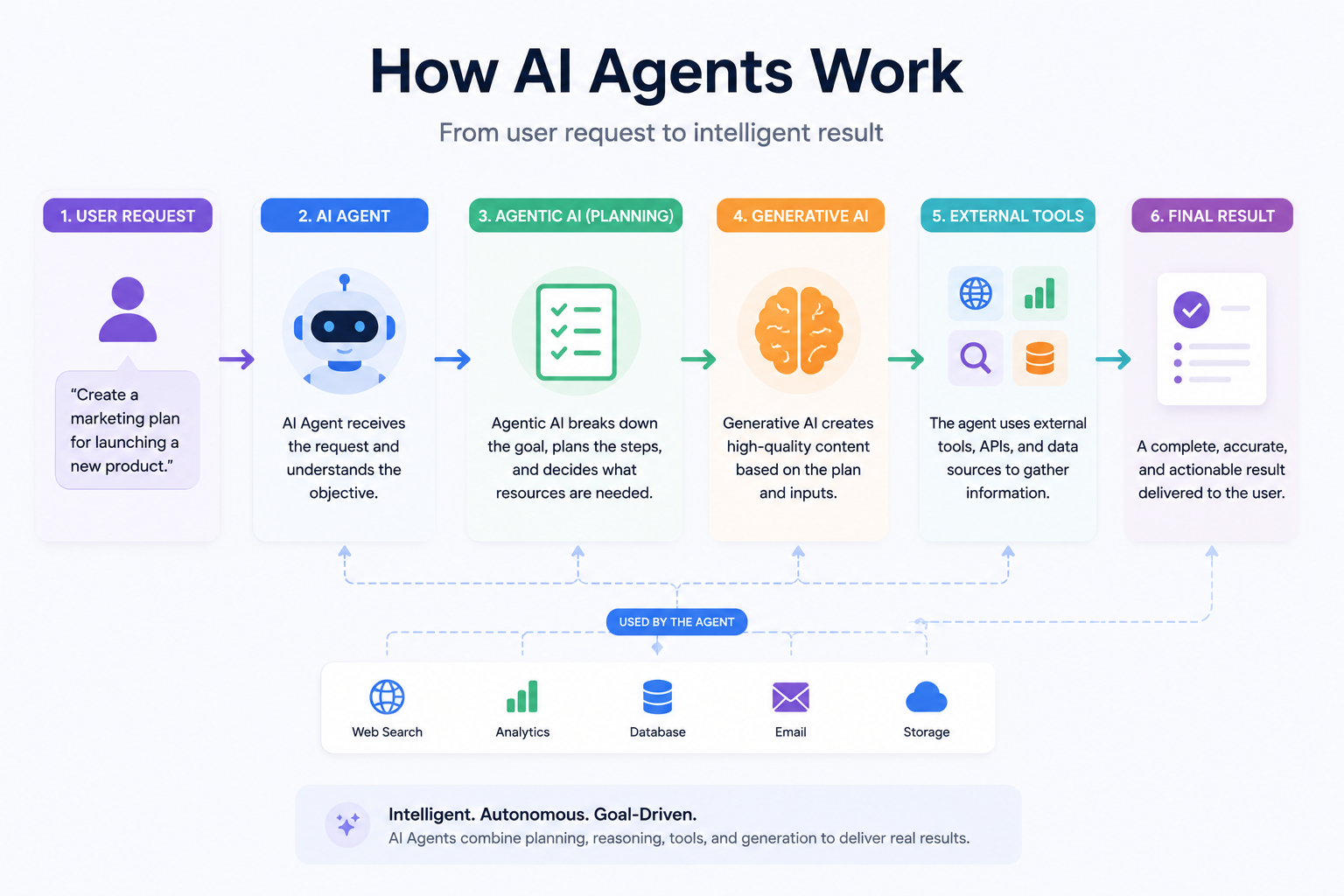
Generative AI Creates the Content
Generative AI is responsible for producing information. It writes text, generates code, creates images, summarizes documents, answers questions, and produces other forms of content based on user instructions. It acts as the creative engine within many modern AI systems.
However, by itself, Generative AI usually waits for instructions and doesn't independently decide what should happen next.
Agentic AI Plans the Best Strategy
Agentic AI sits above content generation and focuses on reasoning. Instead of immediately producing an answer, it determines how the overall objective should be achieved. It breaks large problems into smaller tasks, prioritizes actions, evaluates results, and continuously adjusts its plan when new information becomes available.
Rather than simply answering a question, Agentic AI decides which questions should be answered first and what sequence of actions will produce the best outcome.
AI Agents Execute the Work
AI Agents bring everything together by interacting with external systems. They use the strategy created by Agentic AI and the content produced by Generative AI while communicating with databases, APIs, calendars, cloud storage, search engines, email platforms, CRMs, spreadsheets, and many other digital tools.
Instead of stopping after generating a response, AI Agents continue working until the requested objective has been completed.
A Complete Example
Imagine a business owner asks an AI system to launch a new email marketing campaign for an upcoming product release. Instead of completing only one task, the entire AI system works together.
| AI Technology | Responsibility |
|---|---|
| Agentic AI | Plans the campaign, identifies target audiences, schedules each step, and decides the execution strategy. |
| Generative AI | Writes email copy, subject lines, promotional content, and call-to-action messages. |
| AI Agent | Uploads the campaign into the email platform, schedules delivery, monitors results, and generates performance reports. |
Why This Combination Is So Powerful
Combining these technologies creates systems that are significantly more capable than traditional AI tools. Instead of simply answering questions, modern AI can understand objectives, create execution plans, generate high-quality content, interact with external software, monitor progress, and adapt as conditions change.
This layered approach is becoming the foundation of next-generation AI assistants, autonomous business workflows, intelligent software development platforms, research assistants, customer service automation, and enterprise productivity systems.
Simple Way to Remember
- Generative AI creates content.
- Agentic AI decides what should happen next.
- AI Agents perform the work using tools and automation.
Real-World Examples Across Industries
Generative AI, Agentic AI, and AI Agents are no longer experimental technologies used only by research labs. Businesses of every size are already using them to automate repetitive work, improve customer experiences, reduce operating costs, and help employees make better decisions. Although the underlying technologies differ, they often work together to solve real business problems.
The following examples demonstrate how different industries use modern AI to increase efficiency while allowing people to focus on higher-value work that requires creativity, judgment, and human expertise.
Customer Support
Customer service has become one of the fastest-growing applications of AI. Generative AI can answer common customer questions, while Agentic AI decides how complex support requests should be handled. AI Agents can retrieve customer records, create support tickets, update CRM systems, schedule callbacks, and notify support teams automatically.
This combination allows businesses to provide faster support while reducing repetitive work for human agents.
Software Development
Software teams increasingly rely on AI throughout the development lifecycle. Generative AI assists with writing code and documentation, Agentic AI plans implementation strategies, while AI Agents execute automated testing, review pull requests, monitor deployments, and generate technical reports.
Instead of replacing developers, these tools help eliminate repetitive tasks so engineers can focus on architecture, problem-solving, and product innovation.
Marketing and Content Creation
Marketing teams use AI to accelerate content production and campaign management. Generative AI creates articles, advertisements, email campaigns, and social media posts. Agentic AI determines campaign strategy, audience segmentation, and publishing schedules. AI Agents publish content, monitor analytics, optimize campaigns, and generate performance reports automatically.
This enables marketers to spend more time developing creative strategies instead of manually managing repetitive workflows.
Healthcare
Healthcare organizations use AI to support medical professionals rather than replace them. Generative AI summarizes clinical notes and research papers, Agentic AI helps prioritize patient care workflows, and AI Agents coordinate appointments, retrieve medical records, organize documentation, and automate administrative tasks.
Human oversight remains essential, especially when AI assists with diagnosis or treatment decisions.
Finance
Financial institutions use AI to improve efficiency while reducing operational risk. Generative AI prepares reports and explains financial information, Agentic AI analyzes market trends and evaluates risk, while AI Agents reconcile transactions, detect unusual activity, generate compliance reports, and automate routine financial operations.
These systems help professionals process large volumes of information more quickly while maintaining human review for important financial decisions.
Education
Schools, universities, and online learning platforms are using AI to personalize education. Generative AI creates lesson plans, quizzes, and study materials. Agentic AI develops personalized learning paths based on student progress, while AI Agents schedule learning activities, track assignments, recommend additional resources, and provide individualized feedback.
AI supports educators by handling repetitive administrative work while allowing teachers to focus on instruction and student engagement.
E-Commerce
Online retailers use AI across nearly every stage of the customer journey. Generative AI writes product descriptions and promotional content, Agentic AI recommends pricing strategies and personalized offers, while AI Agents update inventory, process orders, answer customer questions, recommend products, and coordinate shipping workflows.
These capabilities help businesses deliver better shopping experiences while improving operational efficiency behind the scenes.
When Should You Use Each One?
Understanding the differences between Generative AI, Agentic AI, and AI Agents is valuable, but choosing the right technology for your specific situation is even more important. The best option depends on the complexity of your goal, the level of automation you need, and whether the task requires content creation, intelligent planning, or complete workflow execution.
In many cases, you don't have to choose only one. Modern AI platforms often combine these technologies to deliver better results. However, knowing the strengths of each approach helps you build more efficient systems while avoiding unnecessary complexity.
When Generative AI Is the Best Choice
Choose Generative AI when your primary goal is creating new content. It excels at producing text, code, images, presentations, summaries, and creative ideas from simple prompts. If a task begins with a blank page and ends with new content, Generative AI is usually the fastest and most efficient solution.
Common situations include:
- Writing blog posts and articles.
- Generating marketing copy.
- Creating product descriptions.
- Writing or explaining code.
- Summarizing long documents.
- Brainstorming ideas.
- Creating AI-generated images.
When Agentic AI Makes More Sense
Agentic AI becomes the better choice when solving a problem requires reasoning, planning, and multiple decisions rather than simply generating content. Instead of responding to individual prompts, it develops strategies, evaluates different options, and continuously adapts while working toward a long-term objective.
Good examples include:
- Planning complex marketing campaigns.
- Managing software development projects.
- Optimizing supply chain operations.
- Business process planning.
- Research involving multiple sources.
- Strategic decision-making workflows.
When You Need AI Agents
AI Agents are the right choice when the objective involves actually completing work across multiple systems. Instead of simply providing recommendations, AI Agents interact with software, APIs, databases, cloud services, and business applications to perform tasks automatically.
AI Agents are ideal for:
- Automating customer support.
- Managing email workflows.
- Scheduling meetings.
- Processing business documents.
- Updating CRM systems.
- Managing software deployment pipelines.
- Coordinating multi-step business operations.
Can You Combine All Three?
Absolutely. In fact, many of today's most advanced AI applications combine Generative AI, Agentic AI, and AI Agents into a single intelligent workflow. Each technology contributes its own strengths while compensating for the limitations of the others.
Imagine an AI-powered recruiting platform:
- Generative AI writes job descriptions and interview questions.
- Agentic AI decides which candidates best match the role.
- AI Agents schedule interviews, send emails, update applicant tracking systems, and notify recruiters.
Together, these technologies create an intelligent hiring workflow that saves time while improving consistency and productivity.
Common Misconceptions About Generative AI, Agentic AI, and AI Agents
As AI evolves, new terms are introduced almost every month. Because of this, many people use Generative AI, Agentic AI, and AI Agents as if they all mean the same thing. While they're closely related, each technology serves a different purpose. Understanding these common misconceptions will help you choose the right AI solution.
Generative AI Is Not an AI Agent
Generative AI creates content such as text, images, or code. An AI Agent goes much further by planning tasks, using tools, and completing workflows. Creating content is only one part of what an AI Agent can do.
AI Agents Don't Always Use Agentic AI
Some AI Agents simply follow predefined workflows or rules. More advanced agents use Agentic AI for planning and reasoning, but not every AI Agent requires autonomous decision-making.
Agentic AI Doesn't Mean Fully Autonomous
Agentic AI can plan and make decisions, but many systems still require human approval for important actions. Businesses often keep people involved when financial, legal, or sensitive decisions are involved.
Not Every Chatbot Is an AI Agent
A chatbot usually answers questions during a conversation. An AI Agent can perform actions like searching databases, sending emails, updating records, scheduling meetings, or interacting with external applications.
AI Still Needs Human Oversight
Modern AI is powerful, but it isn't perfect. It can misunderstand instructions, make incorrect assumptions, or produce inaccurate results. Human review remains essential, especially when AI is used for healthcare, finance, legal work, or other high-impact decisions.
Key Takeaway
Generative AI creates. Agentic AI plans. AI Agents act. Modern AI systems often combine all three technologies to deliver intelligent, end-to-end automation.
The Future of Generative AI, Agentic AI, and AI Agents
Artificial intelligence is advancing at an incredible pace. Just a few years ago, AI was mainly used to answer questions or generate content. Today, AI can plan projects, automate workflows, collaborate with software, and assist people with increasingly complex tasks. The next generation of AI will become even more capable, more connected, and more personalized.
While no one can predict every innovation, several clear trends are already shaping the future of AI.
Smarter AI Agents
Future AI Agents will remember more context, use a wider range of tools, and complete longer workflows with fewer human instructions. They'll become more reliable collaborators rather than simple assistants.
More Autonomous Workflows
Businesses will automate entire processes such as customer support, marketing, accounting, recruiting, and project management. Instead of automating individual tasks, AI will manage complete workflows from start to finish.
Multi-Agent Collaboration
Rather than relying on a single AI system, organizations will use teams of specialized AI Agents that work together. One agent may research information, another may analyze data, while another communicates with customers or external software.
Better Human-AI Collaboration
AI isn't replacing human expertise—it is becoming a powerful productivity tool. Professionals will increasingly use AI to handle repetitive work while focusing on creativity, strategy, problem-solving, and decision-making.
Responsible AI Will Become More Important
As AI becomes more autonomous, topics such as privacy, security, transparency, fairness, and human oversight will become even more important. Organizations will need clear policies to ensure AI is used responsibly and ethically.
Looking Ahead
The future isn't about choosing between Generative AI, Agentic AI, and AI Agents. The most powerful solutions will combine all three to create intelligent systems that can generate ideas, make decisions, and perform meaningful work with human guidance.
Final Thoughts: Which AI Technology Is Right for You?
Generative AI, Agentic AI, and AI Agents are all part of the same AI evolution, but they solve different problems. Understanding what each technology is designed to do helps you choose the right solution instead of following the latest buzzword.
If your goal is to create content such as articles, emails, images, presentations, or code, Generative AI is usually the best choice. It's fast, creative, and easy to use for everyday tasks that require producing new information.
If your work involves planning projects, making intelligent decisions, or solving multi-step problems, Agentic AI provides the reasoning capabilities needed to determine the best path toward a goal. It focuses less on creating content and more on deciding what should happen next.
When you want AI to actually perform work—such as updating software, sending emails, searching databases, scheduling meetings, processing documents, or automating business operations—AI Agents offer the most complete solution by combining intelligence with real-world actions.
A Simple Way to Remember
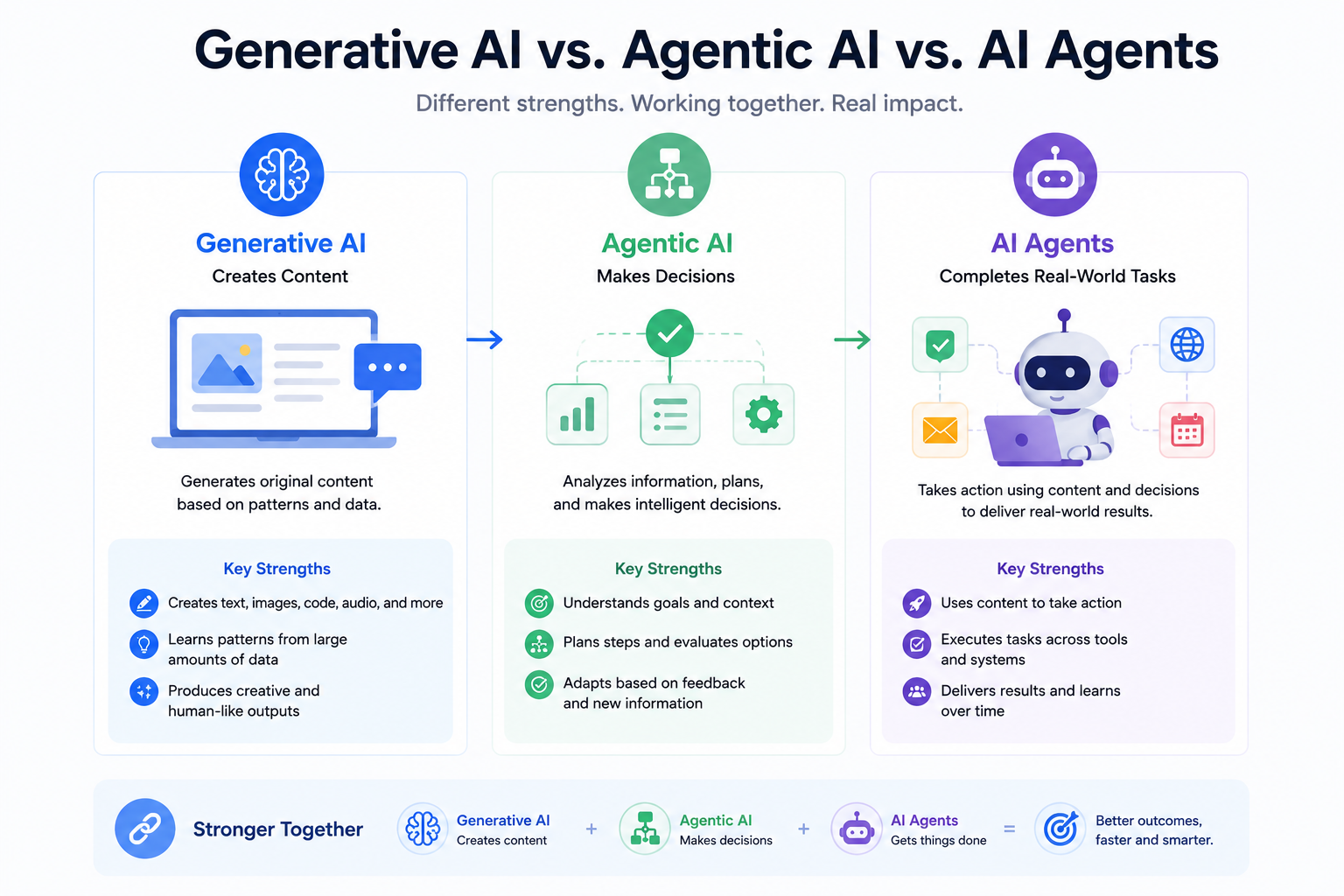
- Generative AI creates new content.
- Agentic AI plans, reasons, and makes decisions.
- AI Agents execute tasks using AI, memory, and external tools.
As AI continues to evolve, these technologies will become increasingly integrated. Future applications won't simply generate answers—they'll understand objectives, develop strategies, interact with software, and complete meaningful work while keeping humans in control of important decisions.
Whether you're a developer, business owner, marketer, student, or simply curious about artificial intelligence, learning how these technologies work together will help you make smarter decisions, improve productivity, and prepare for the next generation of AI-powered tools.